
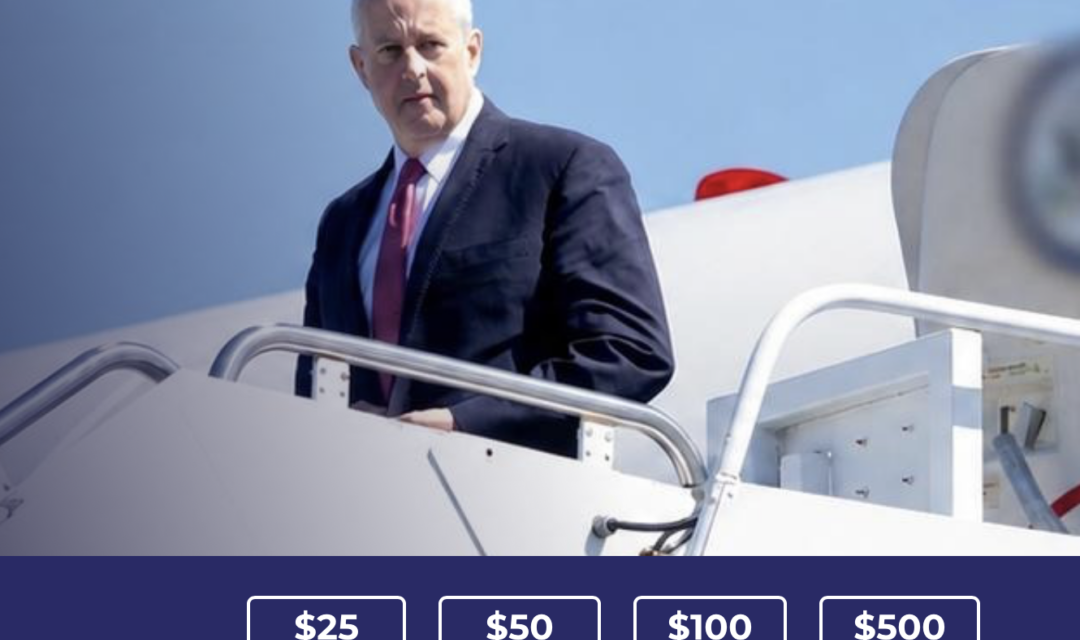
Republican US Senate candidate Michael Whatley is sounding an alarm about the financial state of his campaign, and telling supporters that he’s “dead in the water” unless they quickly send more money.
The unusually urgent fundraising appeal went out as Whatley was getting some very high-profile help from President Donald Trump, who came to Gastonia on Wednesday, Sept. 16, to campaign for the former Republican National Committee chairman.
Whatley’s fundraising letter begins with a warning of what’s coming.
“This is the Hardest Letter I’ve Ever Had to Write,” the headline states.
Whatley then tells his supporters, “I have to be honest with you. I shouldn’t be telling you this, but you’ve been with me from the beginning, and I need you to know the truth about where we stand.”
He said he’d just gotten off the phone with Republican leadership in Washington and then spoken with his campaign team.
“They tried to be encouraging, but when you put the numbers on the table – the grassroots energy versus the cold, hard cash being poured in by the liberal dark money machine – it doesn’t look good,” Whatley wrote.
Then the letter gets even more personal.
“I am more nervous than I’ve ever been in my life,” Whatley wrote. “I feel sick thinking about the possibility of failing President Trump.”
Whatley is running against former Democratic Gov. Roy Cooper for the US Senate seat being vacated by Republican Sen. Thom Tillis.
The race has attracted national attention because control of the Senate could depend on a small number of closely contested races around the country.
Whatley makes that argument directly in his appeal.
“If we don’t win this, we don’t control the Senate,” he wrote. “And without that majority, President Trump won’t be able to achieve anything he was sent back to DC to do. His legacy, the future of our conservative movement – it all comes down to what we do right here, right now, in this single, hyper-competitive fight.”
Then came the line that would normally make a campaign consultant reach for the delete key.
“And here is the part I’m truly not supposed to share: I’m dead in the water if we don’t hit our emergency fundraising daily goal.”
Whatley doesn’t provide a dollar figure for that daily goal or for the deficit he says the campaign is now facing.
He does, however, describe the situation in very dire terms.
“The liberal deficit is terrifying,” Whatley wrote. “They aren’t just outspending us; they are flooding the airwaves with lies, and their outside groups are pouring millions into this state to cement their progressive control.”
He also added, “I can’t come back from this deficit without an immediate surge of support from people like you who understand the stakes.”
Fundraising emails are designed to get people to open their wallets and they routinely use deadlines, emergencies and warnings of impending defeat to do it. So, the language isn’t necessarily a literal accounting of the campaign’s financial condition. But it does show a whole lot of worry.
The most recent Federal Election Commission figures currently available cover Whatley’s campaign finances through June 30. They show his authorized committees had reported about $11.3 million in total receipts and about $7.8 million in spending through that date.
But Whatley’s concern about the state of the race has some support in the public polling.
The RealClearPolitics average of North Carolina Senate polls through Sept. 17 showed Cooper at 49.4 percent and Whatley at 41.8 percent.
However, there’s considerable variation among individual polls.
An Insider Advantage poll conducted Sept. 16 and Sept. 17 had Cooper leading 48 percent to 43 percent, while a Quantus Insights poll conducted Sept. 14 through Sept. 16 had Cooper ahead 49 percent to 45 percent.
A Trafalgar Group poll conducted Sept. 8 through Sept. 10 had Cooper ahead 48 percent to 42 percent and an East Carolina University poll conducted Aug. 31 through Sept. 3 had Cooper leading 52 percent to 44 percent.
Those numbers help explain why Trump came to Gastonia to campaign personally for Whatley.
Trump used much of his speech to attack Cooper on crime while repeatedly praising Whatley – who Trump previously selected to lead the Republican National Committee.
“It was apple pie, right?” he said of North Carolina. “And now it’s one of the most violent and one of the worst in the whole nation.”
He then said, “And it all started with Cooper.”
In 2024, North Carolina had about 376 violent crimes per 100,000 residents, about 4.6 percent higher than the national rate of 359 per 100,000. But North Carolina’s rate was far below those of the states with the highest violent-crime rates, including Alaska at 724 per 100,000 and New Mexico at 717. North Carolina’s violent-crime rate also declined about 4.5 percent from 2023 to 2024.
Trump also called the former governor “terrible” and repeatedly accused him of being soft on violent criminals.
Trump told the Gastonia crowd that when he, Trump, had the opportunity to choose someone from anywhere in the country to lead the Republican Party, “I chose Michael Whatley.”
The president urged supporters to approach the Nov. 3 election as though he himself were on the ballot.
That support from Trump is central to Whatley’s own fundraising message.
Whatley closes his appeal by almost begging supporters to give whatever they can.
“I’m humbling myself completely before you,” Whatley wrote. “If you have any capacity to give this cycle – even a small amount like $5, $10, or $25 – I need you to give it to this race, and this race only. This isn’t a suggestion; it’s a plea.”
He continued, “I need your help. I need you to step into the gap with me, so I can go to DC and fight for the future we believe in and secure the Senate majority for President Trump.”
Then Whatley signs off with one final unusually personal line: “Thank you for letting me be vulnerable with you. I will never forget