
Earlier this month the Guilford County Board of Commissioners was set to hear a presentation in a work session regarding some pretty dramatic changes in how the county uses the space it has. That work session ran long and the commissioners never got to discuss the matter, however materials provided for their review of the changes show the massive scale of what’s to come.
Guilford County is preparing to reshuffle a number of county departments among its downtown Greensboro buildings as officials move from studying the county’s massive real estate holdings to deciding what to do with them.
That plan includes moving Human Resources and Budget within the Truist Building, relocating Finance and Internal Audit, reducing the amount of space occupied by Information Technology – and moving an employee gym and training facilities into the basement of the Katie S. Cashion Center.
It would also create a new Guilford County Board of Commissioners work session room capable of seating as many as 80 people.
The plans are included in a 24-page “County Space Planning Update” that was scheduled to be presented to the commissioners at their Sept. 3 work session.
The plans are the latest step in a process that began when Guilford County hired CPL Architects and Engineers to conduct a comprehensive study of county buildings and space needs.
The contract with CPL was for $1,124,931 and it included evaluating county buildings, determining how departments use their space, studying the effects of remote and hybrid work and developing plans for future space needs. Those consultants were also directed to estimate the cost of renovations, replacement buildings and new construction as well as help develop a long-term capital plan.
Commissioners received the results of that study at a November 2025 work session, and county staff has been working since then on the best way to implement its findings. A December 2025 capital planning presentation specifically described its work as following up on the November space study.
The new plan focuses heavily on getting more use out of buildings the county already owns.
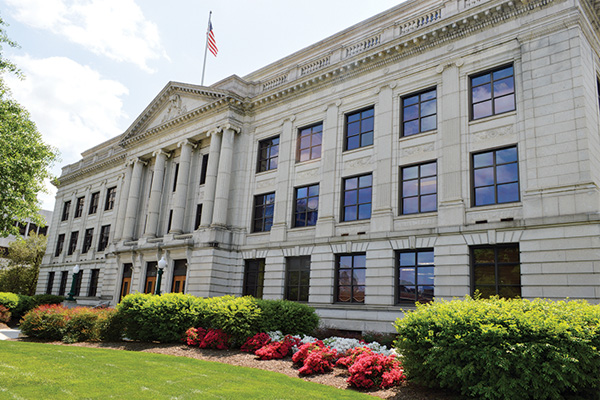
According to the September 2026 presentation, the county’s immediate goal is to “maximize space” in the Truist Building, Independence Building, Katie S. Cashion Center and Old Guilford County Court House, which is the center of county operations.
Staff is also prioritizing major repairs, evaluating Americans with Disabilities Act improvements and talking with departments about changing their office configurations.
One of the biggest changes would occur in the Truist Building, which houses the Register of Deeds Office.
The county plans to put Human Resources on the third floor and reconfigure that floor to provide HR with what the presentation calls a “new permanent home.” Budget would also move to a new location on the third floor.
Making that possible requires moving some other functions.
The employee gym and computer training room would be moved from the Truist Building to the basement of the Cashion Center. The presentation notes that this would also mean employees would no longer have offices in the Cashion Center basement – which county staff says would improve their working environment.
Finance and Internal Audit would be rehoused in the Cashion Center, where the Family Justice Center currently occupies the first and second floors.
Information Technology would get less space: The county proposes reducing IT’s footprint in the Truist Building to reflect the increased use of “hoteling” space by employees who work hybrid or remote schedules. Innovation and Data Services would share space with IT.
That same reconfiguration would provide room for a new Board of Commissioners work session space capable of seating up to 80 people.
Another notable part of the plan is the county’s use of leased office space.
The presentation states that the first floor of the Truist Building has vacant areas, while the county is currently paying about $200,000 a year to lease space elsewhere for county departments. The plan calls for making use of that vacant county-owned space.
The Independence Building isn’t going anywhere under the current plan.
Departments currently located there would remain, but the county plans a phased renovation. The first priority is repairing the exterior to address water intrusion, followed by phased renovations of the interior, all while county operations continue in the building.
The Historic Guilford County Courthouse will also remain a major part of county operations. Plans for that building are still being evaluated but include interior renovations that preserve its historic character, exterior drainage and water intrusion repairs and improvements to the elevators and ADA accessibility.
County staff is even considering new names for the Truist and Independence buildings, although the presentation states that no action is needed on that issue at this time.
The office moves are part of a much larger capital program. The presentation states that commissioners have already approved a $75 million project ordinance for county capital needs and $57.4 million for Guilford Technical Community College projects.
County staff says the existing debt model has enough capacity to fund the projects without requiring “additional new revenues.” Financing could include limited obligation bonds or two-thirds general obligation bonds.
Of the $75 million for county projects, $37.6 million is designated for county facilities and renovations. Another $15 million is designated for parks facilities and renovations, $10 million for the Women’s and Children’s Recovery project, $5.9 million for elevator replacement, $5 million for law enforcement facilities and renovations and $1.5 million for Greensboro courthouse renovations.
And, even with all that, the county apparently isn’t finished studying its space needs. The next phase calls for issuing a request for proposals for what the county calls a “centralization and service accessibility study.”
That study would examine whether residents could be better served by putting health and wellbeing services in neighborhood or regional offices. It would also examine possible centralization of administrative operations, internal support services, courts and even jails.
A future commissioners work session is expected to consider the scope of that study.
The county’s September presentation that never took place describes the overall effort as an attempt to stabilize operations, make better use of existing county space and address years of deferred maintenance.
It also shows that the $1.1 million space study commissioners received less than a year ago is beginning to translate into real decisions about where county employees work, which buildings get renovated and how Guilford County will use its downtown real estate in the years to come.