


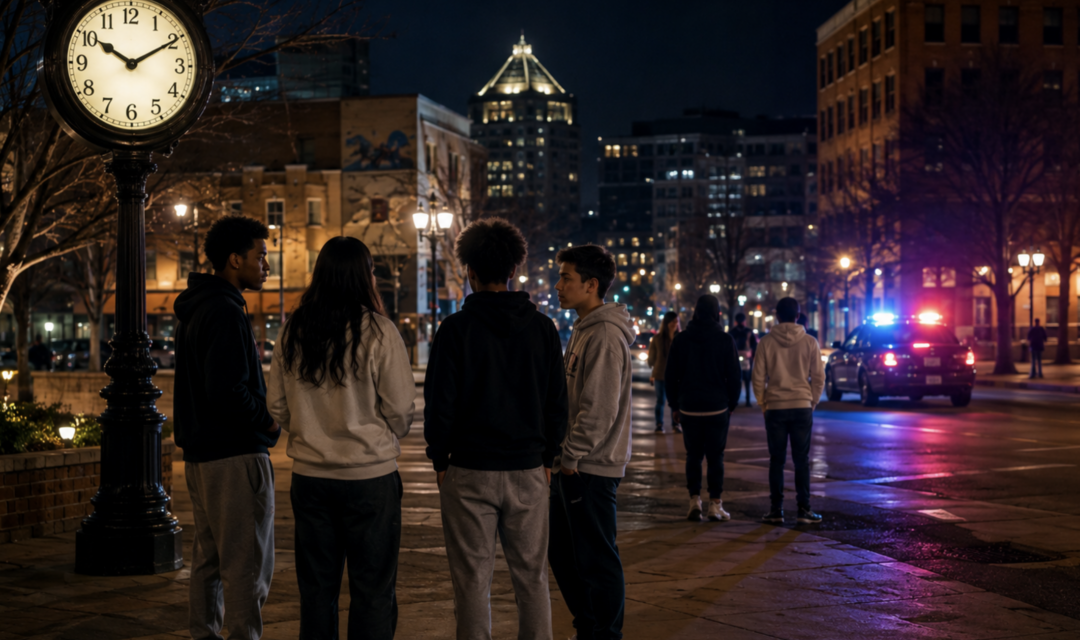
There’s been a lot of talk about the need to curtail crime in Greensboro these days and at the Monday, August 3 meeting of the Greensboro City Council, the council began a public conversation about the possibility of taking a major step in an attempt to make the city safer.
Greensboro city officials have begun exploring whether the city should establish a youth curfew in an effort to protect young people and reduce violence – but no curfew has yet been approved and several City Council members expressed serious reservations about the idea.
At the Monday, Aug. 3 meeting, Greensboro Mayor Marikay Abuzuaiter asked the council for consensus to direct City Manager Trey Davis and city staff to research juvenile curfews and other possible responses to youth violence.
Abuzuaiter stressed that the request wasn’t a reaction to the recent mass shooting at the Royal Banquet Hall, where nine people were injured.
She said city officials had been discussing the issue for months because of violent incidents involving young people over the past year – including a shooting in July of 2025 and problems associated with large youth gatherings.
Abuzuaiter initially described the request as asking the city manager to examine the possibility of a curfew for people younger than 17. She also said staff should examine ordinances adopted by other municipalities.
“We do want to perhaps, and I will go on consensus of my council, to direct the city manager to look into an ordinance for a youth curfew,” Abuzuaiter said.
The council didn’t take a formal vote. Instead, members agreed by consensus that city staff should study the issue and return with more information and possible recommendations.
That doesn’t mean the city will ultimately adopt a curfew.
Abuzuaiter said the review might lead to a curfew or might determine that Greensboro shouldn’t establish one after all.
Council members generally supported studying the issue, but several stopped well short of supporting a curfew.
Councilmember Adam Marshall said he was torn.
“I am all for protecting our youth,” Marshall said. “I think we need to do that. But we need to be careful not to overreach and start preventing folks’ ability to live their life and have their freedoms as well.”
Marshall said Greensboro also has many responsible teenagers and that he would need considerably more information before supporting a curfew.
Councilmember Hugh Holston said the discussion should begin with the safety of young people and the community. He noted that other municipalities have implemented curfews but said that didn’t necessarily mean Greensboro should follow them.
Other concerns raised during the discussion included whether a curfew should apply throughout the entire city rather than only in selected neighborhoods, whether enforcement could unfairly disproportionately affect some young people and whether the city has the personnel and resources needed to enforce an ordinance.
Councilmember April Parker urged the city to look beyond a curfew and examine the underlying causes of violence.
Parker said crime tends to occur in predictable hot spots and she cautioned against adopting a superficial response. She questioned the effectiveness of curfews and said that Greensboro should consider other public safety investments, youth programs and safe places where teenagers can gather.
Parker also pointed to existing youth organizations and programs throughout Greensboro and said that the city should examine how those efforts could be coordinated as part of a broader response.
Near the end of the conversation, Abuzuaiter said she believed the council had reached a consensus to move forward with the research.
The mayor said the city should determine what other cities are doing and what approach would be best for Greensboro’s young people.
“Maybe not one at all, or it may be one,” she said of a possible curfew.
Davis said the city’s Community Safety Department, which provides public safety services outside the Police Department, would participate in the review along with the police chief, the city attorney and other staff members.
Council members also asked staff to examine the responsibility of businesses and event promoters that organize parties attracting large numbers of teenagers.
The council discussion included concerns that the burden of keeping young people safe shouldn’t fall entirely on the teenagers and their parents when businesses create or promote potentially unsafe gatherings.
Greensboro would be far from the first city to implement a youth curfew.
Washington, DC, has had a modern youth curfew since 1995 and has recently expanded its use amid concerns about large youth gatherings sometimes called “takeovers.”
In May, the DC Council gave final approval to legislation continuing a citywide curfew and allowing temporary, earlier curfew zones in designated areas. The permanent schedule generally begins at 11 p.m. on weeknights and midnight on summer weekends, while special zones can begin as early as 8 p.m.
Washington officials used temporary curfew zones this year in areas including Navy Yard, RFK Stadium, NoMa and Takoma – after large gatherings and disturbances involving teenagers.
Supporters have described the curfews as a tool allowing police to disperse potentially dangerous gatherings before they escalate. Critics – including the American Civil Liberties Union of the District of Columbia – argue that the policy gives officials overly broad power and could lead to unnecessary police encounters with young people.
Some of those concerns were expressed at the Greensboro City Council and some argued that, if Greensboro does do something, it should be citywide rather than target certain areas.
Baltimore also has a nighttime curfew, with exceptions for work, school, religious activities, constitutionally protected activities and supervised recreation.
Young people there found violating the ordinance may be taken to a city Youth Connection Center rather than immediately treated as criminal offenders.
Philadelphia combines its curfew law with Community Evening Resource Centers that provide safe nighttime locations and structured activities. Young people encountered by police for curfew violations can be taken to one of those centers.
Prince George’s County, Maryland, has also used a juvenile curfew at National Harbor in response to complaints about large, disruptive gatherings in the commercial and entertainment district.
Whether youth curfews actually reduce crime remains a point of contention, so the apparent split on the City Council makes sense.
A Campbell Collaboration systematic review examined 12 studies and found that juvenile curfews generally didn’t produce meaningful reductions in youth crime or victimization.
Another systematic review found that some of the better-designed studies showed reductions in juvenile crime, victimization and trauma cases. However, researchers said the number and quality of available studies were too limited to reach a firm conclusion.
Critics also note that juvenile crime frequently peaks during afternoon and early evening hours, particularly after school, rather than during the late-night hours when curfews generally apply.
That research doesn’t necessarily mean that curfews don’t have value: Police departments sometimes view them as a way to break up unusually large gatherings, return unsupervised young people to their families and intervene before tensions become violent.
However, the evidence suggests that a curfew by itself is unlikely to resolve the broader causes of youth violence – and that’s one reason Greensboro council members asked staff to examine youth activities, safe gathering places, business responsibility and other public safety strategies as part of the review.
The council didn’t establish a deadline for Davis to complete the research or bring recommendations back for consideration.




Once again GCC prioritizes protecting the minority at the expense of the majority. Troubled and violence prone youth have ZERO use for safe places. It starts in the home. Today’s unsocialized kids are at risk for becoming tomorrow’s gang and criminal element. Statistics PROVE beyond a shadow of a doubt what communities are out of control and suffer the consequences of an unrestrained and uncivilized population. What does the W-S police chief know that our city leaders choose to ignore?
This should be interesting to watch. Especially the response from East Greensboro.
Damn shame the city has to parent these punks.
the parents are ‘cowbirds’ ?
Seems like the policy of throwing more money and having more tax paid ” programs” under multiple names, is not working. So what does City Council do now besides kick the can down the road? Grow a set and a back bone. Council and citizens know the issues and where the majority of problems originate. Address the issue and stop being concerned about being called a racist. Issue the curfew and enforce it.
prove specific programs are ‘not working’
It seems to me that the curfew needs to be a unified decision across the cities and towns in the Triad, including the counties themselves. Otherwise, they are just exporting their problem somewhere else. Kids are mobile, and with social media, they can easily move the party from Winston-Salem to smaller surrounding towns, Greensboro, or High Point. Parties like the one at the Royal Banquet Hall are promoted through social media, likely including some form of tickets or admission fee. I suspect that is the reason many of them exist. I heard a news segment from one of the kids who was shot, and he estimated 1,000 people were there. He said it was an end-of-summer or back-to-school party. But someone is making money from many of these gatherings. So, will they just stop due to the city curfew, or will they find a spot in the county just outside the city, or move to a neighboring city or small town and do business as usual?
None of this seems to be just a random gathering: the street takeovers, the flash mobs, the banquet hall parties, and the infamous Airbnb parties out in the boonies are all promoted through social media. If you check out some of these kids’ social media sites, you will see some who call themselves “Promoters”. The city and the county should be monitoring these social media sites to keep a finger on what’s happening and where. Maybe also tighten the rules and regs on these small “venues” catering to these promoted parties.
what about them kids’ freedom of assembly ? dem city govt infringing civil liberties any chance they get. dont cheer now, theyll come for our rights next!
I didn’t realize kids under 18 had any civil rights, except what their parents give them.
ditto. check out the details of ‘in loco parentis’. i apply it to everyone significantly younger than me
wutz a ‘possible youth’
Punishing everyone because of the misbehavior of some is like punishing all drivers for the excesses of some.
It is not right.
So Miller what solution do you suggest. Growing up and living at home I had a very heavy handed curfew. God bless my Dad, I appreciate everything he ever taught me or did to me. The older I get The more I appreciate my upbringing.
Arrest and jail those who break the law is my solution. Considering the race problem, it is not likely that this will happen. So I have no real solution for the problem here.
Adolecent kids got no business running wild on the streets after 9pm. We have plenty of “adult” delinquents shooting up the streets as it is…
Here, in the 1950s. I would walk to town, meet some friends, and go to the movies. Often getting out late. Then I walked all the way thru downtown until I hit Hill street, past the cemetery, and home. No problems with any of that. A long time ago, and far away. A long walk on a balmy summer evening, through the shadows of a full moon. “No food, no phone, no pets, ain’t got no cigarettes.”
(Sigh) well we ain’t in Kansas anymore Toto…I felt sad reading your last comment. I too grew up in a simpler time.
Godspeed.
warpspeed compromise Mach 3 ?
ditto
The current generation of kids out there got affected by the COVID isolation policies, remote schools, lack of live activities, etc. etc. We forget how extreme society felt under the COVID social restrictions. What we have is a large number of teenagers and people in their twenties who lost many, many months of vital social development in school and official public spaces. The result is a strange mix of social media and anarchistic public behavior, such as teen takeovers, promoted parties, burnout parties in parking lots, and of course, the violent episodes initiated by the truly troubled in the mix. Charlotte is now considering dialing back the curfew from 10pm to 9pm for younger kids aged 16 and under.
anybody who says the kids are bad are saying/proving their leadership – US – failed ! ! ! TRUTH? REBUT wut r we going to do about it ?