
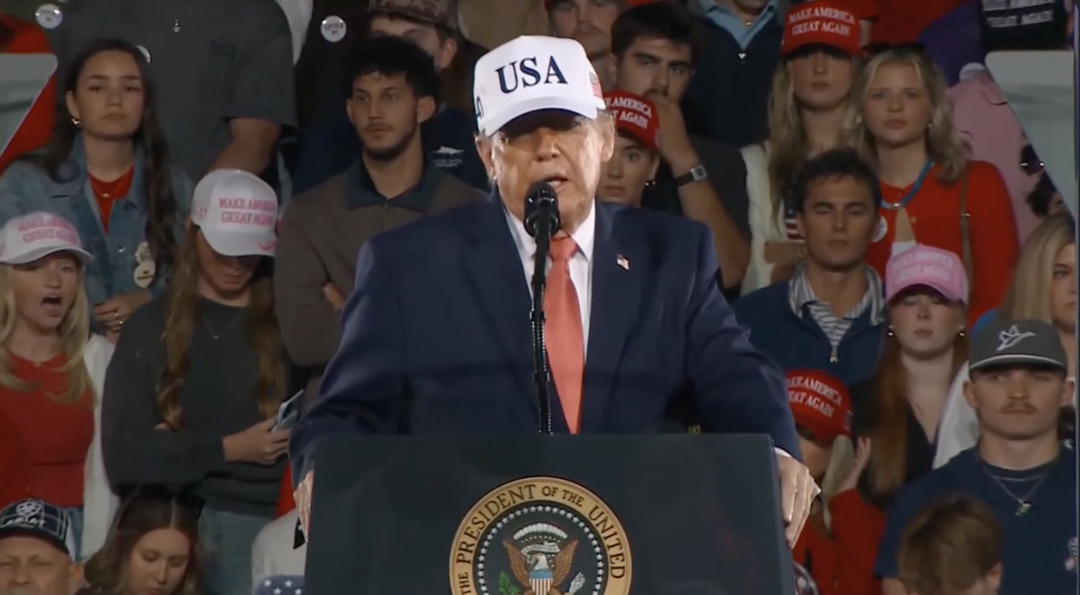
President Donald Trump and Republican US Senate candidate Michael Whatley delivered a barrage of accusations against former North Carolina Gov. Roy Cooper on Tuesday night, Oct. 20, at a rally in Greenville – with both men portraying the Democratic Senate nominee as responsible for violent crime, rising living costs and failures in the state’s response to Hurricane Helene.
While some of their criticisms were based on actual actions taken by Cooper during his eight years as governor, other accusations left out important context or conflicted with documented facts.
Trump also used the rally to promise Americans $5,000 each if Republicans retain control of Congress in November and announced new semiconductor-related investments in North Carolina.
Unlike some Republican candidates who are distancing themselves from Trump, Whatley is all in and his key campaign pledge is that, if you like what Trump is doing, you should vote for Whatley so that the president will have the support to continue.
In other parts of the country some. Republicans are creating space between themselves and Trump. For instance, Former Republican US Sen. John E. Sununu, who’s trying to reclaim his old New Hampshire Senate seat in a race against Democratic Congressman Chris Pappas, is going to unusual lengths to distance himself from the president – even though Trump has endorsed him.
In a campaign ad released this week, Sununu declares, “The way Chris Pappas tells it, I’m President Trump’s long-lost son. I’ve never even met the man.”
Sununu has also publicly criticized Trump’s tariffs on Canada and his war with Iran, calling the latter a mistake, and has said he doesn’t need Trump campaigning for him in New Hampshire.
On Tuesday night at the rally, the president made clear that his central purpose in Greenville was to promote Whatley’s candidacy and defeat Cooper in a race that could help determine which party controls the US Senate.
“I’m here for two things,” Trump said. “I want to tell you how bad Cooper is and I want to tell you how great Michael Whatley is.”
Whatley, who spoke before Trump arrived and returned to the stage during the president’s remarks, was equally critical of Cooper – whom he called the worst governor in North Carolina history.
Among the most serious accusations were claims that Cooper released thousands of dangerous criminals during the COVID-19 pandemic, resulting in murders, rapes and other violent crimes.
Trump told the crowd Cooper released more than 3,500 inmates, including 86 convicted murderers, and that the released prisoners subsequently committed at least 25 murders.
Whatley used a different figure, asserting that Cooper released 4,200 prisoners and that 25 of them went on to commit murder.
There’s a factual basis for the controversy: In February 2021, Cooper’s administration agreed to a settlement in a lawsuit brought by civil rights organizations concerned about the spread of COVID-19 in state prisons.
The settlement provided for the early release of 3,500 inmates.
However, the settlement followed court proceedings in which a judge had already ordered action to address prison conditions. Cooper’s administration had initially resisted demands for broader releases.
A PolitiFact investigation published in September examined claims by Trump and Whatley about the consequences of those releases.
It cited an earlier New York Post report identifying at least 18 released inmates subsequently charged with homicide. However, a WRAL investigation of those cases found that most of the accused either had already been released before the agreement or would have been out of prison by the time the alleged killings occurred even without the settlement.
That distinction doesn’t eliminate questions about the wisdom of releasing prisoners early – but it complicates the claim that Cooper’s decision directly caused the murders.
Both Trump and Whatley also blamed Cooper for the murder of Iryna Zarutska, the 23-year-old Ukrainian refugee fatally stabbed aboard a Charlotte light-rail train in August 2025.
Whatley told the Greenville crowd that Zarutska’s blood was on Cooper’s hands.
The available prison records contradict the assertion that the 2021 settlement released the accused killer, DeCarlos Brown Jr.
According to North Carolina Department of Adult Correction records examined by PolitiFact, Brown was released from prison on Sept. 20, 2020 – five months before the settlement. Corrections officials said that Brown served his required sentence and was not released early under the agreement.
The Whatley campaign has argued that subsequent decisions allowing Brown to remain free reflected Cooper’s broader approach to criminal justice.
Trump also compared Cooper to former Massachusetts Gov. Michael Dukakis, whose 1988 presidential campaign was damaged by the notorious Willie Horton case.
Whatley went after Cooper’s handling of Hurricane Helene, accusing him of attending a climate change event in New York while the storm approached North Carolina.
Cooper did attend a New York Times climate conference on Sept. 25, 2024, however, he returned to North Carolina that day. He’d already requested emergency powers on Sept. 24 and held a state emergency briefing on Sept. 27 as the storm moved into North Carolina.
Trump also accused Cooper of doing virtually nothing to help western North Carolina after the hurricane and he said the recovery only began when Trump returned to office in January 2025. That characterization overlooks emergency response and recovery efforts undertaken by state and federal agencies during the nearly four months between the storm and Trump’s inauguration.
Whatley made additional allegations involving electricity costs, insurance premiums, housing regulations and spending on disaster recovery. He claimed, among other things, that Cooper’s policies had contributed to a 183 percent increase in health insurance premiums and that $100 million intended for hurricane relief had been diverted to housing for undocumented immigrants.
Other criticism involved actions Cooper unquestionably did take as governor.
For instance, Whatley criticized Cooper for vetoing legislation requiring North Carolina sheriffs to cooperate with federal immigration officials on detention requests.
Cooper vetoed such legislation in 2019 and 2022 – arguing that requiring local sheriffs to perform federal immigration duties would divert law enforcement resources and raise constitutional concerns.
Republicans argued that the legislation was necessary to keep dangerous offenders from being released into North Carolina communities.
The two candidates also questioned Cooper’s physical and mental fitness for office.
Whatley suggested that Cooper, who’s spent decades in public office, was experiencing mental decline. Trump repeated questions about Cooper’s health and argued that candidates for major offices should undergo cognitive testing.
Trump devoted a substantial portion of the rally to his own administration’s economic record, arguing that employment, incomes, investments and the stock market were reaching unprecedented levels.
He also repeated his promise to pay out $5,000 to every adult American citizen if Republicans maintain control of the House and Senate.
“If we lose, you get nothing,” Trump said.
He described the proposed payment as a dividend from the economic benefits of tariffs and other administration policies, while saying recipients would be required to invest the money in the United States.
The proposal hasn’t been approved by Congress, and the administration has not presented a detailed plan establishing how it would be funded or distributed.
The president also announced what he described as major new investments in North Carolina’s semiconductor industry.
Commerce Secretary Howard Lutnick joined Trump onstage to announce that Sibelco, an industrial minerals company, plans to construct a quartz manufacturing facility in the state, representing an investment of hundreds of millions of dollars.
The president also announced a planned $1.5 billion Department of Defense investment in semiconductor production in North Carolina –although details of that commitment weren’t provided during the speech.
Whatley said the election represented a fundamental choice between his commitment to lower taxes, economic development and public safety and what he characterized as Cooper’s liberal policies.
Trump, who credited Whatley with helping Republicans win the 2024 presidential election as chairman of the Republican National Committee, repeatedly praised him as a capable and determined leader.
The president also urged voters to support Republican congressional candidates Laurie Buckhout and Jennifer Balkcom and said he might return to North Carolina before Election Day.
Throughout the evening, Trump and Whatley emphasized the stakes of the November election and the possibility that control of Congress could change hands.