


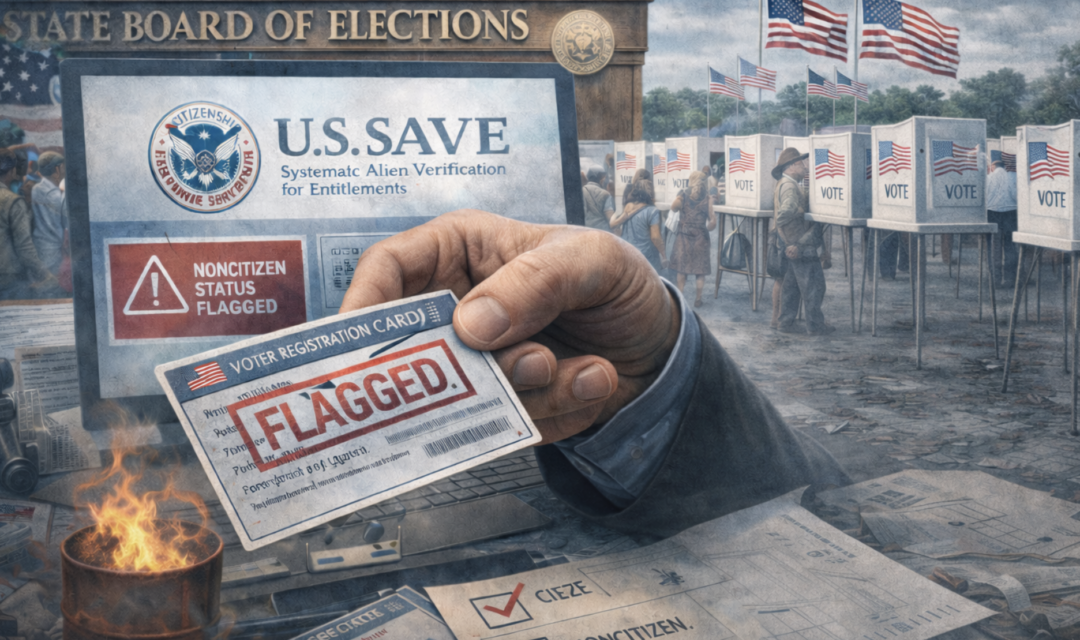
The North Carolina State Board of Elections has approved a new process to verify the citizenship status of all registered voters in the state – a move that officials say is aimed at improving the accuracy of voter rolls while ensuring that eligible voters are not wrongly removed.
At a recent meeting, the board voted to begin checking voter information against a federal database maintained by US Citizenship and Immigration Services known as the Systematic Alien Verification for Entitlements, or SAVE system.
Under the plan, voters’ names, dates of birth and the last four digits of their Social Security numbers will be submitted through the database to flag potential noncitizens. The State Board has entered into a Memorandum of Agreement with federal officials to use the SAVE system, formalizing how that data-sharing process will work.
“This is another way that we will continue to improve the accuracy of our voter rolls and make sure only eligible voters can cast ballots in this state,” State Board Executive Director Sam Hayes said in a statement released by the board pertaining to the new verification process. “As noncitizens are removed from the voter list, necessary precautions will be taken to ensure that no eligible voters are affected.”
The effort comes with a large number of safeguards, according to the board, and the process laid out by the newly approved rules is more involved than simply matching names against a database.
If a voter is flagged by the SAVE system as a potential noncitizen, elections officials will take additional steps before any removal is considered.
First, officials will work with the SAVE system to determine whether other records available through the federal database indicate that the person is, in fact, a US citizen.
Then, state and local records will be reviewed to see whether the voter has ever provided proof of citizenship to a government agency.
If no such documentation can be found, the voter will be notified and given an opportunity to respond, correct the information or provide proof of citizenship.
Under the rules approved by the board, voters must be given notice and an opportunity to be heard before they can be removed from the rolls. That includes the ability to submit documentation verifying their citizenship status.
The rules aren’t in effect yet. They must still go before the Rules Review Commission for final approval before they can be implemented statewide.
State officials emphasized that the effort isn’t being driven by evidence of widespread fraud.
Election officials say they don’t have evidence suggesting that noncitizen registration or voting is a widespread problem in North Carolina. However, they also note that even a small number of ineligible voters can become an issue in a state where elections are often decided by narrow margins. Look at the Sam Page versus Phil Berger election if you want a local example of an important outcome determined by a handful of votes..
The board points to documented cases as justification for tightening verification procedures.
A State Board audit conducted after the 2016 general election found that 41 noncitizens with legal status cast ballots in that election. That election saw nearly 4.8 million votes cast statewide, meaning the number of identified cases represented a very small fraction of the total.
According to that audit, many of those cases weren’t intentional violations of the law.
Interviews and evidence gathered during the audit indicated that some noncitizens were misinformed about eligibility requirements during voter registration drives. In at least one documented instance, a local precinct official provided incorrect information.
In another case cited in the audit, a woman in her 70s had lived in the United States for more than 50 years and believed she was a citizen because she’d been married to a US citizen.
Those examples, officials say, highlight that errors in the voter rolls can occur for reasons other than deliberate misconduct.
More recently, the state board noted that a Canadian citizen pleaded guilty in federal court to two counts of making false claims of US citizenship on North Carolina voter registration applications in 2022 and 2024 in order to vote in elections.
Under both state and federal law, registering or voting as a non-U.S. citizen is a felony.
Under Article VI, Section 1 of the North Carolina Constitution, only US citizens are eligible to vote in state elections. State officials say that maintaining accurate voter rolls is essential to ensuring the requirement is upheld.
The State Board also notes that ineligible ballots can effectively cancel out votes cast by eligible voters, which, again, become particularly important in close races.
North Carolina has seen a number of closely contested elections in recent years, where outcomes have been decided by relatively small margins, adding to the emphasis on the need for maintaining accurate voter lists.
At the same time, the proposal is already drawing concern from voting rights advocates. They warn that the use of federal databases like SAVE could lead to eligible voters being incorrectly flagged.
Critics of similar efforts in other states have argued that government databases aren’t always up to date or perfectly accurate, particularly for naturalized citizens – and that matching errors can occur when records are incomplete or inconsistent.
Those concerns center on the possibility that eligible voters could be wrongly identified as noncitizens and forced to go through a potentially burdensome process to prove their citizenship in order to remain on the rolls.
Critics have also raised broader concerns that aggressive voter roll maintenance efforts, even when well-intentioned, can sometimes discourage participation or create confusion among voters.
State officials, however, argue that the multi-step review process and required notification procedures are exactly designed to prevent that from happening and to ensure that no eligible voter is removed without due process.
In addition to identifying and removing ineligible voters, the new verification effort is expected to generate more data about how noncitizens end up on voter rolls in the first place.
State election officials say that information could help inform future policy decisions and public discussion about administration of elections in North Carolina.
The State Board has also launched a new webpage providing additional information about voter list maintenance efforts, including a question-and-answer section explaining how the SAVE database will be used in the verification process.
The broader goal, according to election officials, is to strike a balance — ensuring that only eligible voters participate in elections while also protecting the rights of those who are legally entitled to vote.
“This is another way that we will continue to improve the accuracy of our voter rolls,” Hayes said, “and make sure only eligible voters can cast ballots in this state.”




————-
What took them so long?
Only US Citizens should be able to vote in US elections.
Will be interesting to see how few non-citizens actually vote illegally. If you listen to the propaganda of the right wingers, it is millions. I bet it is tens, if that.
Regardless of the number of illegals voting, even one vote is too many. A change to the upcoming 2030 census that is so important and needed is the question of citizenship. Currently, a citizen question is not part of the census but should be. A state’s number of representatives in the House is decided by the state’s population. Noncitizens should be excluded for the purpose of House counts because noncitizens cannot vote. States with the highest number of illegals, think California and New York, will resist the citizen question in the census questionnaire.
Finally, it was about damn time they prevented these illegals from voting in elections and illegally shifting the balance. Good on them, a victory for the masses.
I will take ‘Things That Never Happened’ for $500 Alex.
————–
So what are you worried about then?
Waste and people being removed from voting roles without need or purpose. Funny how conservative love waste when they think it benefits them.
————-
Agreed, but non-citizens are not the same as illegal immigrants. Millions of Legal Resident Aliens live in the US, paying their taxes and keeping their noses clean, but are not allowed to vote here (rightly so). They’re not illegal.
If you decided to go live in England you wouldn’t expect to be able to vote in their elections as a US Citizen, would you?
Millions of undocumented immigrants live in the US, paying their taxes and keeping their noses clean. All while facing the lies of people like Austin with their bigotry who refer to millions of immigrants as pollution then tries to lie his way out of the statement when it is pointed out as clearly bigoted.
But you be you
Excuse me, but undocumented immigrants “keeping their noses clean”, isn’t that something like an oxymoron? “Illegal immigrants” have by definition have already broken US laws. So their noses were not clean from day one in the US.
Civil offense at most for majority of them…..you know, about as serious as a traffic ticket. Thinking they snuck in is not how many become undocumented. Many just over stay their paperwork.
The first lady worked illegally under her visa (a civil offense), you gonna deport her as a criminal?
Thank you! I wasn’t ever referring to the visa non-citizens, I was referring to the people who came into this country illegally, even if they are “keeping their nose clean.” They have no right to complain when they are deported because they broke the law by illegally entering this country and cutting the line. They entered ILLEGALLY, THEY ARE NOT CITIZENS AND ARE ACTIVELY VIOLATING THE LAW. They have no right to vote or have a say in our elections. Anyone who believes that someone who entered our nation illegally should be able to vote in this country or says that letting them vote doesn’t make a difference needs to check themselves because that is called being an idiot. I’m perfectly ok with the non-citizens with visas and proper documentation to be in the country, but they shouldn’t be able to vote, and most of these legal non-citizens are ok with it. If you think that its ok for illegal aliens to vote in elections, you need to get checked. The Professor probably thinks he’s the main character in a movie where he is the main character, and we are all Racist and the bad guys, SPOILER ALERT! He is not a main character in this fictional movie and is just a brainwashed hypocrite who says that anyone who has a slightly negative conversation with him is labeled a Nazi and a Bigot. He probably hangs out with Ruth near that church with her propaganda and her big ah fence to hide her hypocritical face. The Professor should really reevaluate his worldview because it is clear that this country is not fascist and we are not racists. Your labelling us makes you a hypocrite because you are literally the embodiment of what you are calling US.
Go speak to someone for help
———–
Keep it up, buddy! You’ve become a caricature of yourself.
“Bigot!” “Racist!” Hater!” “Moron!”
“The Professor” has made himself a running joke. Except that his seething, vituperative hatred is real enough, sadly.
Angry little man.
More hypocrisy from Austin. Yawn
What? Somebody is ACTUALLY listening to We the People? Praise the Lord and pass the ammunition.
As for Christian C Rice/Chris/professor/Polly Pocket/Sybil, I wasn’t aware there were millions of illegal aliens in North Carolina. I know there is a large number of LEGAL non-citizens here.
Is your tinfoil hat so tight you are struggling to read again? Or is it something more systemically wrong with you….?
I never said there were millions of illegal aliens in NC…….try again little man, the effort is appreciated. You can do it!!
————-
We all know you’re a rude, condescending, offensive little man, “Professor”. You don’t have to prove it with every comment you make.
That hypocrisy of yours is rich.
41 out of 4.8 million. Another waste of my tax dollars!
Exactly. Funny how conservatives love to spend money on conspiracy theories but caring for and feeding children is too expensive.
Funnier thing Chris, there was a raid on a downtown bar a couple days ago. 12 people were arrested and over 150 charges were filed. My source from the GPD tell me everyone arrested are illegals. Another bunch of your criminal illegals. You need to read the story and maybe start a go fund me to help with their bail
Why? I never said undocumented people don’t commit crimes. Just that they do it at a lower rate than natural born citizens.
The article I found didn’t note the immigration statuses of the criminals. You claiming Americans aren’t drug dealers? Why didnt you share the news article about Kevin Johnson, the Greensboro fentanyl drug dealer who got 17 years? Weird you only seem to care about immigrants . Typical conservative BS.
I will believe it when I see it. I doubt the State Elections Board will accomplish much of anything….but it sounds good.
ONLY LEGAL CITIZENS CAN VOTE! What a concept. This begs a question. Does requiring proof of citizenship mean or suggest that ILLEGAL ALIENS may have voted in previous elections? What you say??? This is heresy and FAKE NEWS!
I wonder how many people will be removed the voting rolls. dems say requiring proof of citizenship is racist. Why? Will removing ILLEGAL ALIENS from voting rolls cut down on people who vote for dems? dems are scared they will be exposed for the frauds they are.
TIME TO VOTE FOR REPUBLICANS FOR EVERY OFFICE FROM DOG CATCHER TO CITY, COUNTY, STATE AND FEDERAL OFFICIALS. Republicans are not perfect but at least they RESPECT YOUR VOTE, WILL WORK HARD TO KEEP YOU SAFE AND THOUGHTFULLY AND WISELY MANAGE THE WAY OUR MONEY IS SPENT.
What a pile of garbage. Republicans have no interest in free and fair elections. It’s why for the first time (other than court ordered) in US history, they started a redistricting war mid-cycle for fear of losing control of congress given Trump’s awful performance.
With Republicans in control, spending is up, deficit spending has increased, prices are up, we started yet another needless war, gas prices are up, allies no longer respect us, job growth is stalled, housing crisis continues, climate change is accelerating with no plan to address, we have ceded innovation and science to China and other foreign nations, 70% of American families live paycheck to paycheck, we promote conspiracy theories over public health science, inflation is up, etc.. etc.. etc.. which explains why Trump has the lowest approval rating of any US President in history.
But you be you.
———-
The Professor claims that “Republicans have no interest in free and fair elections”. Is that why they’ve blocked the NC Voter ID Constitutional Amendment, approved overwhelmingly by the voters of this state, about a decade ago?
Wait. That is actually the NC Democrat Party and the NAACP, isn’t it? THEY are terrified of clean elections – because dear Aunt Mamie (age 147) would be deprived of her right to vote !!
Multiple times
All unneeded given the lack of fraud in our elections. Just lies from the right….so they can make harder to vote for many people in NC.
Chis is a one-sided charlatan. The Democratic Party has done much more of the bad things he claims the Republican Party did, when it’s actually the Democratic Party that is doing it, it just doesn’t line up with his narrative. The Democratic Party founded the KKK. They founded The Weatherman (a terrorist organization, mind you), instituted Jim Crow Laws, resegregated the federal workforce, and now, they label anyone who disagrees with them a Nazi and want them shot. You guys are fine having guns for yourself, but want them gone when you hear we have them. THE PROFESSOR IS THE DEFINITION OF “what’s mine is mine, but what’s yours is negotiable.” Your party has never in the HISTORY of the United States been the lesser of 2 evils. Based on what you say, you are the Nazi, and we have never been. Your party is fueled by hatred and you need to STOP!
When, tell me, professor, is redistricting justified due to a president’s performance as you state?