

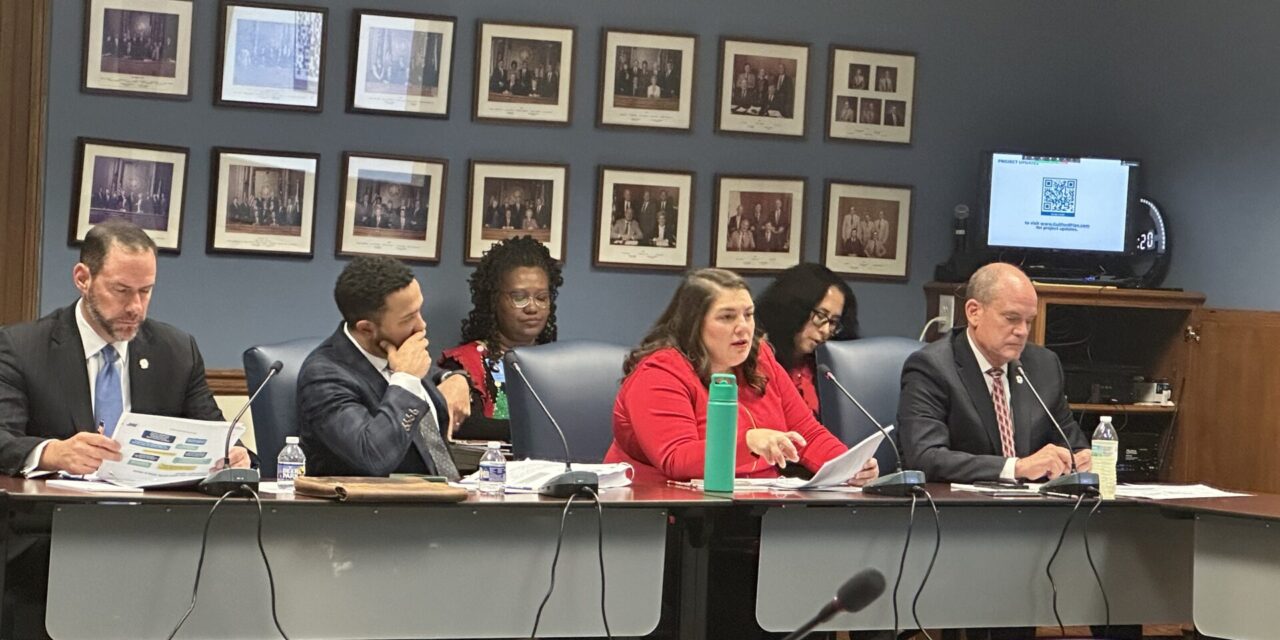
The Guilford County Commissioners are in full-blown budget mode right now and, as part of that process, they’ve been horse trading among themselves, listening to county residents in town halls and regular meetings and trying to balance the revenue needs of a growing county versus what taxpayers will bear.
In addition to any new money they get from the 2026 countywide revaluation of property – which would add an extra $175 million in new revenue if the current tax rate stayed the same – the county is looking for other revenue sources to support future government growth.
For instance, county leaders are hoping that county voters will approve a quarter-cent sales tax increase in November which could bring in north of $25 million in extra revenue per year. County leaders have never been able to convince voters to approve the move, even though they started the effort almost two decades ago.
Recent discussions among county staff and commissioners have also clarified that the county may, in the future, rely on so-called “two-thirds bonds” to finance some coming capital projects. Those are bonds that can be issued without voter approval under certain conditions.
That approach would allow Guilford County to move forward more quickly on some projects, but it would also add even more new debt on top of the more than $2 billion in school bond debt already approved by voters – which, by the way, comes to well over $3 billion in total payback when interest is included.
County officials have emphasized that the school bond program won’t be reduced to pay for county facilities, meaning the two tracks of spending – school bond revenue and two-thirds bond money – would continue simultaneously.
That raises the broader question that’s begun to surface more often in recent discussions: How much debt is too much?
So far, there hasn’t been a definitive answer.
Chairman of the Guilford County Board of Commissioners Skip Alston told the Rhino Times this week that tens of thousands of new residents are moving into Guilford County because of economic development successes like the Toyota battery factory near Liberty, the JetZero win that’s bringing in more than 15,000 new jobs, and other companies coming in – largely at the airport megasite.
“We’ve got to start preparing now,” Alston said, “for all these people that are coming in three, four, five years from now. They are all going to need schools, emergency services, law enforcement protection and other services. We can’t get caught flat-footed. We have to start preparing now.”
He said that also means the county must get more housing – and fast.
“We don’t want them living in neighboring counties and coming into Greensboro just to work,” the chairman said. “We want them paying property taxes in Guilford County, not Rockingham County or Alamance County.”
Alston also pointed out that the commissioners have been getting a lot of blowback from taxpayers who assume the board will keep the tax rate the same and collect all the new revenue generated by higher property values.
In 2022, after the last revaluation significantly raised housing prices, this Democratic-led board – with many of the same members – did keep the rate the same and spent roughly $95 million in additional annual revenue generated by those higher valuations.
“We don’t need all $175 million,” Alston said. “But we do need some of it. So the tax rate won’t stay the same – but it won’t drop to revenue neutral.”
When told that one Rhino Times commenter suggested in a post that the board would end up collecting $174.999999 million rather than the full $175 million, Alston laughed, and he joked, “That might not be a bad guess.”
However, the commissioners also have to take into account the large number of irate taxpayers they’re hearing from.
No major votes have been taken. No tax rate has been set.
But based on past behavior and large spending by the current board, taxpayers are very worried.
At this point, almost everything is on the table.
That will start to change once the manager’s budget is released in mid-May. At that point, commissioners will have a concrete proposal to react to, and the public will get its first real look at how the numbers are coming together.
From there, the process will move quickly.
The board will hold its legally required public hearing on the proposed manager’s budget – giving residents a final chance to weigh in before decisions are made.
After that, commissioners will work through any adjustments, add their last-minute “pet projects” – funding for nonprofits they like, and then adopt a final budget, usually in mid-June.
Last year, the board didn’t even name the nonprofits in the adopted budget. Instead, commissioners set aside a couple of million dollars for that purpose and then, in late summer, decided which groups would receive funding. One reason may have been to call less attention to the generally unpopular move, but there was still plenty of outrage later that summer over what many saw as a seemingly random list of groups that got taxpayer money as opposed to those that did not.
Once the new fiscal 2026–2027 budget is approved, that document will govern county spending from July 1, 2026, through June 30, 2027.
Right now, the Guilford County Board of Commissioners is in the familiar early stretches of the process – holding town halls, listening to public comment and waiting for the staff numbers that will ultimately drive everything else.
Commissioners are talking – and listening – but not yet deciding.
And the biggest unanswered question hanging over all of it is how much property taxes will actually go up after the county’s 2026 revaluation.
Under North Carolina law, if no action is taken, counties by default adopt a “revenue neutral” tax rate after a revaluation – a rate that would bring in roughly the same amount of revenue as the prior year, adjusted for new growth.
However, that’s just a starting point: Commissioners are free to set the tax rate higher or lower.
In the meantime, commissioners have been fanning out across the county holding budget town halls throughout April, gathering input from residents. The message at those meetings has been consistent and predictable: People want more services – but they don’t want higher taxes.
Many speakers have urged the county to increase funding for education, public safety and other core services – especially as Guilford County continues to grow.
That growth is a key factor shaping the conversation. County officials have been highlighting projections of roughly 27,000 new jobs over the next three to five years – driven by economic development across the region.
And how much to give Guilford County Schools – which typically accounts for about 45 percent of the county’s entire budget – is always a major point of debate.
Guilford County Schools has submitted a proposed budget of about $961 million, including a request for roughly $24.6 million in brand new county funding on top of what they got last year.
That request is now sitting squarely in the commissioners’ laps, and it’s expected to be one of the biggest drivers of whatever tax increase is ultimately adopted.
Historically, school funding debates have dominated Guilford County budget discussions, and this year will be no different.
At the same time, commissioners are wrestling with a separate but related issue: a desire to move forward with long-term capital projects and renovations.
Guilford County has been discussing a capital plan totaling roughly $572 million, including a proposed downtown Greensboro government complex estimated at about $137 million. That project isn’t part of this year’s budget, but commissioners know it may not be far off.
So far, none of those projects have been formally approved, but the conversation is becoming more concrete, and the Board of Commissioners is clearly moving in that direction, with staff gleefully leading the way.
All of it feeds into the same central issue: how to pay for growth, how much to tax, and how much debt the county is willing to take on to get there.
For now, the answers remain unclear.
However, in a matter of weeks, the numbers will start to solidify, the proposals will be on the table, and the decisions will begin.
And when they do, taxpayers across Guilford County will be watching very closely.




————-
So when tens of thousands of new jobs and businesses are added to the tax base of Guilford County… that’s a reason to INCREASE taxes? Er, no ….when your tax base is added to so massively, that makes it an opportunity to REDUCE the tax burden on each citizen or tax parcel, and still reap much greater revenue.
But we shouldn’t be surprised by this legerdemain by Democrats. They represent the interests and appetites of government and the Parasitic Sector. And there is limit to the rapacious greed of people who can simply force other people to surrender the money they have earned.
Government is greed.