
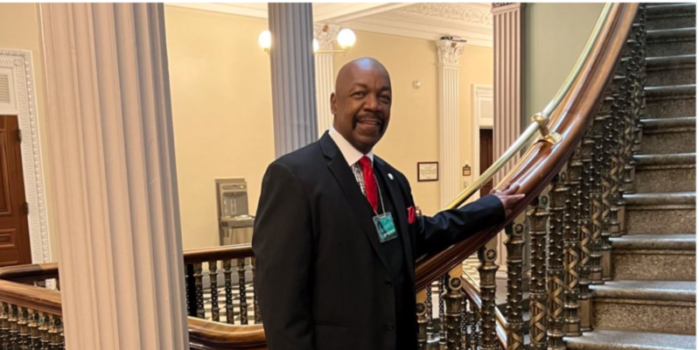
Chairman of the Guilford County Board of Commissioners Skip Alston is about to add another chairmanship to his lengthy resume on Saturday, Aug. 1, when he takes over as chairman of the North Carolina Real Estate Commission.
Alston, who is, of course, seemingly chairman for life of the Guilford County Board of Commissioners, has served as vice chairman of the nine-member state Real Estate Commission for the past year. The commission elected him chairman at its July meeting.
The new position puts Alston at the head of the state agency that licenses and regulates more than 100,000 real estate brokers statewide. The commission establishes education and licensing requirements, investigates complaints, disciplines brokers and adopts rules governing North Carolina’s real estate industry.
For Alston, the chairmanship is both a return to familiar territory and another significant addition to the influence he’s developed at the local, state and national levels over more than four decades.
Alston previously served on the NC Real Estate Commission from 2003 to 2009 and was elected chairman in 2007 and again in 2008. Former NC Gov. Roy Cooper appointed him to the commission again in October 2024. Less than a year later, his fellow commission members elected him vice chairman, putting him in line for the top position.
Alston told the Rhino Times that the new chairmanship gives him another opportunity to give back to an industry that has served him very well throughout his adult life.
He became a licensed real estate broker in 1982 and founded The Alston Realty Group that same year. More than four decades later, real estate remains at the center of his sprawling collection of business, political and civic interests.
The position is also the latest chapter in a genuine rags-to-riches story.
Alston was born in Durham in 1957 and grew up poor in one half of crowded duplex. His mother, Constance Alston, worked as a custodian and housekeeper at Duke University. His father, Raymond Alston, worked as a cook in the kitchen at the Durham Veterans Affairs hospital and later as a forklift operator.
Alston said that when he was young, he and his friends would sometimes walk through one of Durham’s wealthy neighborhoods. The children who lived there would taunt them and throw rocks at them.
He said that experience helped create a determination that has stayed with him for the rest of his life. He has worked hard and tried his hand at a whole lot of things, whether it was real estate, selling cars, chicken biscuits, hot dogs or something else.
“I made a decision then that I was going to be successful,” Alston said of his difficult childhood.
He still keeps a picture of that house to remind him of his humble beginnings.
Alston said that growing up in a cramped home with his parents and siblings made him want to own a large home and enjoy the kind of life that seemed far out of reach at the time. However, he said he also made a promise to himself about what he would do if he achieved that success.
“If I ever got successful, I was going to give back,” Alston said.
Alston added that the Lord has blessed him and, because of that, he has tried to follow a lesson taught by his father: The Lord continues to bless those who give back to others.
Alston takes a lot of criticism from those who don’t like his politics and who don’t like the fact that he has played a big role in raising Guilford County tax rates over the last several decades.
He has been a major player in county politics since before the turn of the century and is a co-founder of the International Civil Rights Center & Museum.
After graduating from high school in 1975, Alston studied business administration and management at North Carolina Central University.
He went to work as a life insurance salesman for Metropolitan Life Insurance Company in 1979. In 1981, he became a resident manager for the US Shelter Corporation, giving him experience in housing and property management before he established his real estate company.
Over the years, Alston has tried his hand at a remarkably wide range of businesses. In addition to real estate, his ventures have included a chicken business, a car dealership and the eatery Skip’s All Beef Hotdogs.
Some succeeded and some lasted longer than others, but Alston has never been reluctant to move into a new business venture or take on an additional challenge.
That willingness to move forward aggressively has also marked his political career.
Alston was first elected to the Guilford County Board of Commissioners in 1992. He served for 20 years before leaving the board in 2012, then returned following the 2016 election.
He became the first black chairman of the Guilford County Board of Commissioners in 2002. He is now serving again as chairman and has held the position more times than anyone else in Guilford County history. He has also become the most powerful political figure in the county.
Alston controls a solid 7-to-2 Democratic majority on the Board of Commissioners, where members of his party almost never vote against him on a major issue. He plays a leading role in developing the county budget, determining spending priorities, making appointments and deciding which projects advance and which ones don’t.
His influence has extended well beyond county government.
Alston served as president of the Greensboro Branch of the NAACP from 1990 to 1992, president of the North Carolina State Conference of the NAACP from 1995 to 2005 and as a member of the NAACP National Board of Directors from 2001 to 2007.
He also served as treasurer and later president of the National Association of Black County Officials and has held leadership roles with the National Action Network and numerous state and local boards.
In 1996, former NC Gov. Jim Hunt appointed Alston to the Governor’s Task Force on Church Burnings. Alston also served on the North Carolina Housing Partnership Commission and the state’s Martin Luther King Jr. Holiday Commission.
Long before Greensboro routinely celebrated Martin Luther King Jr. Day with a parade, Alston led the fight to rename Asheboro Street in King’s honor. He went door to door advocating for the street name change, which the Greensboro City Council eventually approved.
The effort faced intense opposition, and the Greensboro City Council initially rejected the proposal. Alston and other supporters continued pushing until the city agreed in 1989 to rename the street Martin Luther King Jr. Drive.
Alston then organized a parade in 1990 to celebrate the street’s new name. It was meant to be a one-time event. However, it became the annual Greensboro Martin Luther King Jr. Day Parade, which Alston and the Greensboro NAACP have continued for more than three decades.
One of Alston’s largest and most visible accomplishments is the International Civil Rights Center & Museum in downtown Greensboro.
Alston and former Guilford County Commissioner Earl Jones purchased the former F.W. Woolworth building to preserve the site of the Feb. 1, 1960 sit-ins. After years of fundraising, political battles, construction problems and doubts about whether the project would ever be completed, the museum opened in 2010.
Alston continues to play a central role in overseeing and supporting the museum.
His new position with the Real Estate Commission brings his political, business and civic careers together.
The commission isn’t a ceremonial board: It has very real and substantial authority over who may work as a real estate broker in North Carolina and whether brokers accused of misconduct may keep their licenses. Its decisions affect thousands of people in an industry that handles billions of dollars in transactions each year.
Alston told the Rhino Times that he doesn’t expect the commission chairmanship to interfere with his responsibilities as chairman of the Guilford County Board of Commissioners, his real estate business or his work with the civil rights museum.
“I’ve got the time,” Alston said when asked how he would manage the additional responsibilities.