


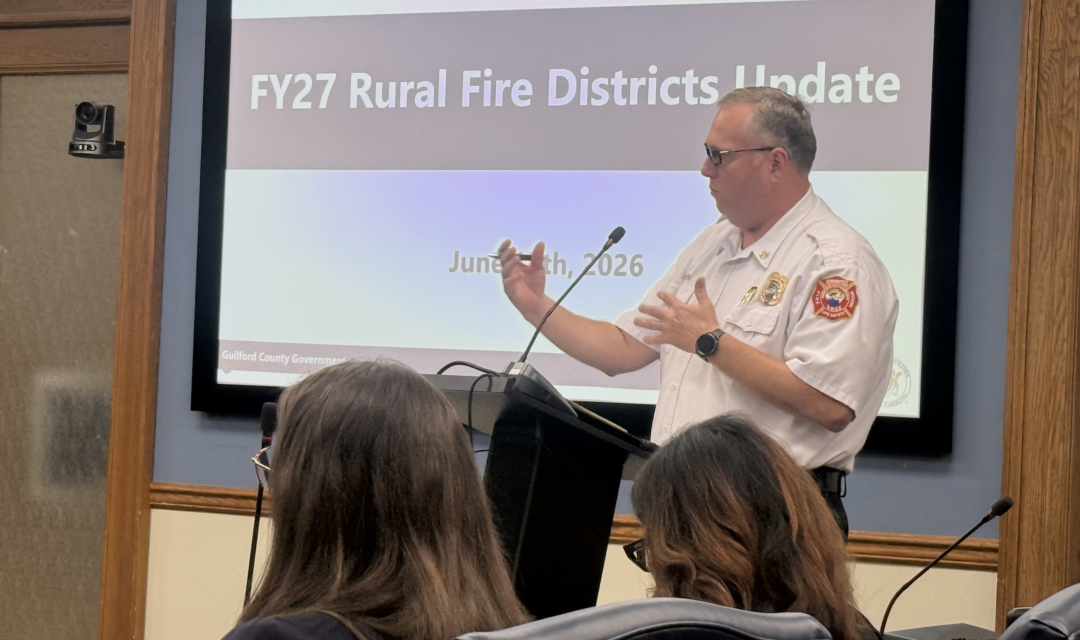
The state’s property tax reappraisal moratorium might force Guilford County’s rural fire departments to delay hiring firefighters, postpone equipment purchases and rethink long-term plans that many departments have spent years developing.
That message came through repeatedly during a Guilford County Board of Commissioners work session on Thursday, June 18, as county staff and fire chiefs outlined the potential impact of Senate Bill 889 on the county’s 23 rural fire districts.
County Budget Department staff told commissioners that rural fire districts originally requested a combined fiscal year 2026-2027 budget of about $42.9 million.
Since the county can’t use higher property values assessed for 2026 as a tax base, one “moratorium budget” under discussion, projected revenue for the Rural Fire District Fund would fall to about $35.5 million, roughly $7.4 million below what the districts requested.
County staff said the county contracts with 17 nonprofit fire departments and four municipal fire departments to provide fire protection in rural Guilford County and noted that county’s investment in rural fire protection has steadily increased over the past six years, with per-capita funding rising from $155 in the 2019-2020 budget to $275 in the current budget.
According to county staff, all rural fire districts reported higher projected operating costs for the coming fiscal year due to increases in insurance premiums, retirement contributions, workers compensation expenses, turnout gear costs and other supplies.
County staff outlined three suggested approaches for commissioners to consider: maintaining current tax rates under the old 2022 property values, adjusting tax rates to offset equalization losses and keep districts at current funding levels, or increasing tax rates enough to fund expansion requests submitted by the departments.
The main spokesperson for the fire departments was Summerfield Fire Chief Chris Johnson – though many chiefs were there to show support. Johnson said fire departments have spent years moving away from annual budget requests and toward long-range planning.
Johnson said fire departments must plan years ahead for apparatus purchases, station improvements, training and staffing. He noted that new fire trucks can take three to five years to arrive after being ordered and said departments have already made commitments based on previously approved funding plans.
Johnson said Summerfield signed a contract for a new fire truck and began work on a station renovation after last year’s budget decisions.
According to Johnson, personnel costs now exceed $4 million annually in Summerfield and account for between 70 percent and 85 percent of the budget in many departments.
He argued that a moratorium-based budget could force departments to raise tax rates higher than originally planned simply to maintain commitments that have already been made.
He also expressed concern about the delayed property tax bills. Because the county now expects tax bills to go out in mid-August rather than mid-July, fire departments could experience a temporary cash-flow problem during the first part of the fiscal year.
Johnson said that some departments may have reserves available to bridge the gap, but using those funds could reduce investment earnings or require departments to tap money originally set aside for capital projects.
Guilford County Manager Victor Isler said that the county would move some funds around to provide liquidity during that period if need be.
The fire chief repeatedly emphasized staffing concerns.
He said that volunteer participation continues to decline nationwide and that career firefighters are becoming increasingly important to maintaining service levels.
Johnson said that Summerfield, Oak Ridge and Stokesdale developed a joint operational plan designed to reduce duplication and improve service. Under that plan, he said, the three departments expected to add personnel; however, the moratorium could eliminate nine planned positions across the three districts.
Johnson argued that inadequate staffing affects both firefighter safety and emergency response times.
“When staffing levels are inadequate, response times increase,” Johnson told the board. “When response times increase, property loss increases and the risk to our citizens rises.”
Guilford County Emergency Services Director Jim Albright echoed those concerns.
Albright explained that because fire departments operate around the clock, adding three positions doesn’t simply mean adding three employees.
He said it takes approximately nine employees to continuously staff a single fire apparatus and closer to 12 employees when vacation, training, illness and other absences are considered.
Albright also said Guilford County’s growth has increased pressure on rural departments.
He noted that county fire districts generally operate with stations serving much larger geographic areas than municipal departments, while residents still expect urban-level response times.
Commissioner Carly Cooke asked how fire departments gather public input on tax rates and service expectations.
Johnson responded that tax rate requests are ultimately made by local fire boards rather than fire chiefs. He said Summerfield surveyed residents before seeking a tax increase last year and found strong support for the proposal.
Several commissioners also questioned the long-term funding structure for rural fire protection.
Johnson said fire departments are exploring additional funding options, including possible state-level solutions and revenue opportunities connected to sales tax revenue if the Guilford County voters approve a sales tax hike in November.
Isler said the county would continue working with fire departments on capital planning and long-term funding issues as budget discussions move forward.
The commissioners are expected to adopt a budget on Thursday, June 25.
The discussion came as commissioners continue evaluating the broader financial impact of Senate Bill 889, which has forced Guilford County to reconsider major portions of its proposed fiscal year 2026-2027 budget.




Perhaps the commissioners should put a moratorium on some of the superfluous spending on unnecessary stuff. Also, what is the fire tax used for. I thought that was used for rural fire departments.
So you got cash flow problems! Welcome to our world. With the county clown commissioners and their so called budget, all citizens have a cash flow problem. Deal with it like we have too.
Hey genius, when the taxpayers become broke you want have any firetrucks.better have a bunch of garden hoses.
today’s news: kernersville fire truck rollover. oops
Budget cuts need to come out of the county and city’s frivolous spending.
Focus should be on the immediate, urgent needs of the general public – affordable housing, food, health care, education, social services, children, elderly, drug and crime prevention.
The above issues need to be solved before focusing on wants and growth. We survived, grew and thrived on much less technology, wants, and luxuries than we currently have.
I disagree.
Who determines “needs”? Needs are the basis for Socialism. Almost all of your focus are for “needs”, not essential services.
The fire tax collected for rural fire protection remains within the community where it is generated. Unlike regular property taxes, which are collected by the county and placed into the general fund for allocation through the county budget process, rural fire taxes are collected by the county and distributed directly to the fire department or fire district that provides service to that area.
These funds are never included in the county’s general fund or operating budget. Each fire department is governed by a Board of Directors, which determines and requests the tax rate needed to support its district. That recommendation is submitted to the County Manager, who then presents a proposed rate to the Board of Commissioners for consideration and approval as part of the annual budget process.
It is important to understand that rural fire district funding is completely separate from the county’s general fund. Every dollar collected through the fire tax remains within the district where it was generated and is used exclusively for fire protection services, including personnel, operations, training, facilities, and equipment necessary to protect the community.
‘needs’ are the basis for capitalism – a system of barter/trade exists & some people end up with more than others creating jealousy & ‘class’ warfare. i need a beer. psychologist abraham maslow rip established a ‘hierarchy of needs’ similar to your ‘essential services’.
how is EMS funded/provided for rural guilford co. ?
EMS funding comes from the normal property taxes paid by every resident of Guilford County. They also receive funding from billing for certain services that are allowed. But the rural fire tax does not go to GCEMS. It remains in the community it was collected in.
Perceived Cash Cows of Guilford County/Greensboro,
Skip the Omnipotent, his willing thralls who have the testicles to call themselves ‘representatives of the people’ and his puppets on the Greensboro City Overlords don’t care.
They stand before you convinced they can continue to sell you their bags of bovine fertilizer and scare you into believing they can’t cut anything from their budgets without causing suffering to you. Plenty of people have listed their finding in both budgets showing how much cumshaw they are handing out, in YOUR money, to their friends, relatives and supporters for the sole purpose of maintaining power and influence.
As I have said many times, we need a Boston Tea Party moment. Am I advocating violent action? Not at this time,not to say it won’t come to that. But how many TAXPAYERS stand to lose what they have worked for their entire life, their homes, their possessions to these vampires lead by our version of Count Dracula?
I will say it…THEY, NONE OF THEM, CARE ABOUT US, THE COMMON CITIZEN!!! They give OUR hard earned money to these supposed NPOs. Funny thing, I see some of these ‘caring individuals’ living in really nice houses, driving really nice cars, living really nice lifestyles while getting handouts from their buddies in the local governments. How many of these ‘organizations’ have you ever heard of? Yes there are some recognizable, but if they doing ‘God’s work’ why go to the government. If you are worth supporting, people will support you ON THEIR OWN AS THEY CAN. But it’s more profitable to talk to their elected buddies. Ask yourself this…how much are they getting paid to run these organizations? Some will jump up and say they get little to nothing, but what about the ones who just whistle and look at the sky?
What about all these government funded boards and committees with feel good names? I know, they are (supposedly) unpaid…but what about all the government support, IE staff, utilities, material support, other expenses they are using? Don’t urinate on my head and try to tell me it’s raining.
What can We the People do? For starters, since they are OUR government who (supposedly) work for US, how about term limits, for starters. Next, make for the ability to conduct recall elections. Make the County Board of Commissars all At Large position since the city critters outnumber those of us in the County and can therefore have an unfair effect on us. Instead of these dog and pony shows they call public input on the budgets and other spending, put TAX PAYING CITIZENS on the committees with real power.
As President Lincoln said in the Gettysburg address we are, supposedly, a “government of the people, by the people, for the people”. Personally, I feel more like slave for the Rulers.
NPOs & support for unpaid boards…..you are ranting about a very small part of the budget problem. The gap they need to cut to stay tax neutral is $86 million. They need to cut ineffective departments entirely to solve this problem. And there are a number of those to target….but you rant about NPOs and paying for lights in a conference room for volunteers to meet and discuss community problems? Real cuts need to be made if you all want to avoid the Skip spending spree..
If you want to rant about real change…go learn what’s really in the budget versus your made-up problems that don’t even make in a dent in solving the actual issues of bloat and programs that make little impact on the community:
$15 million for a new ERP system – is it really needed?
$1 million for ‘street outreach’ program?
$500 for the office of Asst County Manager for a Strong Community?
$1.5 million for the MWBE program – paper exercise? They recently cut the budget but need to kill the program
$500 for EDO funding – Does it really work?
$2 million for NPOs – yes this is an easy cut
$10 million to reduce spans of control in management layers (best guess estimate)
$1 million on GC cooperative Extension
$1.3 million on Small Business and entrepreneurship Department
That covers about half the problem and that is just a cursory look into the budget detail.
Bah-loney. They always do this when they say money is tight – say they will cut essential services, while the padded employee line explodes. Plenty of cash for their vote-buying, feather-bedding schemes.
It’s time for tar and feathers….
———–
You’re right, Miller.
ALL the agencies of the Public Sector have the same M.O. when their budgets are trimmed, or not increased enough to satisfy them. They threaten diabolical results. The sky will fall! Children will die! The elderly will expire en masse.
In the early 1980’s the obese British Public Sector and its labour unions took great care actually to inflict the maximum pain on the British public as Margaret Thatcher cut the fat from their funding – while the bureaucrats still rested their feet on their desks.
It was how they put pressure on Maggie to restore their money. She faced them down, called them out publicly,
and embarrassed them.
She wasn’t called The Iron Lady for nothing.
There are a lot of taxpayer expenses that are not reasonable municipal expenses. Police, Fire, EMS, all reasonable. Roads, water and sewer, register of deeds and even tax collection, reasonable. And schools at a controlled level. Everything else, everything, is a personal responsibility, or the willingness of volunteers to donate or handle. The government is not your mother and father, raising and caring for you unto the grave. This must stop.