


Wow.
Just wow.
If you thought Guilford County had its hands full overseeing and funding $2 billion in school bond projects, a new Sheriff’s Office headquarters and lots of other ongoing projects – well, at a Thursday, Jan. 15 work session, county staff unveiled plans for another huge undertaking: Demolishing the county-owned Truist Bank building in downtown Greensboro, building a new Guilford County government complex and moving most administrative functions there.
And that’s just for starters when it comes to the county’s new long-range $572 million in plans that will mean massive construction and renovation in both Greensboro and High Point.
Plans also call for a $148 million consolidated Health and Human Services Campus in Greensboro, $30 million in renovations to Court House in Greensboro, $29 million for expansion of the county’s EMS base, $26 million for the Old Guilford County Court House (which just underwent massive renovation six years ago), $15 million for the Independence Building (which the county plans to rename) $15 million for a new EMS substation and tens of millions more for parks, the High Point jail and many other projects.
For years, Guilford County officials have talked about consolidating scattered county departments into fewer buildings. At the January 15 afternoon work session in the conference room on the first floor of the Old Guilford County Court House, county officials announced detailed plans to tear down the Truist building in downtown Greensboro and replace it with a large new central government complex.
The project hasn’t been formally approved by the Guilford County Board of Commissioners, but the board did allow for the staff-suggested move to go forward as part of Guilford County’s long-range capital improvement planning that calls for a complete reshaping of county government facilities in both Greensboro and High Point.
The proposed Greensboro project, labeled as the “New Government Complex,” will involve demolishing the Truist building downtown and constructing a new administrative campus connected to the Old Guilford County Court House by an elevated pedestrian bridge.
The new building, as currently envisioned, will total 118,325 square feet, spread across four floors of approximately 29,600 square feet each.
Parking would be handled by a new three-level parking deck providing about 279 spaces – roughly 93 spaces per level.
The estimated cost for the New Government Complex is listed at $137 million. That figure appears in a table of proposed funding for major capital projects and is part of a total package of $572 million.
Diagrams presented to commissioners show how multiple departments would be moved out of existing buildings and consolidated into the new downtown structure.
Those departments include Administration, Budget and Management, Clerk to the Board, the county Attorney’s Office and Information Technology.
Many of those departments are currently in the Old Guilford County Court House in Greensboro.
Other county operations would be shifted or retained elsewhere as part of the consolidation plan.
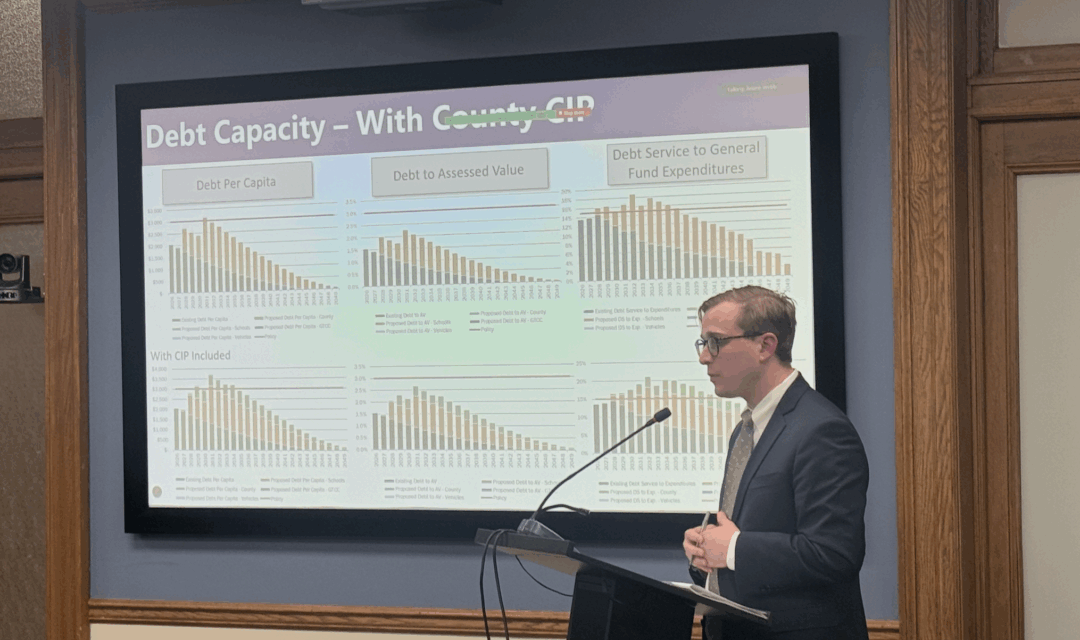
Toy Beeninga, Guilford County’s budget and management director (pictured above), explained during the work session that the county is trying to look beyond individual building needs and instead plan holistically for how government services are delivered and housed over the next decade.
The idea, Beeninga said, isn’t just about new construction but about long-term efficiency, reducing redundancy and avoiding continued investment in aging facilities that no longer meet operational needs.
Guilford County Facilities Director Eric Hilton walked the commissioners through the physical layout of the proposed consolidation. Hilton explained how departments currently spread across multiple downtown buildings could be brought together into a single administrative hub – with other services redistributed to better-suited locations.
In the diagrams presented, buildings such as the Katie S. Cashion Building, the Independence Building and the Old Court House are shown feeding services into the new structure, while other functions are shifted to retained facilities or specialized centers like the Family Justice Center.
Greensboro is only one piece of a much larger facilities plan.
In downtown High Point, Guilford County is also planning major capital investment, including a consolidated campus and major courthouse renovations. The proposed cost for the High Point Courthouse alone is listed at $11 million, while additional High Point projects – including public health and probation facilities – push the total for downtown High Point investment significantly higher.
Altogether, capital projects tied to High Point total tens of millions of dollars, reflecting the county’s intention to maintain parallel administrative and judicial infrastructure in both cities. Guilford County is one of the only counties in the state to have duplicate offices – like tax, register of deeds, health, etc. – in two locations. That’s because the county has two large cities, but maintaining that duality is expensive.
The New Government Complex in downtown Greensboro sits within a broader list of projects that includes courthouse expansions, EMS bases, park improvements, library upgrades, jail facilities and deferred maintenance across the county.
When combined, those projects produce a total proposed capital spending figure of $572 million.
It’s possible that some of that might not get done: Projects can be delayed, resized or removed altogether before final approval.
Still, the current Board of Commissioners rarely meets a project they don’t like and the level of detail already developed for the New Government Complex and other projects suggests the concept has already moved well beyond the state of being a casual idea.
It’s a good time for the board to start new construction because new housing and business property values, which will be released the day after Valentine’s Day, are going to come in much higher than they are now and, if the Board of Commissioners keeps the tax rate the same – as they did after the last revaluation – that will mean more than $100 million in extra free money annually that the commissioners be able to spend.
Renderings, square footage, parking counts, departmental assignments, and cost estimates are already in place. That typically happens only after county staff has been directed to treat a project as something that will get approved.
The proposed demolition of the Truist building is likely to draw a lot of public attention. While the building isn’t historic in the same sense as the Old Court House, it occupies a prominent downtown location and represents another step in the ongoing transformation of Greensboro’s center.
Supporters of consolidation argue that modern county government requires modern facilities and that scattering departments across outdated buildings is inefficient and costly over time.
Critics, however, are likely to question whether spending all that money on a new administrative building is justified, particularly when the county continues to face demands from school funding, public safety spending and tax relief.




I dare anybody to look me in the eye and say you are totally blindsided and surprised by this action.
This is Skip the Omnipotent grabbing his crotch and the rest of the Board of Commissars (R and D) telling us peons to go cry in a corner and be thankful we have them to look out for us.
Nailed it!!
Don’t forget they will need millions to increase staff to fill all this office space. They did not outline how much money we could save by having all these people in one place. Could we eliminate management positions and save money. Do we really need to construct and own office buildings in these times of high building cost??? This is total BS
Yep. Spot on!
They could eliminate 90% of what they have now, refund the taxpayers & be just fine. When are we going to stop allowing this to continue? Having retired from this BS, I can say that with absolute certainty & without any hesitation whatsoever.
I think Skip should be identified as ole skippy and NOT Skip the Omnipotent. These terms give the impression ole skippy is someone of importance instead of the backroom, smoke filled room political hack he is. Of course, he lacks any logic or knowledge about financial matters or what his servants (taxpayers) can actually afford to pay without going broke or depriving their family with basic needs. A true leader-NOT ole skippy-can ‘read the room’ and be able to distinguish between what MUST be done and those projects he would like to do…but can’t afford to do. Like the $2 Million tree house. ole skippy must not have any basic math skills but he sure is ‘less than honest and truthful’ with taxpayers.
I am sorry liberal dems keep voting for ole skippy and his cronies all of whom are financially,socially and morally illiterate. One of these days when dem voters can’t afford to buy groceries, gas to get to work or their taxes, they may open their eyes for the first time and vote for Conservative Republicans who truly care about them. Want proof? Look how Republicans in the North Carolina legislature continue to LOWER STATE INCOME TAXES while the democrat governor and liberal democrat legislators vote against lowering taxes. Remember ole skippy wants to INCREASE the SALES TAX AND WANTS TO BORROW ANOTHER $550 Million for the schools.
To recap; ole skippy borrowed $1.7 BILLION for schools and now admits WE will pay $1.5 BILLION in interest for a TOTAL COST OF $3.4 Billion. That means that every year for the next 30 years, taxpayers-that means YOU-will be paying $113 Million dollars each and every year to pay off these school bonds.
ole skippy wants to borrow another $550 Million for the schools even before the $3.4 BILLION is repaid. That will cost another $30 Million every year for the next 30 years.
Now ole skippy wants $572 Million for new county government buildings in Greensboro. So that is another $40 Million each and every year for the next 30 years.
That totals a staggering $183 Million dollars taxpayers-that’s YOU-will pay every year for the next 30 years. The banks and lenders ALWAYS GET PAID FIRST, If you don’t pay your mortgage, insurance, and taxes, your banker or the government will take your house.
Do you think it is fair to leave your kids in debt up to their eyeballs? A child born TODAY, will be paying off this debt until they are 30+ years old with a family of their own. DID YOU KNOW THAT? IS THAT REALLY THE LEGACY YOU WANT TO LEAVE YOUR KIDS AND GRANDKIDS? I HOPE NOT. But hey, if you keep voting for out of control spending by liberal dems, this is exactly what you will get.
BTW, you can bet your very last dollar that ole skippy and his liberal democrat cronies will borrow even more money in the 30 years. You will end up like share croppers. You will ALWAYS BE IN DEBT, ALWAYS PAYING for old skippy and his tax and spend policies and YOU WILL NEVER really own you home or be able to build a better life for your family.
Remember the movie Network News where a character says ‘I am mad as hell and I am not going to take it anymore.’ Have you reached that point yet? If not, good luck trying to live on the crumbs ole skippy and liberal dems leave you to fight over.
VOTE FOR A CHANGE!. Vote for CONSERVATIVE REPUBLICANS. NO MORE INCREASING PROPERTY TAXES AND NO MORE HIGHER SALES TAXES. ENOUGH ALREADY!
Ken, thanks for your input and support. Not to seem confrontational , but I think I’m going to stick with Skip the Omnipotent only because that’s how I and a few others see him. I considered using Skip, the Slave Master of Guilford County but after thinking about it decided that while it is (IMO) appropriate, I didn’t want to show any support for the Witch of Texas.
Regardless of what moniker is used, they all express basically the same thing…No matter how hard he and his cronies try to pee on our heads and convince us it’s raining only his blind, ignorant followers buy it.
Term limits is at least a start.
I am gobsmacked, never had a clue. Help me to understand, oh Master.
Oh, and I’m taking bets on who this Grand Palace will be named after.
Any takers?
I’m thinking probably O’Henry, well, maybe not!
Oh, it will absolutely be named after Skippy boy!
I think we all know! TIME TO GET OUT AND VOTE for more sensible people on City Council and County Board.
This grand scheme will triple our taxes!
Don’t hold your breath. Get outta town!
Only Josey Wales can fixit.
————–
This is just revolting greed. The Parasitic Sector engorges itself on what it confiscates from our labour, and recently it lays claim to the labour of our children as it indebts the people of Guilford County for years to come.
And still it’s not enough.
Isn’t there a song wherein the lyrics say something about the parasites who “..Live off of other people’s taxes”?
Forgive me, but I’ve seen this movie before.
I’m an immigrant, a refugee from a country that would’ve grabbed most of my hard earned income if they could. But when they imposed a 15 per cent sales tax on my nascent small business which I’d started at 19, skimming off the top 40 per cent of my profit – before all the other taxes – I decided to leave for a country that would let me keep most of the fruit of my labour, and give me a chance to get ahead.
When I first arrived, one of the most salient things I noticed was that the Public Sector/Parasitic Sector buildings in Greensboro were mostly modest and older facilities (in 1984). But the buildings housing the Public Sector in the UK were all new and quite magnificent while the Private Sector struggled to look presentable. The bureaucrats worked in luxury; those who paid for their salaries worked in barely disguised squalor, and struggled to stay afloat. No guaranteed Direct Deposit at the end of the month for them. No “working” for just 30 years before getting to retire, as early as 48, with an Index-Linked Pension that padded your paycheque every year to insulate you from inflation… and recessions… and depressions. Oh no, our Masters were perfectly insulated from economic realities.
We were not.
And now…. here the Parasitic Sector enriches itself off our taxes. The Left incessantly claims that “Capitalism” (a term coined by Marx) is greed. But The Free Market System earns its money from people voluntarily giving up their money for something they desire. Both parties win.
The Parasitic Sector employs coercion and threat to accumulate their wealth.
The former is ethical, decent, and creates wealth.
The latter is unethical, immoral, and destroys wealth.
The pigs are feeding at the trough. This is disgusting.
Is it time for a political revolution in Guilford County?
.
Don’t hold your breath, Austin. The demographics just ain’t right.
“Isn’t there a song wherein the lyrics say something about the parasites who “..Live off of other people’s taxes”?”
You’re thinking of the line “Is there aught we hold in common with the greedy parasite” from Solidarity Forever, but it’s about the owners of wealth who make money without having to labor for it. Song goes on to say,
“They have taken untold millions that they never toiled to earn,
But without our brain and muscle not a single wheel can turn.
We can break their haughty power; gain our freedom when we learn
That the Union makes us strong.”
The mistake you’re making here is not understanding that capital, wealth, and income would not exist without the government creating and enforcing the contract and property law necessary for them to exist. Actually all income and wealth is “parasitic” on the government, not the other way around.
.
BS.
The Free Market has existed since a hungry guy traded his hat for an apple.
Government creates no wealth, it draws off it.
You are 100 per cent wrong.
Whatever you’re smoking, I want some.
——————–
No, you’re wrong. The song I’m talking about is the Steve Miller Band’s “Take the Money and Run”.
There’s a line referring to a Sheriff that says “He makes his living off of the people’s taxes”.
And if you think that the productive Private Sector is parasitic on the public sector, you’re badly deluded mate. You have it completely ass backward.
* What part of The Parasitic Sector do you work in, anyway?
Oh please! When I work to attract clients and provide services they pay me for, THAT is not a parasitic activity. That is delivering a service for a fee, in a competitive marketplace. A parasite attaches itself to a host in order to feed off of the host. It is NOT a consensual transaction. And yes, commerce, capital, wealth and income would ALL exist with or without government. Humans have been trading long before governments were established. Not sure what song you refer to, but sounds like usual tirade against the wealthy. Try reading up on basic economics.
Property and contract enforcement form the bedrock of everything you need to actually own something and you need the government to enforce them.
————-
No, that’s not necessarily true even though that mechanism is the norm today.
The entire insurance industry got its start in London in the Medieval era when government enforcement was non-existent. Lloyds of London would guarantee to reimburse a ship owner if his ship sunk with cargo, only on the basis of their promise. But they knew that if they reneged on their promise no-one would bother insuring their ships again – or anything else. This is the basis of “An Englishman’s word is his bond” and it founded the entire insurance industry.
No government required.
At best, the state is merely an peripheral adjunct to commerce, and the wealth creation of The Productive Sector.
The only people who acquired wealth without really working for it are Public Sector retirees.
& scions & ‘founding fathers’ sans b franklin & rockefellers & morgans & lees & chases & . . .
Austin, a political revolution is way overdue, and according to my friend Patrick, it should include R as well as D
Agreed, Alan.
I think “government complex” is a pun. 572 mil is more than enough to hire and pay people to provide necessary benefits. You know, like POLICE, FIRE, INFRASTRUCTURE, YARD WASTE PICKUP, etc. But nooooooo. Feather ye olde nest for the faithful on the dole (sorry Bob).
If the conservatives don’t get out to vote, there is literally no hope. Vote, or get outta Guilford County.
Well it appears Guilford is going to do High Point one better. High Point spent $11 Million to buy the church property and has been discussing building a new $130 Million city hall. This according to two council members and news reports. It is just one block from the baseball stadium so they can sit in their new offices and watch games…for free.
I suggested they build a 2 story addition on each side of the existing city hall. This approach will cost less than $130 Million and could be partially funded by selling the church property. When sold, the church property could be developed for apts, condos, shopping, restaurants and entertainment venues. THAT would bring people to the downtown area 7 days a week because NOBODY goes downtown at night or on weekends to look at empty government buildings.
Years ago I also suggested buying the Oak Hollow mall now owned by HPU. My thought was that the mall, located in the geographic and demographic center of High Point, could have the City of High Point AND Guilford County offices in the hall along with shopping, restaurants and conference/office spaces. It could be the High Point Governmental Center. Then the current HP city hall and county offices could be sold and redeveloped. I ran the numbers and it would take 50 years as a tenant for less money than it would take to build and maintain a new city hall. The same holds true for Guilford County. I even sent information to HPU describing the idea. Unfortunately HPU has some unidentified plans for the mall. BTW, although a large parcel, they only pay about $36,000 in taxes for the entire mall not including Dillards which they own separately.
While HPU may not sell the mall, there still exists the possibility of Guilford and High Point building a JOINT governmental complex in High Point (wait for it) on the church property. Then the current city hall and Guilford buildings can still be sold to help offset some of the costs and allow developers to repurpose those properties..
Gee, I wonder if Guilford could do the same in Greensboro.
The thing to remember is that WHATEVER ANY GOVERNMENT says a project will cost, they are NOT TELLING THE TRUTH. They ALWAYS HIDE THE TRUTH. Look at the $1.7 Billion school bonds that Guilford now admits will cost $3.4 BILLION when you include interest.
It is PAST TIME to throw out current elected officials and elect fiscally conservative citizens and Republicans. How long are YOU willing to wait do this and how long will it take to pay off the expensive and wasteful projects of liberal democrats?
Just asking.
Good work Ken, even if it fell on deaf ears.
Government inevitably morphs into a cancer on the people. “Power corrupts…”
consider the huge voting ‘bloc’ that public employees wield; a trip to the polls is there next perk/pay raise from their astute political candidate. they should lose the right to vote on local matters ?
Well it’s definitely a conflict of interest, like people who live on welfare having the vote. OF COURSE they’re voting for the the party that preserves and expands their freebies.
Hell, Obama even gave them free cell phones and service (Obamaphones).
It’s an inarguable conflict of interest, and anyone receiving public funds should be disenfranchised.
Yet we cannot afford to fully fund and staff our police department?
More spending, and I guess the property tax increase will fund this too. We seniors are hardly getting by as it is
What about funding for police, EMS, firemen, services.
This is not to mention a lot of the buildings were taken over by the local government to save money but as usual proper building maintenance was NEVER a priority ( just like all the school buildings)
This is truly disheartening! How are people supposed to live, especially those like me on fixed incomes? I am sick of the greed of this county. Whatever happened to living within your means and making do with what you have? Skip and his cronies care nothing about the people of this county, only attracting businesses and building apartment building after apartment building. There won’t be a non-developed piece of land once they’re done. It’s time for me to move.
Kelly H
“Skip and his cronies care nothing about the people of this county,”
From your lips to God’s ears
$572 million? No way. It will be much more than that. If the DEI requirements aren’t met, guess who will issue the stop order? Since it happened on the sheriff building, my bet is it will happen again. More wasted tax dollars and govt bloat and the monkeys will continue to run the zoo.
Does any of this sound familiar?
Hint: It comes from a source they don’t teach in the GOVERNMENT run schools (read Indoctrination Centers) for better control of the serfs.
“When in the Course of human events, it becomes necessary for one people to dissolve the political bands which have connected them with another …”
“That whenever any Form of Government becomes destructive of these ends, it is the Right of the People to alter or to abolish it, and to institute new Government …”
“That whenever any Form of Government becomes destructive of these ends, it is the Right of the People to alter or to abolish it, and to institute new Government.”
“The history of the present King of Great Britain (substitute with Chairman of Guilford County) is a history of repeated injuries and usurpations, all having in direct object the establishment of an absolute Tyranny over these States (replace with Guilford County).
“He has refused his Assent to Laws, the most wholesome and necessary for the public good.”
“He has forbidden his Governors (County Commissioners) to pass Laws of immediate and pressing importance, unless suspended in their operation till his Assent should be obtained; and when so suspended, he has utterly neglected to attend to them.”
“He has erected a multitude of New Offices, and sent hither swarms of Officers to harrass our people, and eat out their substance.”
“For imposing Taxes on us without our Consent”
“In every stage of these Oppressions We have Petitioned for Redress in the most humble terms: Our repeated Petitions have been answered only by repeated injury. A Prince, whose character is thus marked by every act which may define a Tyrant, is unfit to be the ruler of a free people.”
This is the year of celebration of the 250th anniversary of what is (was?) the single greatest country in the world, yet we, the tax paying citizens of Guilford County, are living under what is anything except a Representative Republic (NOT a Democracy), covertly ruled by someone who considers us his subjects, not his constituents.
If (when) he surrenders power there is some who say a family member would replace him. I don’t know if any of that talk is true but honestly, it wouldn’t surprise me.
As the old commercial goes “you asked for it, you got it…”
California, here I come
Right back where I started from
Open up that Golden Gate
California, here I come
Well, you know, Carolina, here I come.
What about Shirley Frye’s YWCA?
The crux of the problem is demographics. Blacks (90+%) and liberals Jews (70%+) vote for Democrats, regardless. That one fact demonstrates why Guilford County is a mess. The reckless spending; unlawful discrimination through DEI hiring practices, including contracts; practicing perceived economic justice through hiring Blacks in high-paying government jobs; and the expansion of government because Blacks view large government as a benefit to them since government passes laws that benefit Blacks, are all part of Skip Alston’s DNA. Short of term limits, the only chance to thwart Skip Alston is to elect strong candidates who are opposed to Skip Alston ideas. The candidates should campaign on spending issues but also campaign against Skip Alston’s spending and tax tactics to reward his pals who unfairly receive special treatment; people like Deena Hayes-Greene, Cofounder and Managing Director of Racial Equity Institute, LLC and a member of Guilford County School Board. Why do you think Skippy wanted the school bonds to pass? For his pal Deena Hayes-Greene who had/has no idea how to preside over the Board.
This makes me sick. This city and county are not on the taxpayer side. They just want our money and not provide servicesthat we expect. It scares me to think of what this waste and greed will lead to.
“Consolidate services” is a funny way of sounding important with no real numbers justifying it. There is already ROD, IT, Budget, and other departments in the Truist Building as it is. It’s a perfectly fine building. If consolidation for other departments is needed, why not relocate the departments already there? Not every service needs to be consolidated. I understand maintenance, renovations, new buildings, etc is all necessary but this seems over the top.
They also currently have multiple departments leasing space. That money could have been allocated towards new buildings or renovations instead of going down the drain. “MWBE” Department leases an office and they’re hardly ever there. Watch out for a new $7 million lease coming with Lincoln Financial for prime Downtown real estate for other departments to move into.
You know what happened to staff after the fire on Greene Street? A lot of them are still working remotely. Staff is getting the job done anywhere, but let’s tear down a perfectly fine building and replace it for $140 million in the name of “consolidation”.
Really? At a time when DOGE exists and the Federal government is investigating and arresting people for fraud and abuse of government funds in states such as MN and CA, is this really a well-thought through idea? $572 million for new facilities when the olds ones are fine. Yes, they may be old. Yes, the plumbing may be outdated. Yes, they may need repairs, but the costs to do so would be far less. In the meantime, if they have all this excess money, I am sure there are far mor worthwhile projects which the TAXPAYERS would benefit from far more.
This reminds me of what is happening far too often with today`s younger generations. They make more money at work than we Boomers ever did so they have more money left over, even with higher housing prices. Do they put it into Savings and Investments for the future? No. They buy new “toys”–the latest IPhone, the latest Apple computer, the latest AI–and then they complain about higher prices because they spent all their extra money on things they really didn`t need. The county doesn`t really need the new facilities, but they are shiny and new and they want to keep up with Mecklenburg and Wake. How about you concentrate on taking care of the folks who put you in those positions in the first place instead!
You get what you deserve. Not one of the County Council promised less government or less taxes during the last election cycle. We all know what a wolf looks like, no need for sheep’s clothing.
Until a majority stands up and throws these wolves out of office, we’re stuck with two choices ; live with it or leave.
Welcome to Little Portland.
Nancy Vaughn tried so, so hard to find a legacy, with no success. Skip Alston wants his legacy to include the Woolworth Museum (even though it is a money pit for Guilford County, having so few visitors that the museum could not exist without taxpayer money,) bright and shiny school buildings (even though there is no real learning going on behind the walls and student academic outcomes are dismal,) and bright new Guilford County office buildings that are not needed. I would like his legacy to be that he is the reason that voters realize the need, value, and importance of term limits.
——————-
Well said. Too many politicians believe they become heroes by spending taxpayers’ money.
TERMLIMITS
As I said to Kelly H in an earlier reply
From your lips to God;s ears