Dorothy might not be in Kansas anymore but, boy, a lot of the money that was supposed to be spent in North Carolina this election sure is.
With less than a month until Election Day, some of the biggest Republican money players in the country appear to have decided that there are better places to spend their money than trying to elect Michael Whatley to the US Senate from North Carolina.
And one of those places is Kansas, which no one a year ago was talking about as a potentially contested Senate race.
The Senate Leadership Fund – the major super PAC aligned with Republican Senate leadership – has stopped buying ads in North Carolina after spending about $32 million so far trying to help Whatley defeat former Democratic Gov. Roy Cooper.
According to the Associated Press, the group had another $18 million in North Carolina advertising planned for the final month of the campaign. Instead, the PAC has reserved about $8.2 million in advertising in Kansas in order to help Republican Sen. Roger Marshall.
Kansas isn’t normally the kind of place Republicans have to spend millions defending. President Donald Trump carried the state by nearly 16 percentage points in 2024, and a Democrat hasn’t won a US Senate race there since 1932.
However, Marshall is facing a surprisingly competitive challenge from Democrat Adam Hamilton – and Republicans apparently decided that that money could do them more good in Kansas than North Carolina.
The decision was a major topic on a lot of political podcasts last week and also on Sunday, Oct. 4, on ABC’s “This Week.”
Former New Jersey Gov. Chris Christie, a Republican and ABC contributor, said that Republicans had finally made the smart decision by pulling money out of the North Carolina race.
Christie reminded host George Stephanopoulos that when the two discussed Cooper more than a year ago, Christie had made a very confident prediction: “Roy Cooper will never lose that race.”
Christie said Republicans had since spent more than $30 million trying to prove him wrong and were now “pulling out of and giving up on” the North Carolina race.
Republican strategist Doug Heye, a former Republican National Committee communications director who’s from North Carolina, agreed with Christie.
Heye noted that North Carolina’s big statewide races are usually close and he added that he couldn’t remember seeing Republicans essentially write off a major North Carolina race this early.
Heye said, “It’s the right move to send that money now to Kansas.”
His larger point wasn’t particularly comforting for Republicans: Heye said the Republican electoral map was shrinking while the Democratic map was expanding – exactly the opposite of what a party wants to see a month before an election.
And Senate Leadership Fund isn’t the only Republican group cutting back.
Axios reported that several major Republican super PACs canceled planned October advertising buys in North Carolina. Old North Action had already cut $6.5 million from its October reservations, and other Republican groups have also backed away from the state.
Republicans spent about $53 million on the North Carolina Senate race in September compared with $44 million by Democrats, according to AdImpact.
The reason for the retreat isn’t hard to find: Cooper has led Whatley in virtually every public poll for months – and the margin hasn’t been getting much better for Whatley.
Republicans are also having to spend enormous amounts of money in Texas – a state they normally wouldn’t expect to have to defend so aggressively in a US Senate election.
Texas is an especially expensive place to advertise because of its size and its many major television markets. Republicans have already poured more than $100 million into the Senate contest there.
So national Republicans are increasingly having to decide where their money has the best chance of making a difference – and some of the money once slated for the First in Flight State is now flying somewhere else.
A Sept. 24 High Point University Poll of likely North Carolina voters had Cooper at 50 percent and Whatley at 42 percent.
An AARP poll released days later had Cooper ahead 53 percent to 42 percent, and a Sept. 30 Catawba College poll also showed Cooper with a double-digit lead.
Recent polling averages have likewise shown Cooper ahead by roughly 9 percentage points.
The prediction markets are even more pessimistic about Whatley’s chances.
As of this week, Kalshi’s North Carolina Senate market was pricing Cooper at roughly a 94 percent chance of winning and Whatley at about 6 percent, with more than $2.4 million traded in the market.
Prediction markets aren’t polls and certainly aren’t guarantees, but people putting real money on the outcome have become overwhelmingly convinced that Cooper will win.
Even Trump sounded less than certain Friday.
Asked about Whatley as he left for a campaign rally in Alabama, Trump said, “I am worried about him,” before adding that he hoped Whatley would win.
One particularly interesting aspect of Whatley’s predicament is that he hasn’t followed the path of some Republican candidates around the country who’ve attempted to put some distance between themselves and Trump.
On the same ABC roundtable Sunday, the panel discussed Republicans in competitive races attempting to create some separation from Trump.
But that’s not the strategy Whatley has chosen.
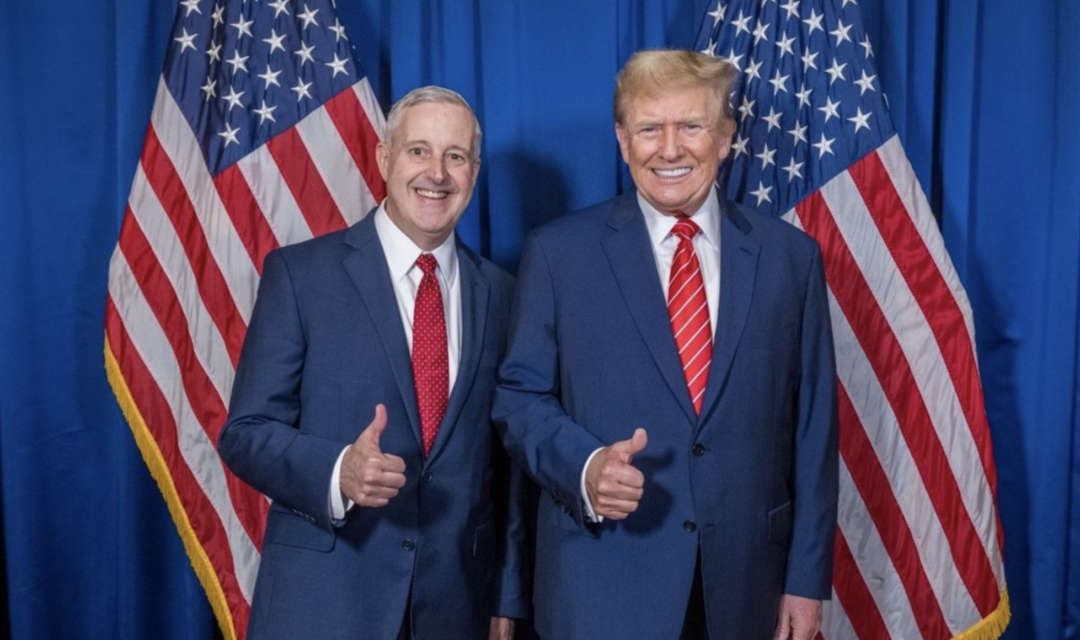
The first item on Whatley’s campaign website under “Michael’s Plan for North Carolina” remains “Enact the Trump Agenda in the U.S. Senate.” Whatley states, “I am committed to advancing President Trump’s America First agenda” as North Carolina’s next senator.
His website also describes him prominently as Trump’s endorsed candidate and says he is “100% supportive of President Trump securing the border and deporting the millions of criminal illegal aliens that Joe Biden and Roy Cooper allowed into this country.”
When Trump came to Gastonia to campaign for Whatley in September, Whatley similarly promoted the relationship, writing, “President Trump needs an ally in the Senate and North Carolina needs a fighter.”
Whatley previously said that as senator he would be an ally for Trump in Washington.
That strategy may still help Whatley turn out Republican voters in a state Trump carried in 2016, 2020 and 2024.
But, so far, the strategy hasn’t closed the gap with Cooper.
Whatley’s campaign insists the race isn’t over. After news broke that the Senate Leadership Fund was pulling back, campaign spokesman DJ Griffin said the campaign remained confident it had the resources to make its case against Cooper and win in November.
North Carolina also has a long history of statewide races tightening considerably in the final weeks.
However, the symbolism of the money shift is hard to miss.
Republicans started the election cycle expecting North Carolina to be one of the marquee Senate battles in the country and pledged tens of millions of dollars to keep the seat currently held by retiring Republican Sen. Thom Tillis