

There’s an old joke that goes like this: A doctor visits a patient in the hospital room and says, “I have some good news and some bad news – which do you want first?”
And the patient responds, “I guess I’ll hear the bad news first?”
The doctor then says, “Well, your test results are in; you have an incurable disease, and you’ll be dead within a week. And there’s absolutely nothing we can do about it.”
The stunned patient takes in what he’s heard and says, “Oh my God, what could possibly be the good news?”
The doctor points to a nurse standing out in the hallway and says, “You see that fantastically beautiful nurse out there?”
“Yeah,” the patient responds.
“Well, I’m having sex with her.”
At the Guilford County Board of Commissioners meeting on Thursday, May 7, Guilford County Manager Victor Isler had some very bad news for county taxpayers, but he also offered some good news that’s about as good as the “good” news the hospital patient received.
Isler’s “good” news for those listening to his presentation was that his proposal calls for the county to lower the tax rate to the lowest level since 2006.
The bad news, however, is that that doesn’t matter one bit when it comes to the size of your tax bill: If the Guilford County Board of Commissioners adopts a budget anything like the one the manager is recommending, property owners are going to see a big spike in their property tax bills at a time when gas is creeping up toward $5 a gallon and food prices are sky high as well.
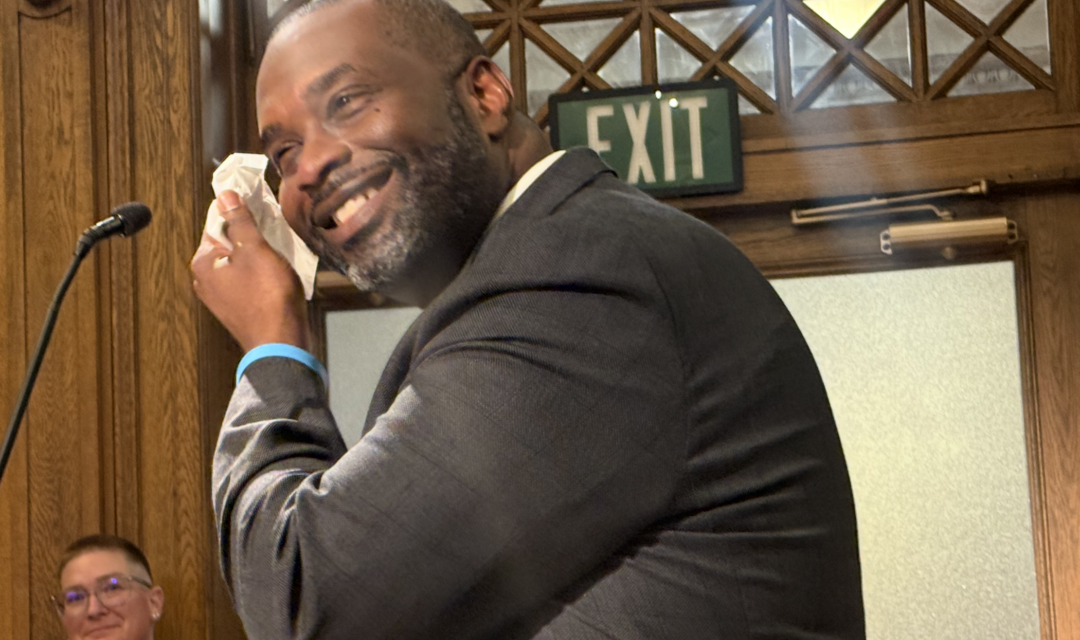
During the presentation, Isler was sweating heavily and, several times while speaking, he had to take a handkerchief and wipe his glistening forehead. When asked later if he was sweating because of the size of the tax increase, he said no, it was because of the hot lights just over the speaker’s podium.
And he did speak for about an hour and it is somewhat warm in that spot, but it must also be said that he was wiping sweat off his forehead before he even stood up to walk over to the podium.
So, the somewhat harsh reality of the financial challenges facing the county may very well have accounted for at least some of those drops on his forehead.
If this budget is adopted, Guilford County property owners will see a very significant tax increase despite county leaders highlighting the fact that the official property tax rate would go down.
If the commissioners made the rate revenue neutral (they won’t), the county would still receive about $12 million in new revenue that would have been the result of new growth in the tax base over the past year. But other than that, the overall amount coming in from taxpayers would have been the same.
If the commissioners kept the current rate where it is (thankfully, they won’t), the commissioners would have an additional $175 million from taxpayers due to higher property values.
Isler’s proposed budget essentially splits the baby by calling for the county to impose an additional $89 million charge on county property owners. That new $89 million would be available for the commissioners every year until the next revaluation.
The proposed fiscal 2026–2027 budget would lower the county’s tax rate from 73.05 cents to 61.9 cents per $100 of assessed value following the 2026 countywide property revaluation.
Although Guilford County officials have emphasized that the proposed county property tax rate would fall, many homeowners would still likely see substantially higher county tax bills because of large increases in their property values. Estimates discussed publicly during the revaluation process suggested that the average residential property value in Guilford County increased roughly 42.5 percent during the countywide reassessment. The medium increase was up 59 percent, but let’s say an owner was luck and only had that 42 percent increase.
That means a homeowner whose property was previously assessed at $300,000 could now see that same property valued at roughly $427,500. Under last year’s tax rate, that homeowner would have paid about $2,191 annually in county property taxes. Under the proposed new budget and tax rate, the county tax bill on a $427,500 home would rise to about $2,646 – an increase of roughly $455 a year.
The proposed rate is well above the county’s stated revenue-neutral rate of 53.26 cents. Revenue neutral is the rate that would bring in roughly the same amount of property tax revenue as the previous year after revaluation.
Under Isler’s proposal, the county would tax residents at a rate 8.64 cents above revenue neutral.
During his lengthy presentation Thursday night, Isler acknowledged that residents are worried about rising costs and the impact of the revaluation.
“The revaluation of property has created an understandable concern about future cost hardship and also economic resiliency,” Isler said during his speech.
Still, Isler argued that the county needed the added revenue to continue funding schools, public safety, social services and other county operations while also dealing with inflation, population growth and uncertain federal funding.
The proposed county budget totals approximately $1.1 billion – including a General Fund budget of about $935.5 million. The manager described the spending plan as a balancing act between public demands and county residents’ ability to pay.
“This recommended budget reflects a careful balance between what is required, what is demanded, and what is reasonable,” Isler stated Thursday. “It maintains essential services, honors our commitments, invests in the future, and recognizes the real pressures residents are facing from inflation and the rising cost of living.”
While county leaders repeatedly emphasized that the tax rate itself is decreasing, the more important number, of course, for homeowners, will be the actual dollar amount they pay.
The proposed rate is also notable because Guilford County commissioners have spent months publicly discussing the importance of minimizing the impact of revaluation on taxpayers.
County officials said that education is the biggest reason the proposed rate remains above revenue neutral.
According to the county, 5.53 cents of the 8.64 cents above revenue neutral is tied to education spending, including Guilford County Schools operating expenses and debt payments associated with the school bonds approved by voters in 2022.
The proposed budget would allocate about $307.5 million to Guilford County Schools for operations and capital needs – an 8 percent increase over the previous year.
The proposed increase for Guilford County Schools includes:
- $7.9 million for operating expenses and inflationary costs
- $9 million toward a phased pay plan for “classified” employees like cafeteria workers, janitors and bus drivers
- $1.8 million for school safety and security enhancements
- $5 million for a student technology initiative
- $1.3 million for capital expenses such as replacement activity buses
The county also plans to continue funding debt service related to the school bonds approved by voters.
During his remarks Thursday, Isler stressed repeatedly that the county needed to continue following through on its school capital plans.
“The county must get back on track with the school capital debt-service plan that was established in 2022,” Isler said.
At several points during his presentation, Isler tried to frame the large spending increases as unavoidable costs associated with growth, state mandates and previous commitments by commissioners.
“These are not abstract increases,” Isler said. “They are costs of sustaining our commitments, meeting our mandates and maintaining appropriate service providers.”
Isler also emphasized population growth and economic development as justification for increased county spending.
According to the county, Guilford County currently has more than 558,000 residents and is projected to add approximately 86,000 more over the next two decades.
The manager pointed to major economic development announcements and manufacturing projects as evidence that Guilford County must continue expanding its infrastructure and services.
The proposed budget includes funding for a wide variety of county initiatives and programs, including:
- Three new Environmental Health positions tied to development permitting and inspections
- $150,000 for small-area growth planning
- $238,014 for a new code compliance program focused on unsafe residential structures
- More than $558,000 to continue programs previously funded through federal ARPA money
- Additional social services positions related to Medicaid, foster care and guardianship cases
- $2.66 million for library support in Greensboro, High Point, Gibsonville and Jamestown
- $1 million for homeless outreach and emergency shelter efforts
- $860,000 for eviction mediation and landlord engagement programs
The proposed budget would also continue funding for a variety of county technology and operational upgrades.
Those include:
- $1.2 million for sheriff’s office body camera replacement
- $1.5 million for technology replacement planning
- $3 million annually toward a new enterprise resource planning software system
- Additional staffing in the County Attorney’s Office, Information Technology and other departments
The budget would add 28 new county positions overall.
County officials noted that the number of new positions is far smaller than the 97 positions added in the previous year’s budget.
Even so, Isler said that the county left many departmental requests unfunded.
According to Isler, about 50 requested positions and about $18.6 million in requested operating costs weren’t included in his recommended budget.
During the presentation, Isler repeatedly stressed “fiscal discipline” and the county’s strong financial condition.
Isler highlighted that Guilford County continues to maintain high credit ratings and said the proposed budget reduces the county’s use of fund balance from $17.8 million to $10 million.
Isler also repeatedly discussed the county’s desire to diversify revenues away from property taxes.
One major point of discussion during the presentation was the possibility of another one-quarter cent sales tax referendum. The Rhino Times has lost track of how many times the commissioners have tried to sell that sales tax hike to the voters, but the Rhino does know the voters always vote it down.
County officials said a one-cent sales tax could potentially generate approximately $28.7 million annually if approved by voters in November.
Isler argued that additional sales tax revenue could eventually help relieve pressure on property taxes.
“Revenue diversification” became a recurring phrase throughout the presentation.
The manager also warned commissioners about uncertainty coming from Raleigh and Washington.
County officials specifically mentioned Senate Bill 889, a proposed state measure related to property taxes and revaluation limits, as a possible threat to future county finances.
Isler expressed concern about changing federal funding formulas and reductions in reimbursement rates.
At one point, Isler said recent federal policy changes would create a $3.1 million deficit related to food and nutrition services funding.
He also warned that nonprofits across the region are struggling because of reduced federal and state funding.
“You heard from nonprofits across the region that they are experiencing an erosion in federal as well as state funding,” Isler said.
Throughout the presentation, Isler often returned to broader themes about “community conditions,” “fiscal responsibility,” “growth management” and “quality of life.”
The presentation lasted about an hour, with the manager moving repeatedly between budget numbers, broad philosophical themes and long discussions about regional growth patterns and county strategy.
Still, the main takeaway for many residents will likely be straightforward: even with a lower official tax rate, the county is proposing a budget that would collect substantially more property tax revenue than a revenue-neutral budget would.
The county manager’s proposed budget is only a recommendation.
County commissioners can and will make changes before adoption.
Residents will have an opportunity to comment during a public hearing scheduled for Thursday, June 4.
Commissioners are currently expected to consider adopting the budget at their Thursday, June 18 meeting.
The new fiscal year begins July 1 and runs through June 30 of next year.




Free and Honest Taxpaying Citizens of Guilford County,
To Skip the Omnipotent and his puppets that sit as the Board of County Commissars,
“When in the Course of human events, it becomes necessary for one people to dissolve the political bands which have connected them with another, and to assume among the powers of the earth, the separate and equal station to which the Laws of Nature and of Nature’s God entitle them, a decent respect to the opinions of mankind requires that they should declare the causes which impel them to the separation.”
“We hold these truths to be self-evident, that all men are created equal, that they are endowed by their Creator with certain unalienable Rights, that among these are Life, Liberty and the pursuit of Happiness.–That to secure these rights, Governments are instituted among Men, deriving their just powers from the consent of the governed, –That whenever any Form of Government becomes destructive of these ends, it is the Right of the People to alter or to abolish it, and to institute new Government, laying its foundation on such principles and organizing its powers in such form, as to them shall seem most likely to effect their Safety and Happiness.”
“He has erected a multitude of New Offices, and sent hither swarms of Officers to harrass our people, and eat out their substance.”
“For imposing Taxes on us without our Consent:”
“In every stage of these Oppressions We have Petitioned for Redress in the most humble terms: Our repeated Petitions have been answered only by repeated injury. A Prince, whose character is thus marked by every act which may define a Tyrant, is unfit to be the ruler of a free people.”
“And he did speak for about an hour and it is somewhat warm in that spot, but it must also be said that he was wiping sweat off his forehead before he even stood up to walk over to the podium.”
What could possibly have caused such a reaction. Maybe something like this…
“The budget would add 28 new county positions overall.” Oh but that’s smaller then the 97 that were created last year. That’s so good of the High Commissars to do for us.
“According to Isler, about 50 requested positions and about $18.6 million in requested operating costs weren’t included in his recommended budget.” Oh thank you High Masters and Mistresses for looking out for we, your cash cows.
“Isler also repeatedly discussed the county’s desire to diversify revenues away from property taxes.”
Undoubtedly at the orders of his boss, Skip the Omnipotent
“He also warned that nonprofits across the region are struggling because of reduced federal and state funding.”
Well, if our Rulers weren’t taking so much of our money and giving it to the NPOs of their choice (I call it veiled vote buying), maybe we would have money to give to NPOs WE want to support.
““Revenue diversification” became a recurring phrase throughout the presentation.”
This, folks, should really be burning your biscuits. “Revenue diversification” is Skip the Omnipotent and his marionette Commissars way of saying “We know best how to spend YOUR money, so shut up, sit down, and pay up.”
Does anyone else find it ironic that the year of our 250th birthday day we are again under the thumb of a Royal Ruler?
REMEMBER DECEMBER 16TH, 1773!!!
Couldn’t agree more sir!
————-
Pure Public Sector greed.
” The manager described the spending plan as a balancing act between public demands and county residents’ ability to pay.” What public demands? Did the public demand hiring more employees? Did the public demand more money for failing schools especially considering that most payers of property taxes do not have children in public schools including businesses? What about funding for “inflationary costs?” A line item that is purposedly vague. Notice the expenses that are going to support small groups who do not directly pay property taxes: Almost a million dollars for eviction mediation and landlord engagement programs; $1 million for homeless outreach and emergency shelter efforts. $5 million for a student technology initiative, what does this mean? Sounds like a bait and switch.
Cut whatever in the budget that will bring spending down to the level of the last budget rather than raising taxes to pay for more spending.
I do not want to pay $250,000 to the Woolworth Museum, which was hidden somewhere in the budget.
Government is not to be trusted whether it be county, municipal, state, or federal. They all operate off your money. They produce nothing. End property taxes and force the state of NC to find another way to fund county government. I am tired of paying for deadbeats who do not pay property taxes.
Totally agree!
From your lips to God’s ears
Scott, speaking about county budgets and spending. If the sheriff wants to buy new vehicles who has to approve the purchase
The county commissioners must approve.
Thanks Scott. I’m curious as to why the commissioners approved $150k for a new fully loaded SUV for our sheriff, then it was taken and tricked out with a set of new oversized tires and rims. I’m pretty sure not many people have seen it yet as it’s being kept under wraps but it’s out there. Just how many patrol vehicles could have been put into service for what our “above everyone else “ is being driven around in. Taxpayers deserve to hear about this and should be totally outraged with skip and the sheriff. Do a little investigator reporting Scott and see what turns up.
Thanks
Egads!! A whopper of a tax bill for me… I cannot believe this news…Holy cow!!! Anyone want to buy a house??
i was disinvited from the holy cows & now find camaraderie with the holy mackerel
The moratorium State Bill pending cannot get approved quick enough!
Regardless, it has to be signed by the governor. What are the chances a democrat governor will sign such a bill?
As I understand it, that Bill would affect property values. It has nothing to do with tax rates. The fact that my home value is up really means I have a higher net worth on paper. Skip and the gang can choose to tax that value, whatever it is, at whatever rate they choose to get the money they want. We are in a progressive Democrat controlled county where tax and spend is part of the political DNA……they will get their money…….and they will continue to get elected.
Estimates are that almost 50% of the voters in Guilford County are renters and pay only vehicle taxes at the most, no property taxes. They have no skin in the game because they do not see that the rent increase they may get is not due to the tax increase…..it is because of “greedy landlord”. Until we find a way to make everyone feel the tax increase and understand what that increase means, this will never change.
Sadly, those of us who live in the county are subject to the whimsy of a County government that largely supports the Greensboro political machine. The overview of spending listed above looks like a leftist democrat wish list of goodies used to inflate a yearly budget. Lets see some justification, lets see some belt tightening and lets see some restraint. Like the voters have to do in their households.
“Well, I’m having sex with her.”
As a Guilford county resident we have something in common with the nurse EXCEPT we are not at least getting a ki$$.
Select your own version of bulls&*t. Mine is $2.66 million for Library Support. Money to cull out books that they don’t want us to read, and select what they do want us to read.
I’ve been using the Library for many, many years. With the info on the internet, you can find books that may be valuable. I have found that many such books like this have “got gone”. Inside job, or books that were never returned. Over the years, the Library has culled numerous books that were “taking up too much space”. What is a Library for? See who is running it. Ask polite questions at the counter, you get the minority-shuffle.
our culture is trying to go paperless & add the ability to manipulate (files etc) with i-device in hand rather than paper. the ‘library’ is in the ‘cloud’ & brick/mortar libraries/librarians r no longer necessary . HUGE COST TIME EFFICIENCY gains NO TRAVEL. everything u’v ever read stored with your notes in your hand – massive storage & automatic curation u design – trees prosper – birds sing – we will curse it when we drop it in the tub/toilet sans $$ & ‘recovery ha’ process
It used to be the very BLUE city of Greensboro would hike the taxes, while the more Conservative County would lower them making things come out about even. That is, until Skip Alston joined the Commissioners and came up with all sorts of failed ideas which needed taxpayer money. So what is it this time, Skip? Need to pay for a proposed city retreat in the mountains or on the coast? Whatever the reason, the voters of this county should say enough is enough, both now and at the next elections.
i want most citizens voluntarily doing some necessary public service to < the cost of guvmnt – & get a tax break – & get an actual job done JUST RIGHT the 'of' by & for the people method
Will this budget be passed and then we get to vent about it in a meeting? They were crying we would be without ambulance service if budget is not increased and property tax not increased. They try scare tactics to get more money for extravagant budget and then use the money where they want. I would like to retire at some point . Looking like I’ll be homeless by then.
Not happy living in Greensboro
OK, I’m confused. Here’s my numbers…
My prior tax bill from 2025 shows assessed value was $221,500,
So, to get $100 of assessed value I do…
$221,500 /100= $2,215.
$2,215 X 0..7305 = $1,618.06
So I was taxed at = $1,618.06 by Guilford county in 2025.
This year my assessed value is $317,100,
$100 of that assessed value is $317,100/100= $3,171
I multiply $3,171 X 0.619 cents = $1,962.84
So I will be taxed at $1,962.85 by Guilford county in 2026.
That means my taxes increase by $1,962.8 – $1,618.06 = $344.79
If that is right, it’s not great, but it’s less than the $477.02 increase in 2022.
In my case, I have High Point taxing me at a couple hundred bucks less than Guiford county, every year.
In 2021, my total tax by the county and town was $2,152.44
In 2022 my total tax by the county and town was $2,970.89
That was a total increase of $818.45, which I consider an insane jump in taxes.
I wonder if there’s some resource available to see what the town of High Point tax adjustment will be this year?…
Don’t forget your higher insurance policy!
don’t forget the ability to borrow more because of > collateral value or ‘more road to kick can down’
What about the quality of my wallet. This guy is a whack job from hell.
No one seems to address or talk about the pension burdens in the budget. How many school employees, county employees, and government officials are we funding at 100% of the average of the last four years of their salary after 25. And this number grows every year. We pay for it. Not one of us gets anything from the county to help support us in our later years. I have repeatedly told people around here that there will soon be more of them than us. And what do you do then? Chicago is about to declare bankruptcy. Pay attention. It will be the only hope we have to get out of this mess. Unless you want Guilford County to become an “own nothing and be happy” part of this country.
—————-
Socialism inevitably results in more economic parasites than economic producers, which is why it results in poverty, squalor, and despair – for those in the Productive Sector.
Those in The Parasitic Sector live like Lords – because that’s what they are. No different to medieval Lords & Masters who demanded their tribute from the impoverished serfs.
We’re the serfs. Our “public servants” are really our Lords & Masters.
Are you claiming that Greensboro is a socialist government? Weird, not sure how such a mid-sized city can form a socialist government within the largest capitalist economy in the world.
Oh, socialism is just your trigger word to rile up fear and hate. Got it.
——————-
No.
So the balance of your comment is based on a false premise – like a lot of your arguments.
Garbage In – Garbage Out
Oh it was another rant against a system of socialism that doesn’t exist in the United States. Got it.
i said that ONE TIME to my mother
Three years ago because of an increase in our taxes, the county got an extra $80 million now they need another $80 million??? And be grateful that’s all we’re telling you we want? The $3 million in food stamps that they claim as a reduction is merely a caveat that you have to actually qualify if you’re 18 to 62 and able-bodied, in other words, they probably shouldn’t be receiving the benefits to begin with. the county could attempt to reduce it spending the number of nonprofits and NGO’s that we now have is staggering compared to just 20 years ago. Perhaps we should just buy skip a printing press.
I do agree that A Democratic governor from the tax and spend party probably will not sign a moratorium bill. The party of everyone must pay their fair share…. As if we haven’t already that would be very doubtful.
Laughing and sweating at the same time. Must be a certified liar. Don’t blame it on the lights. Sweating is just a natural reaction when you know you are screwing over the citizens. You’ll soon get good enough and you won’t sweat. Look around the dias.
Is there leaf pickup in there somewhere?
It’s going for giveaways.
“Well, I’m having sex with her.”
At least the nurse got a kiss out of the deal.
Thanks, Scott, for sharing the framework and formula of how our county property taxes will look come August 2026! What is not being shared is that this affects not only our property taxes but also the Fire Dept. tax, and if you have a business and pay a percentage of the property, that will also increase.
We checked with our county commissioner; she was not sure about the other taxes, and if those rates would stay the same, which for Fire is 16.0, and for business, it depends on how much square footage you claim. But she advised that this was for our benefit, that we just didn’t understand the urgent need, and that it wasn’t going to be all that much.
She also shared that we could appeal the new appraisal, but failed to mention that for the department to even consider it, we would have to have our own appraisal done, and that the fact that many leasing companies are buying up the homes in our area, which is why the market is inflated, cannot be considered. Consequently, most appeals are denied. We now have 3 leased homes right across the street from us, which are already not being kept up, which we feel devalues our home, but it is not a factor that is being discussed or considered in the appeal process.
Using the formula in this article, our property taxes will be increasing 51%, including the Fire and Business amounts.
2025 2026 Increase % Increase
$1475 $2236 $761 51.59
Another factor is that we own our 38-year-old home, and budget monthly for the taxes so that we pay them when we receive the bill. But since this was not announced until now, what the amount could be, we also have to come up with an extra amount over what we have budgeted so far to be able to pay in full when we receive the bill. For some, living on fixed incomes, this would be impossible for them.
We are blessed to be able to absorb these amounts, as we are still working, but many of our neighbors will have a decision to make, which could result in even more leased homes coming into our subdivision. I guess home ownership will one day be a thing of the past, just as it is in cars for some residents.
There are many issues in this overall increase that need to be addressed before a complete decision is reached, but will they be?
I hope everyone reads this article and takes the time to see how their own situation could look, and shares this article so others can see it too!