
The giant controversy over data centers seems to have popped up out of nowhere in the last few months, but it has landed in Guilford County government’s lap in a big way, and the Guilford County commissioners are now spending a whole lot of time on the issue.
Some members of the Guilford County Board of Commissioners were serving on the board more than a decade ago when Project Haystack – a proposed massive data center park in eastern Guilford County – caused an uproar among nearby residents. After years of discussion, that Haystack eventually got blown away.
Now, in 2026, the Guilford County commissioners are moving toward a possible temporary moratorium on new data centers while county officials decide how the increasingly massive and power-hungry facilities should be regulated.
The Board of Commissioners voted unanimously on Thursday, Sept. 17, to schedule an Oct. 15 legislative public hearing on a proposed moratorium of up to 180 days on potential data center projects in Guilford County.
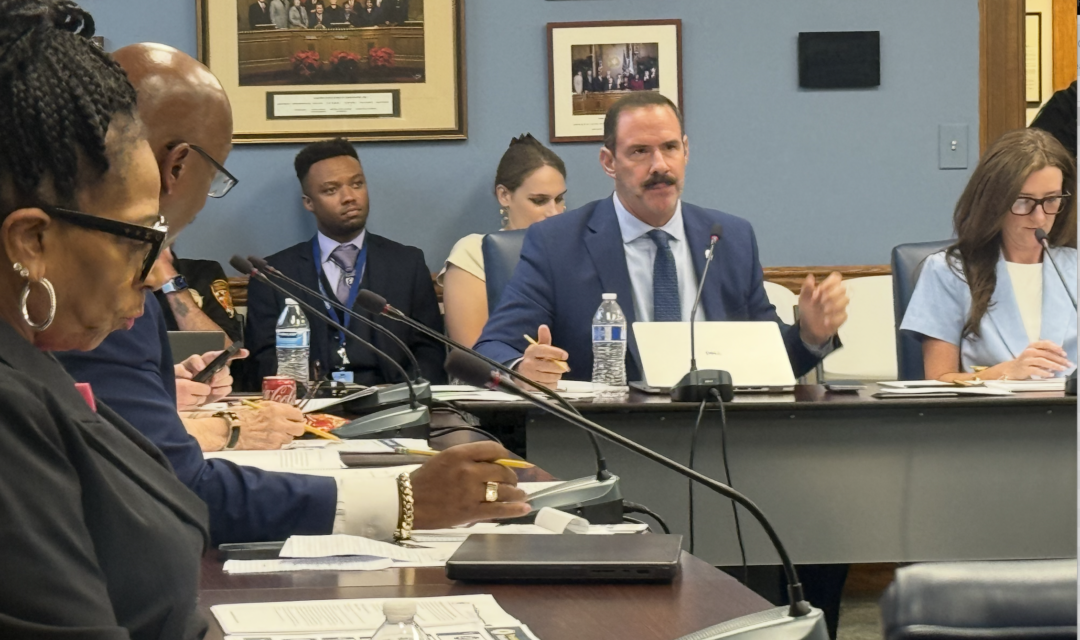
The vote came in an afternoon work session in the Carolyn Coleman Conference Room at the Old Guilford County Court House, where commissioners heard presentations from county staff and spent considerable time discussing both the potential benefits and the potential problems associated with data centers.
The idea behind a moratorium is to give county planners time to write regulations specifically addressing data centers while Guilford County currently has no application for a major new facility pending.
And, at the moment, the county apparently has some breathing room.
Guilford County Planning Director Leslie Bell told the commissioners that the county has no pending building permit applications or other requests for a new data center in the unincorporated areas of Guilford County.
What the county does have is a zoning ordinance that doesn’t specifically define a data center.
Bell said the existing ordinance would likely treat one as a light industrial use or possibly as a warehouse-type use. But simply leaving data centers out of the ordinance isn’t necessarily enough to prohibit them, since courts have generally favored the free use of land rather than blanket prohibitions on uses that aren’t specifically listed.
That leaves Guilford County in essentially the same position as a growing number of local governments across North Carolina – trying to catch its zoning rules up with an industry that’s changing quickly.
Bell told the commissioners that at least 18 North Carolina cities or towns have adopted data center moratoriums lasting more than six months. He said a number of counties have also enacted moratoriums – some lasting a year or longer.
County staff spent much of Thursday’s work session explaining that “data center” can mean very different things.
Guilford County Economic Development Director Heather Schaeffer told the board that the category ranges from relatively small “edge” data centers to cloud centers and enormous hyperscale facilities with dramatically different requirements for land, electricity and water.
Schaeffer said that Guilford County already has a major data center – the American Express facility – which she said is about 510,000 square feet and falls somewhere between a regional cloud center and a hyperscale data center.
Commissioner Alan Perdue said that distinction should matter when the county writes its rules.
“One fallacy of this debate is one size fits all,” Perdue said.
Perdue noted that residents depend on data centers constantly, whether they think about it or not, including when using cell phones and even when calling 911.
He suggested that Guilford County might eventually establish different standards based on a facility’s size and electricity demand rather than forcing everything from a small data center to a 100-megawatt hyperscale facility through the same process.
That issue may become one of the central questions as county planners develop proposed regulations.
Schaeffer told the commissioners that data centers can provide substantial financial benefits to local governments. They generally involve extremely high taxable investments, particularly business personal property, while placing relatively little demand on many county services.
That can translate into significant recurring property tax revenue.
The trade-off is that data centers aren’t typically major permanent job creators.
Schaeffer said they create considerably more employment during construction than they do once they’re operating.
She also laid out the other side of the equation – potentially enormous electricity demand, water requirements, noise, heat, air quality concerns, compatibility with nearby residential development and the amount of land consumed by the largest facilities.
Another issue is what happens decades from now if changing technology leaves behind enormous, highly specialized buildings.
County planners are therefore considering not only how data centers should be approved, but also whether operators should face decommissioning requirements and provide some form of financial guarantee to deal with abandoned facilities.
Commissioner Pat Tillman said the county shouldn’t ignore those concerns, but he cautioned against automatically treating data centers as undesirable.
“I think we’re doing it the right way,” Tillman said. “I think taking our time, not rushing, but understanding our leverage and the questions we ask.”
Tillman said that local governments can impose conditions intended to protect residents and ratepayers rather than simply rejecting data centers outright.
He also pointed to the debate over water consumption, noting that other major industrial users consume large quantities of water without provoking the same reaction.
“It’s interesting – data centers are getting, in some ways, a bad rap,” Tillman said. “And I’m not pro or against. I’m just stating the facts.”
Tillman also argued that the issue extends beyond local tax revenue and land use.
He said the rapid development of artificial intelligence and quantum computing has national-security implications and added that the computing infrastructure behind those technologies matters far beyond Guilford County.
“I think the moratorium is the wise move,” Tillman said, but he added that commissioners should understand that “the implications are far reaching.”
Commissioner Carly Cooke said she supported using a temporary moratorium to give the county time to deliberately develop its rules.
“I really like the idea of, for a data center, we can just pause for a set period of time to be very intentional about our rights and policies and ordinances,” Cooke said, adding that the county should do everything it can to protect residents from negative impacts.
Bell said county staff could use a moratorium period to define data centers in the ordinance, determine the zoning districts where they should be allowed and establish an approval process.
Potential standards could cover setbacks, generator screening, vegetative buffers, building height and design, noise, lighting and decommissioning.
One possible approach would be to require conditional zoning, giving the county the ability to consider a proposed site individually and impose conditions agreed to by the property owner.
Another possibility would be a special use permit process, in which an applicant would have to demonstrate that a project meets specific standards and is compatible with surrounding uses.
Bell laid out a rough timetable of about 60 days to develop ordinance language, another 60 days for Planning Board consideration and roughly 45 days for the proposal to work its way through the Board of Commissioners process – a timetable that would fit within the proposed 180-day moratorium.
North Carolina law allows local governments to impose temporary development moratoriums, but they can’t simply declare one without explanation.
Bell said an ordinance would have to identify the conditions that make the moratorium necessary, alternatives the county considered, the types of development approvals affected, the reason for the duration and the steps the county intends to take while the moratorium is in effect.
Guilford County isn’t having the discussion in a vacuum: The North Carolina General Assembly has spent much of the 2025-2026 session debating how the state should handle the rapid expansion of data centers.
The most significant change actually enacted this year repealed the sales and use tax exemption for electricity consumed by qualifying data centers, although the state retained tax exemptions for qualifying data center equipment. The change became effective July 7.
Other proposals remain pending.
Senate Bill 730, the Ratepayer Protection Act, includes requirements dealing with some of the same concerns being discussed in Guilford County. The bill would require certain large data centers to enter service arrangements intended to recover the incremental cost of serving them and reduce the risk that those costs would fall on other electric customers.
It also contains provisions dealing with sound and site assessments, water use, cooling systems and local zoning authority. The bill passed the House in June and was returned to the Senate but hasn’t been enacted.
House Bill 1189, the Datacenter Transparency Act, would go much further by establishing a two-year statewide moratorium on permits and approvals for certain large data centers while the state studies their effects on the electric grid, utility rates, water, wastewater, air quality, noise and nearby property values.
That bill remains pending and has not been enacted.
House Bill 1180 would define a “large-load data center” as a facility with aggregate electric demand of more than 20 megawatts and would require utilities to seek approval for a dedicated tariff designed to assign capital and incremental operating costs to those customers.
That bill remains in the House Rules Committee.
For Guilford County, however, the immediate question is much more local – whether commissioners want to pause new data center approvals while those rules are being written.
Board of Commissioners Chairman Skip Alston said at the afternoon meeting thatg he had attended a recent Greensboro City Council work session on data centers and had learned a great deal from that discussion.
Alston then made the motion directing staff to schedule the Oct. 15 hearing so commissioners can consider an ordinance establishing a temporary moratorium of up to 180 days on potential data center projects.
The motion also authorized county staff to take the steps necessary to prepare the proposed ordinance in accordance with state law.