


The state’s property tax reappraisal moratorium might force Guilford County’s rural fire departments to delay hiring firefighters, postpone equipment purchases and rethink long-term plans that many departments have spent years developing.
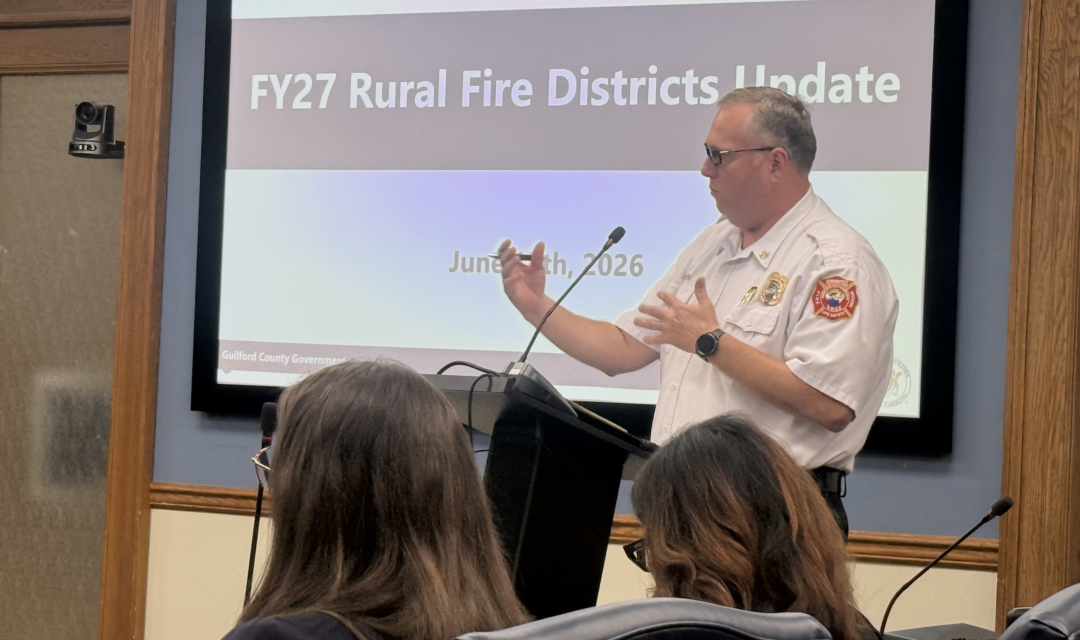
That message came through repeatedly during a Guilford County Board of Commissioners work session on Thursday, June 18, as county staff and fire chiefs outlined the potential impact of Senate Bill 889 on the county’s 23 rural fire districts.
County Budget Department staff told commissioners that rural fire districts originally requested a combined fiscal year 2026-2027 budget of about $42.9 million.
Since the county can’t use higher property values assessed for 2026 as a tax base, one “moratorium budget” under discussion, projected revenue for the Rural Fire District Fund would fall to about $35.5 million, roughly $7.4 million below what the districts requested.
County staff said the county contracts with 17 nonprofit fire departments and four municipal fire departments to provide fire protection in rural Guilford County and noted that county’s investment in rural fire protection has steadily increased over the past six years, with per-capita funding rising from $155 in the 2019-2020 budget to $275 in the current budget.
According to county staff, all rural fire districts reported higher projected operating costs for the coming fiscal year due to increases in insurance premiums, retirement contributions, workers compensation expenses, turnout gear costs and other supplies.
County staff outlined three suggested approaches for commissioners to consider: maintaining current tax rates under the old 2022 property values, adjusting tax rates to offset equalization losses and keep districts at current funding levels, or increasing tax rates enough to fund expansion requests submitted by the departments.
The main spokesperson for the fire departments was Summerfield Fire Chief Chris Johnson – though many chiefs were there to show support. Johnson said fire departments have spent years moving away from annual budget requests and toward long-range planning.
Johnson said fire departments must plan years ahead for apparatus purchases, station improvements, training and staffing. He noted that new fire trucks can take three to five years to arrive after being ordered and said departments have already made commitments based on previously approved funding plans.
Johnson said Summerfield signed a contract for a new fire truck and began work on a station renovation after last year’s budget decisions.
According to Johnson, personnel costs now exceed $4 million annually in Summerfield and account for between 70 percent and 85 percent of the budget in many departments.
He argued that a moratorium-based budget could force departments to raise tax rates higher than originally planned simply to maintain commitments that have already been made.
He also expressed concern about the delayed property tax bills. Because the county now expects tax bills to go out in mid-August rather than mid-July, fire departments could experience a temporary cash-flow problem during the first part of the fiscal year.
Johnson said that some departments may have reserves available to bridge the gap, but using those funds could reduce investment earnings or require departments to tap money originally set aside for capital projects.
Guilford County Manager Victor Isler said that the county would move some funds around to provide liquidity during that period if need be.
The fire chief repeatedly emphasized staffing concerns.
He said that volunteer participation continues to decline nationwide and that career firefighters are becoming increasingly important to maintaining service levels.
Johnson said that Summerfield, Oak Ridge and Stokesdale developed a joint operational plan designed to reduce duplication and improve service. Under that plan, he said, the three departments expected to add personnel; however, the moratorium could eliminate nine planned positions across the three districts.
Johnson argued that inadequate staffing affects both firefighter safety and emergency response times.
“When staffing levels are inadequate, response times increase,” Johnson told the board. “When response times increase, property loss increases and the risk to our citizens rises.”
Guilford County Emergency Services Director Jim Albright echoed those concerns.
Albright explained that because fire departments operate around the clock, adding three positions doesn’t simply mean adding three employees.
He said it takes approximately nine employees to continuously staff a single fire apparatus and closer to 12 employees when vacation, training, illness and other absences are considered.
Albright also said Guilford County’s growth has increased pressure on rural departments.
He noted that county fire districts generally operate with stations serving much larger geographic areas than municipal departments, while residents still expect urban-level response times.
Commissioner Carly Cooke asked how fire departments gather public input on tax rates and service expectations.
Johnson responded that tax rate requests are ultimately made by local fire boards rather than fire chiefs. He said Summerfield surveyed residents before seeking a tax increase last year and found strong support for the proposal.
Several commissioners also questioned the long-term funding structure for rural fire protection.
Johnson said fire departments are exploring additional funding options, including possible state-level solutions and revenue opportunities connected to sales tax revenue if the Guilford County voters approve a sales tax hike in November.
Isler said the county would continue working with fire departments on capital planning and long-term funding issues as budget discussions move forward.
The commissioners are expected to adopt a budget on Thursday, June 25.
The discussion came as commissioners continue evaluating the broader financial impact of Senate Bill 889, which has forced Guilford County to reconsider major portions of its proposed fiscal year 2026-2027 budget.




Perhaps the commissioners should put a moratorium on some of the superfluous spending on unnecessary stuff. Also, what is the fire tax used for. I thought that was used for rural fire departments.
So you got cash flow problems! Welcome to our world. With the county clown commissioners and their so called budget, all citizens have a cash flow problem. Deal with it like we have too.
Hey genius, when the taxpayers become broke you want have any firetrucks.better have a bunch of garden hoses.
Budget cuts need to come out of the county and city’s frivolous spending.
Focus should be on the immediate, urgent needs of the general public – affordable housing, food, health care, education, social services, children, elderly, drug and crime prevention.
The above issues need to be solved before focusing on wants and growth. We survived, grew and thrived on much less technology, wants, and luxuries than we currently have.