North Carolina chose not to officially participate in President Donald Trump’s Great American State Fair in Washington, DC, but the state still ended up in the middle of one of the fair’s biggest controversies.
A privately organized North Carolina booth at the fair drew national attention after a video display in the exhibit showed a Confederate flag image. The image was removed after NC Gov. Josh Stein’s office issued a strongly worded statement condemning it.
“This flag does not represent the North Carolina that we love,” Stein’s office said. “America 250 is about unity and bringing our nation together. Glorifying this divisive confederate symbol does the exact opposite. We demand the organizers stop dishonoring the flag of North Carolina.”
One Facebook poster stated below a story about the controversy that he had no problem about the confederate flag being shown as long as they showed the rea one. His post was accompanied by an image of a flying white flag of surrender.
The Great American State Fair is part of the Trump-backed Freedom 250 celebration of the nation’s 250th birthday. The event, which opened on the National Mall in Washington, D.C., is scheduled to run from June 25 through July 10, with a major Independence Day celebration planned for July 4.
Trump also announced this week that he was moving the fireworks display in Washington from 9 p.m. to 11 p.m. and said he will give a speech beforehand. He posted on Truth Social that this July 4 celebration will be “the most spectacular TRUMP RALLY of them all, a ‘TRIBUTE TO AMERICA.’”
Freedom 250 bills the fair as a large national exposition featuring state and territory pavilions, business displays, music, carnival rides, military flyovers, cultural programming and a 110-foot Ferris wheel on the National Mall. The event is free and open to the public though many visitors have complained about the high prices at the concession stands.
A lemonade at the fair will set you back $9. Stuffed Pretzel Rolls vary from $12 to $25 and one serving of Turkey Legs will cost you $23.
The fair has drawn controversy even before the July 4 celebration. Every major musical act planned for the event pulled out when they realized it was turning from a national celebration into a partisan event. The only major act that didn’t pull out was Vanilla Ice. But his show was cancelled due to weather and, after that, he was never rescheduled to perform.
North Carolina was among the states that declined to send an official state delegation to the event. The North Carolina Department of Natural and Cultural Resources said the decision was based on budget and staffing limits. WUNC reported that state officials estimated it would cost more than $100,000 to set up a pavilion in DC.
Instead, the state said it would focus its resources on America 250 events in North Carolina, including a July 4 event at the State Capitol in Raleigh.
However, a North Carolina booth did appear at the fair after private sponsors stepped in: SPEVCO, Richard Childress Racing and Operation Helo were the primary sponsors of the North Carolina pavilion.
SPEVCO, a Winston-Salem company that builds custom exhibits, provided a custom trailer. Richard Childress Racing provided the No. 3 car and a racing simulator. Operation Helo, a Cornelius-based volunteer disaster relief group, provided a display and venue support.
The theme of the North Carolina pavilion was “The Spirit of North Carolina: First in Flight, Fast on the Track, Strong in the Storm.” The Carolina Journal reported that the booth was meant to feature the Wright brothers’ first flight, North Carolina’s racing heritage, Hurricane Helene response efforts, agriculture, workforce development, innovation and the state’s “First in Freedom” motto.
That carefully planned message was overshadowed when the Confederate flag image appeared in a video display.
The booth was operated by private sponsors and wasn’t organized by the State of North Carolina or connected to state officials.
Mt. Olive Pickles, one of the North Carolina companies associated with the pavilion, withdrew from the event after the controversy. The company said it was unaware the image was included in the display.
That flap was one more problem for an event that’s already been criticized as being too political, too Trump-focused and, lightly attended.
The first days of the fair have drawn sparse crowds, though organizers hope that the July 4 holiday weekend will bring bigger ones. Several states declined to send official delegations, with some citing cost and concerns that the event had taken on a partisan tone.
The fair is being run by Freedom 250, a public-private partnership created by the White House to coordinate 250th anniversary celebrations along with federal agencies. That has caused confusion with America250, the bipartisan national semiquincentennial effort created by Congress in 2016.
The Washington Post reported earlier this year that America250 and Freedom 250 were both involved in the 250th anniversary celebration, with America250 operating as the congressionally authorized bipartisan effort and Freedom 250 emerging as the Trump-backed organization tied to high-profile events in Washington.
The Post also reported that the two groups were set to share in $150 million appropriated by Congress and managed by the Interior Department.
The cost and funding of the celebration have become part of the controversy. Public Citizen and the Revolving Door Project, two watchdog groups often critical of the Trump administration, released a report this month saying that nearly $103 million in federal contracts and grants for 250th anniversary celebrations had gone to what the groups described as a politicized network of entities. The report said that, of $126 million in grants awarded to celebrate the 250th anniversary, more than 80 percent had gone toward events and entities connected to the Trump-backed Freedom 250 effort.
Freedom 250 has defended the celebration as a national event meant to honor American history and bring people together.
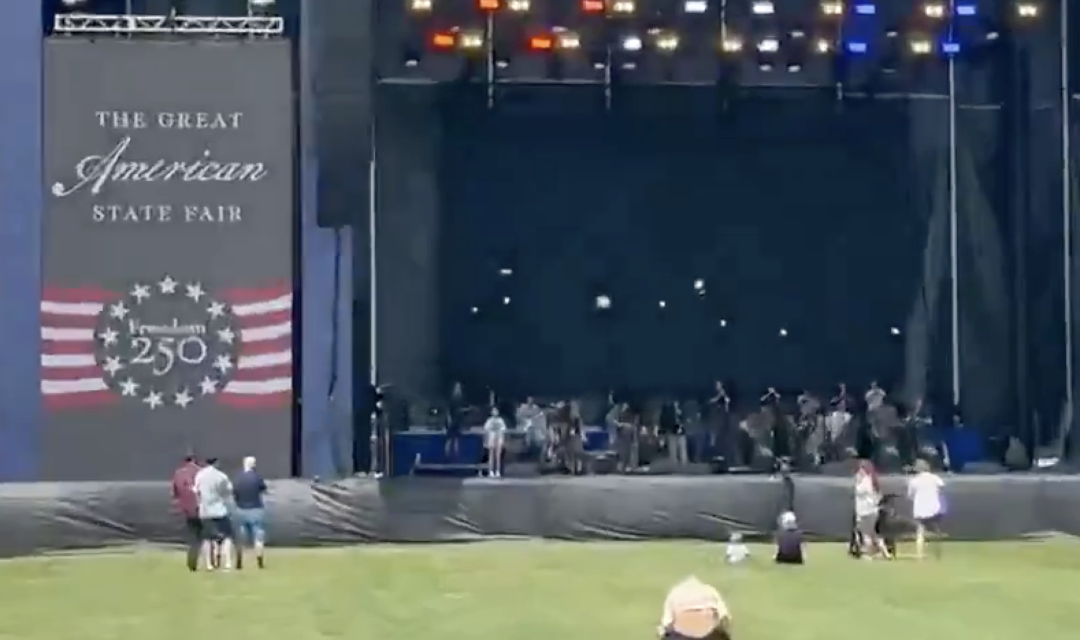
But online critics have been mocking it relentlessly. Photos and videos of sparse crowds, empty-looking spaces and lightly attended areas of the fair have circulated widely on social media. YouTube channels and political commentators have also posted videos ridiculing the turnout and comparing the upbeat claims about the fair with images showing large open areas and thin crowds. In one video, (see photo above) a large musical group was performing on stage and there were literally more people on stage than in the audience.
Snopes examined one widely circulated image showing sparse crowds at the fair and found that the image was real, though it noted that the photo was taken on opening day before crowds later picked up.
For North Carolina, the political irony is that the state tried to avoid spending public money on the Washington event and instead concentrate on its own America 250 celebration. However, once private sponsors created a North Carolina presence at the fair, the state still got pulled into the national story.
And, instead of the Wright brothers, NASCAR, Hurricane Helene relief or “First in Freedom,” the North Carolina booth became known for a Confederate flag image that the governor’s office said dishonored the state