


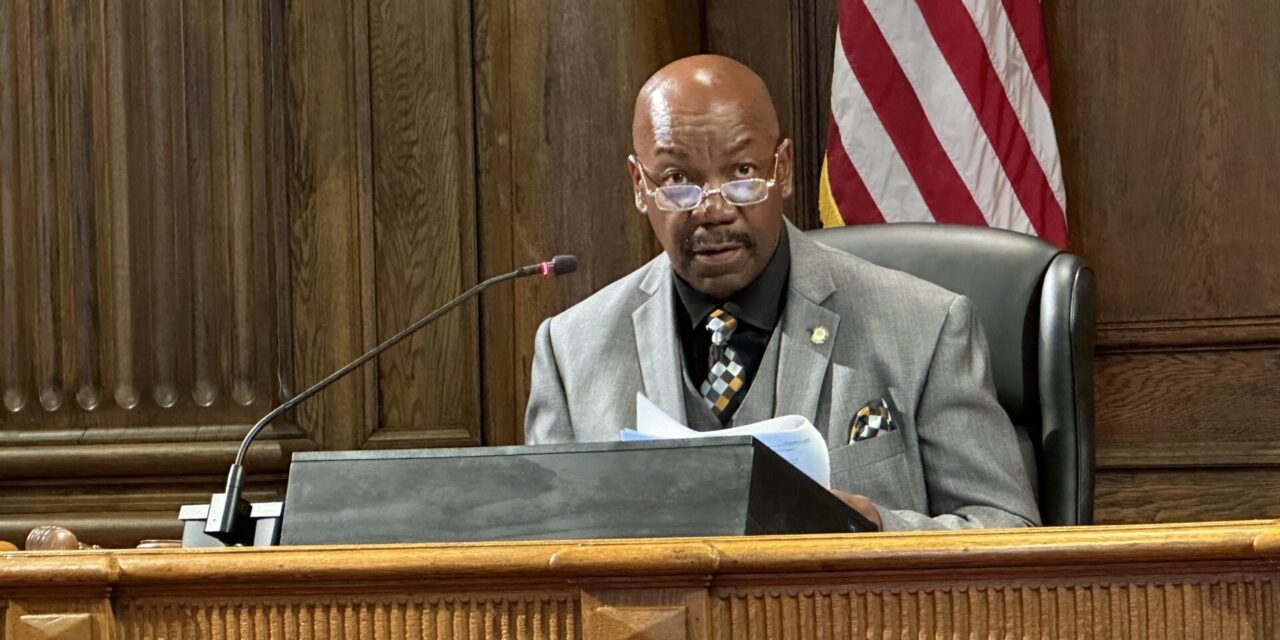
Chairman of the Guilford County Board of Commissioners Skip Alston said that the board deliberately resisted pressure from Guilford County Schools to approve a larger property tax increase this year, arguing that commissioners had promised taxpayers they wouldn’t raise taxes any more than necessary.
Alston made the comments in an interview with the Rhino Times after calling a Friday, June 26 press conference to respond to criticism from Guilford County Schools. The school system warned that the county’s budget could force teacher and staff layoffs and criticized the commissioners for approving raises for county employees while not providing enough local funding to support comparable raises for school employees.
Alston said that that criticism doesn’t tell the whole story.
“No one on this Board wants to see teachers lose their jobs,” Alston said during the press conference. “No one wants to see school employees worried about their future. No one wants to see our students receive anything less than the education they deserve.”
At the same time, he said, commissioners also have an obligation to taxpayers and to every county department that depends on county funding.
Guilford County Schools sought nearly $19 million in additional operating money this year. Commissioners approved the county manager’s recommendation, increasing local operating funding by about $5.6 million over last year, but they declined to provide the additional funding that school officials requested.
During the interview, Alston said commissioners intentionally held the property tax increase to 5.9 cents.
“We’d always said we didn’t want to put any more on the taxpayers than we had to,” Alston said. “We tightened our belt and the school system will have to tighten their belt. Just because you can raise taxes doesn’t mean you should raise taxes.”
Alston said the board never wanted to cross the 6-cent mark.
Many county residents did not want a tax increase at all, but that was never really an option with this board.
“I didn’t think it was appropriate for us to raise taxes more than that at this time,” he said. “I did not give in to the school system.”
According to Alston, school officials argued that commissioners approved raises for county employees while not providing enough money for school employees to receive comparable raises.
“They said we should’ve been looking out for their employees also,” Alston said.
His response was that county government has many responsibilities extending far beyond public education.
“This isn’t about choosing one group of employees over another,” Alston said during the press conference. “It’s about meeting our responsibilities to everyone we serve.”
He noted that county government must recruit and retain deputy sheriffs, detention officers, paramedics, nurses, social workers, behavioral health professionals and many other employees who provide services required by law.
Alston also argued that North Carolina places the primary responsibility for funding teacher salaries and school operations on the state, not counties.
“The state is also responsible for funding schools,” he said during the interview. “That’s the state’s obligation to give raises to the teachers, not the county.”
During the press conference, Alston emphasized that Guilford County increased, rather than reduced, its support for the school system.
The county approved $288.1 million for Guilford County Schools’ operating expenses, a 2 percent increase over last year. In addition, the county will provide $26.9 million to pay debt service on school construction bonds previously approved by voters.
That debt service has been and will continue to take a big chunk of the county’s taxpayer money because they are paying back about $3.3 billion when recent school bonds are included with interest. The final bill could be more than that depending on what interest rates do.
“County funding for Guilford County Schools was not cut,” Alston said. “County funding increased.”
He noted that approximately 43 percent of the county’s General Fund budget goes directly to education.
“Nearly half of every local tax dollar we spend goes to supporting our public schools,” Alston said. “That is a significant commitment by any measure.”
He noted that if the schools cut their budget by 1 percent, they would make up the remainder of their request.
He contrasted that commitment with the county’s obligations to fund dozens of other services, including the Sheriff’s Office, Emergency Medical Services, Public Health, Social Services, the courts, elections, libraries, parks, Veterans Services and other legally required programs.
“Those are not optional services,” Alston said. “They are mandated by law. We can’t simply stop providing them.”
Alston also pointed to the budget turmoil caused by Senate Bill 889, which prevented Guilford County from using its 2026 property revaluation for this year’s budget.
According to Alston, commissioners had expected to have substantially more revenue available before the legislation changed the county’s financial outlook.
“We would’ve given them more money this year,” Alston said during the interview. “But we couldn’t do that because of Senate Bill 889.”
Technically, they could have but it would have driven the tax rate nearly 2 cents higher.
He added that the county also lost millions of dollars in anticipated state and federal revenue during the final weeks of the budget process.
Alston revealed during the interview that the county commissioners and school leaders held a conference call meeting on Wednesday evening before the budget was adopted in a last attempt to resolve their differences.
According to Alston, school officials urged commissioners to approve a larger tax increase and warned that they would publicly criticize the county if commissioners declined.
“They said, ‘We’re probably going to be issuing a press release saying that you all are looking out for your employees and not looking out for ours,'” Alston recalled. “I said, ‘Well, you have to do what you have to do, but we’re not going to be raising taxes.'”
Despite the disagreement, Alston said he still considers county government and Guilford County Schools to be partners.
“We remain committed to working collaboratively with the Board of Education and the leadership of Guilford County Schools,” he said during the press conference. “We are partners. We should never become adversaries.”
Alston said he hopes a proposed quarter-cent local sales tax referendum expected to appear on the November ballot will eventually provide another recurring source of education funding without placing the entire burden on property owners and Guilford County residents.
He noted that most of the new revenue, if voters approve the tax, would go to public schools, with additional funding dedicated to Guilford Technical Community College and rural fire districts. That sales tax hike has been voted down many times since it was first offered as an option from the state in 2008, however, for this November the commissioners got the state to allow the exact wording on the ballot as to how the money will be used.
“It’s not all on the backs of the property taxpayers,” Alston said during the interview. “Forty percent of the sales taxes are paid by people outside Guilford County.”
For now, however, Alston said commissioners believe they made the right decision by holding the line on taxes despite intense pressure to do otherwise.
“We didn’t just cave in to the school system because they wanted more money,” Alston said. “We promised the taxpayers we weren’t going to take any more money than we needed, and we kept that promise.”




Alston is a multi-millionaire who got rich off of Greensboro and Guilford County citizens with his real estate company. Never forget that. He has been in power for decades.
The county budget under his dictatorship has gone from the $600 million range in 2020 to the $900 million range this coming year. He and his cronies have placed heavy property tax burdens on the backs of property owners such as aging grandmothers and renters who live paycheck to paycheck. He is Guilford County’s “Potter” that leads the Guilford Democrat Party to do what they do best….tax,tax,tax, and spend, spend, spend….all about power and money….wake up Democrats and Liberal UNA’s!!!! The Fox has been in the hen house all along feasting!!!
Unfortunately, his district must like his tax and spend policy. They keep electing him. That’s why he has been in power for all these years. His constituents are either ignorant, approve of his leadership, or pay little to no property taxes, or all of the above. How many college students in Skippy’s district own homes and pay property taxes? Their hovel is a dormitory room or rental space.
In 2022, the City of Greensboro and Guilford County provided significant public funding to the International Civil Rights Center and Museum to support its expansion and purchase of adjacent property.
The Greensboro City Council voted to provide $2 million from city ABC revenues for the museum’s expansion efforts. Guilford County Commissioners approved $1 million plus an additional $200,000 (later reauthorized as part of a five-year commitment) to help pay down the mortgage for the newly purchased former First Citizens Bank building. This combined public investment supported the museum’s goal of acquiring the entire downtown block to facilitate its bid for UNESCO World Heritage Site status.
Skip Alston and community organizer, Deena Hayes-Greene (Skippy’s buddy) are co-chairmen of the museum. Sit In Movement is listed as IRS subsection 501(c)(3) Public Charity. Really? The museum donors are few in number but donate impressively. One donor is Moses Cone Hospital. Moses Cone is listed as a charity. They must be charging too much for their services.
Guilford County continues to give taxpayer money to Skip’s museum. It is hidden in the budget.
Chief Commissar Alston,
“I should commend you for at least trying to cover the 4th point of contact of your followers…Should, but won’t.”
Uh-huh
“Alston revealed during the interview that the county commissioners and school leaders held a conference call meeting on Wednesday evening before the budget was adopted in a last attempt to resolve their differences.
According to Alston, school officials urged commissioners to approve a larger tax increase and warned that they would publicly criticize the county if commissioners declined.”
IMO this sounds like a little collusion. They stand to lose some of their cumshaw.
“We didn’t just cave in to the school system because they wanted more money,” Alston said. “We promised the taxpayers we weren’t going to take any more money than we needed, and we kept that promise.”
Again IMO that sounds a blatant CYA.
“We promised the taxpayers we weren’t going to take any more money than we needed, and we kept that promise.”
Don’t you mean you were FORCED to keep a promise never made?
.
Ah, the public schools would suck every single buck out of your pocket if they could.
Have you seen what the “underpaid educators” are getting paid these days? And the vehicles they’re driving? For working only 9 months a year!
But…. “It’s for the children”.
Yeah, right.
the quality education of my own children ‘would suck every single buck out of MY pocket’. because IT IS THAT IMPORTANT
—————
Yes Markl, quality education is vitally important, not only to individual families but to the nation as a whole. We agree on this. But what the Government Schools provide is rubbish education. I was shocked when I arrived at UNC-G to see how ignorant and uneducated the other students were.They struggled with work I had done as a 14 year old. I was lucky to be educated in a British private institution that had existed since 1552 and which would not tolerate mediocrity. And the standards were even higher for the “A Stream” boys like me.
Their pathetic ignorance was NOT the fault of the kids. They’d been cheated by a crap government monopoly that existed for the benefit of the people who worked in the system, not for the children. The kids were just the victims of a system that produced youngsters who always score about 25th – 30th in Global testing, well below many Third World countries.
I really want our nation’s children to receive a good education. I just became a grandfather. I hope my grandson is home schooled, or that my son and his wife take advantage of School Choice Vouchers.
Because,,, GOVERNMENT SCHOOLS ARE CRAP.
Fact.
not all of them, hopefully not most of them. let’s entice teachers to leave the public schooling morass & become EDU entrepreneur capitalists with vouchers FOR THEM ?
i am willing & able to pay > sales tax if it isn’t on food or ‘services’. COG back on my street again third visit to same leaking pipe in 15 years. i’m not worried because austin morris is standing with them now checkbook/wallet open. let’s tax the MEL out of motor vehicles because they are so destructive & all the infrastructure >$ : Pay 2 ‘Play’ the ‘projectile’ game ?
Markel Please don’t ever cross the street in front of me My car has really bad brakes
. . . & u r @ the ‘wheel’
Of course. I don’t own a self driving vehicle
————-
Now, now, Markl, try to control yourself.
Just because you bike & walk everywhere doesn’t mean that everyone else can, or wants to. We enjoy the flexibility, freedom and flexibility of the private automobile, so try to hide your spite, envy, “hate”, resentment, Luddite leanings, or whatever it is exactly that you suffer from.
By the way, if you have to move anything bigger than yourself, do you use a horse & cart?
Enjoy your 18th Century existence.
Are you saying cars caused the leaking pipe? How? Truly interested in this phenomenon.
i’m saying public utilities/services require taxation & if u dislike taxes, stay out in the sticks with austin’s tax free ‘horse & cart’.
I dislike taxes and if anyone values freedom, they should too. Requiring taxes to operate utilities may be necessary but the “services” provided by government are not necessarily necessary. The coliseum, the Tanger Center, and many more “services” are not necessary.
those guvmnt formed/involved ‘services’ draw people into our city where they hopefully drop coin on businesses & return for more. we have ‘cheerleaders’ public & private who MAKE THAT HAPPEN – do u tithe ? do you support that ‘tax’ ?
taxes are rational u aren’t it’s all about how much & what’s done with it
—————
So another guy’s fixated with me.
Should I be flattered?
Austin I guess you just have that special “allure” about you
Congratulations on your achievement !!
Austin,
I’m jealous
LOLOLOL
————–
Thanks lads. Maybe I do have a certain allure. I’m not much to look at, especially these days, but back in the day I was reasonably attractive and could always draw a crowd, for some reason.
That was then. This is now.
I’m now a sexagenarian – which is not as sexy as it sounds. Really….
I pulled a wife who was a 9. Thank you Jesus! Actually, my friend from Mumbai always said she was a 10. She’s still a looker, actually.
We’ve been married for 40 years. And she hasn’t shot me yet.
Yet….
And there are plenty of guns in the house.
It’s a bloody miracle! Am I a lucky lad, or what?
Every morning I make myself proclaim the blessings I have received, and I make sure that I am grateful for them.
My God gentlemen. as we live in the USA today, we live better lives than 95% of the World’s population.
Thank you Jesus.
Thank you America.
Skip opens mouth….more lies and BS fall out.
If the demorats would cut some of their porkbarrel favorites then everyone including the School System could operate respectfully.
If skip would cut out the 1.8 million vote buying dollars he gives to the so called npo’s and give back the 200k that taxpayers are giving to his personal downtown money pit museum, that would be a great start. That’s a couple million more to help the really “ESSENTIAL” services he keeps talking about
I’m actually impressed with their decision. Every part of the County, and the City need to reassess cost. This is the time to put off special projects and wasteful spending. School systems are the same. My mom taught for 30 years at Jackson Jr High. Teaching is a most honorable profession. All teachers go to heaven. But the school system, like others, needs to take a look at itself. Again, top heavy salaries. And, sad as it is, more and more parents are getting vouchers for private schools. It’s time to look at the system as a whole.
—————
Melvin “Mugabe” Alston is presenting himself as the saviour of us taxpayers as he wags his finger at us, saying it could have been a lot worse.
This is one of the interrogation techniques used by the KGB and other secret police agencies. They cut off your pinkie… but, you know, it could have been a lot worse. It induces a warm feeling of gratitude towards the guy who’s torturing you, irrational as it may be.
This is what Guilford County’s own Robert Mugabe is doing here.
And he does kinda look like Mugabe, doesn’t he !
Melvin “Mugabe” Alston… has a nice ring to it.
Nothing out of nowhere.
This is a ridiculous headline! The truth is, the Democratic majority Guilford County Commissioners worked hard to lower the tax rate below 6% by changing it to 5.9% with the stroke of a pen because it sounds better to us, the taxpayers.
It’s time for decisive action to demand real change in Guilford County! The current Commissioners are failing to address the critical needs of our Senior Citizens and Farmers, and we cannot stand idly by any longer.
If you’re tired of leaders who ignore the voices of their constituents—the very individuals who put their trust in them—this is your moment to speak out. Your concerns are vital, and they must resonate clearly and powerfully!
Stand up and make your demands known today. If you’re committed to electing passionate individuals who truly care about our community in the upcoming elections, we need Commissioners who prioritize the needs of the voters. Let’s unite in advocating for a Guilford County Commissioners Board that champions effective governance and bipartisan solutions.
Join me in this essential movement! Contact me, Marc Powell, at marcpowellgccseconddistrict@gmail.com. Together, we will drive the transformative change our community deserves!
Both the school system and the City need to cut spending and save the taxpayers money. They will not do it, because they think the taxpayers are stupid and do not pay attention. Their supporters are stupid and do not care.
Commissar Skip the Omnipotent,
It appears your hired help, the County BOE, is not happy with you actions. It also appears your kingdom is slowly falling apart.
We can only hope.
Sons of Liberty
——————
You’re right.
Guilford County Schools say “We want more money”, and Melvin “Mugabe” Aston says “How much?”.
And sends us the bill.
because ‘social democrats’ are profligate, let’s discuss forming a ‘social republican’ platform & win back fiscally conservative independents LIKE ME ?
What’s a ‘social republican?’
TERMLIMITS,
I think a ‘social republican’ is a freedom loving American who attends community BBQs, pool parties, Christmas or Hanukkah celebrations, Fourth of July celebrations, Christening and Bar Mitzvah ceremonies, celebrate Veterans Day and honor Memorial Day.
A ‘social republican’ an American, born or naturalized, that admits we are not perfect but we care and try.
But hey, what do I know.
we need your leadership Patrick Henry . look, you even rate 2 capital letters this comment !
an altruistic accountant
TL a great definition of a “social Republican” is beer drinking, moonshine swilling, pickup driving redneck. This is straight from professor’s definition of us good ole Southern boys
———
“The Professor” – who is not a professor – likes to hurl insults and invective as he displays his prejudice, bigotry, and “hate” … but then accuses us of the same thing!
Classic projection, from a bitter, angry hater.
i’m getting close to meeting the criteria . . . all i lack is usefulness & a pickup truck. just recently learned some hawaiian language – ‘ u ma moo ma truk ‘ – before it gets ticketed.
To marklsparkl:
Nowhere in the Bible is it written to tithe. Do I donate? Yes. To tithe 10% is a personal decision. But there is nothing in the New Testament or the Old that mentions tithing 10%. As a Christian, it is the New Testament that is the guide for Christians. Jesus Christ changed everything about the old religion and the New Testament became the foundation of Christianity. Many mothers sent their sons off to war not with the Bible but the New Testament.
As far as the Coliseum and the Tanger Center, with all government involvement, there is never a cost benefit analysis. If there has been, correct me and direct me to where to find the study and its results. It costs a load of money to maintain, operate, and pay for all the events. Then there is the amortization of the buildings. They won’t last forever. I am assuming the city borrowed money to finance the undertakings.
I don’t know, but I bet that the coliseum and the Tanger Center operate in the red year after year; translated, the taxpayers subsidize both. The only possible building and enterprise that may pay for itself is the aquatic center.
Funny thing about the coliseum TL, when it opened in the 60’s parking was $.50 but paying to park would end when the parking lot was paid for. Here we are 60+ years later and some events charge $20 + for parking. That must have been one heck of a loan to buy that parking lot
————-
Will, our government lies to us.
All. The. Time.
[ The Sales Tax on groceries was imposed on NC citizens in 1961 as a temporary tax by “Food Tax Terry” Sanford. Before that Democrat Governor imposed this extremely regressive tax, food was exempted. SIXTY-FIVE YEARS later, we are still paying tax on groceries. ]
guvmnt does a lot to make that ‘food’ happen
consider public amenities ‘loss leaders’ for the profitable tax paying private business that surround & support them. nowhere in a comic book is it written to tithe. nowhere in the koran is it written to tithe. farmer’s almanac horoscope i hope you financially support WHATEVER club, cult, guvmnt you use. IT IS WRITTEN ha ha got your manna catching hat ready ? loaves n fishes endless wine magic spirits
I can only hope that some good, intelligent Republicans run for seats on the Guilford County Board of Commisioners the next time they’re up for election. Skipper and Co. can head back to Gilligan’s Island, for much, much longer than a three hour tour.
Could not agree with you more. The Republican Party must get busy finding and attracting good candidates, that is the job of the party.
consider/contrast ‘operations in the red’ where only the ‘operators’ are benefitting (our guvmnt) to ‘operations in the red’ where many ‘taxed’ to support it, individually benefit & see the Need for the Bleed ? (i am donating blood today getting a $40 gift card, tee shirt #42, coffee & most of the cookies & an opportunity to flirt ! )
marklsparkl, I would have been more impressed with your donation if you had rejected the gift card and tee shirt for the benefit of someone else.
my donation earmarked ‘not 4 TERMLIMITS’
We are so lucky to have Commissioner Alston looking out for us.