


The Guilford County Board of Commissioners approved the county’s fiscal 2026-2027 budget Thursday afternoon on a 7-2 vote after an unusually difficult budget season that was thrown into turmoil by late action from the North Carolina General Assembly.
That budget included a 5.9-cent tax increase that many property owners didn’t want to see in these troubled economic times.
Republican commissioners Alan Perdue and Pat Tillman voted against the budget. Democratic commissioners voted in favor.
During the remarks, commissioners had some harsh words for the state legislature, which didn’t allow counties that conducted a revaluation for 2026 to use the new valuations. The law affected about a dozen counties in the state including Guilford County.
Several Democratic commissioners noted that the board had been discussing a tax rate cut before the state law – one even said “tax cut” – but the board appeared prepared to move forward with what critics have long called a “hidden” tax increase made possible by the revaluation. Due to the state’s last-minute wrench thrown into the budget machine, the commissioners had to publicly admit with their votes that they were actually giving taxpayers a hefty tax increase.
As Tillman pointed out, “I think part of it is transparency and truth,” he said of the last-minute law, adding, “I do have a fundamental issue with the timing.”
Tillman went on to say that many residents’ revaluation notices came in very high, that people were asking commissioners to “give us a break,” and that with rising food, fuel and utility costs he couldn’t support the budget.
The new law made the tax increase much more visible.
Before the law, the commissioners were discussing the manager’s recommended budget which, on the 2022 valuations, would have raised the tax rate 11.7 cents per $100 of assessed property value. When you can say you “cut the tax rate,” it’s easier to sell a 12-cent tax hike.
That’s exactly what this board did in 2022 when it approved what amounted to a giant 14-cent tax increase that was hidden behind that revaluation.
But people don’t care if the tax rate goes down. They care if their tax bill goes down.
It seems unlikely the commissioners would have left the manager’s full 11.7-cent recommendation intact because saying out loud that you are raising people’s taxes 12 cents is politically unpalatable. However, it’s also unlikely that if they had been able to use the 2026 numbers, they would have cut the tax increase to essentially half of the manager’s recommended increase.
Psst – don’t tell the members of the Greensboro City Council that a tax increase that large is unacceptable to the voters. The City Council really didn’t have to do much in the wake of the new law. They just said, what the heck, let’s raise the tax rate more than 12 cents.
The special 4 p.m. budget meeting – where the budget was the only item on the agenda – was held in the Commissioners Meeting Room in the Old Guilford County Court House.
Commissioners Mary Beth Murphy and Carly Cooke participated in the meeting remotely from vacation locations after the budget vote was delayed by state legislation that forced the county to abandon its original financial plan and use 2022 property values instead of the new 2026 revaluation values.
There was little actual debate before the vote. Instead, commissioners went one by one explaining why they supported or opposed the spending plan.
Although nearly every commissioner expressed frustration with the process, those voting in favor said they believed the budget represented the best compromise available under the circumstances.
Commissioner Brandon Gray-Hill said he didn’t appreciate the state’s action.
“This law is not a solution,” Gray-Hill said. “It is simply kicking the can down the road.”
The new 2026 property tax values will become effective next year.
Gray-Hill blamed state lawmakers for forcing the county to revisit weeks of work and said commissioners were left trying to balance rising costs, inflation and what he described as additional unfunded mandates while still funding county services.
Commissioner Kay Cashion described supporting the budget as “a bitter pill” but added that Guilford County had obligations it simply had to pay.
Murphy called adopting the budget “the most important” thing the commissioners do each year and thanked County Manager Victor Isler and county staff for navigating what she described as numerous “surprise twists and turns.”
Murphy said budgets almost never satisfy everyone because they always involve compromise.
“I believe that in these unprecedented times we have built a budget that strikes a balance between new investment in our community and fiscal responsibility,” she said.
Murphy also argued that county commissioners shouldn’t be blamed for the tax increase, instead criticizing the General Assembly for limiting the authority of local governments.
Cooke likewise said commissioners were required by law to adopt a balanced budget before June 30 and that compromise was unavoidable.
“I’m not thrilled with this budget, nor are we able to avoid an increasing tax rate as I was hoping,” Cooke said. “It’s not perfect. It never is.”
Cooke also praised county staff for repeatedly revising the budget as state lawmakers continued changing the county’s financial assumptions.
Commissioner Carlvena Foster called it “a very tough budget” but said commissioners had a responsibility to support schools while also ensuring county government continued providing services throughout Guilford County.
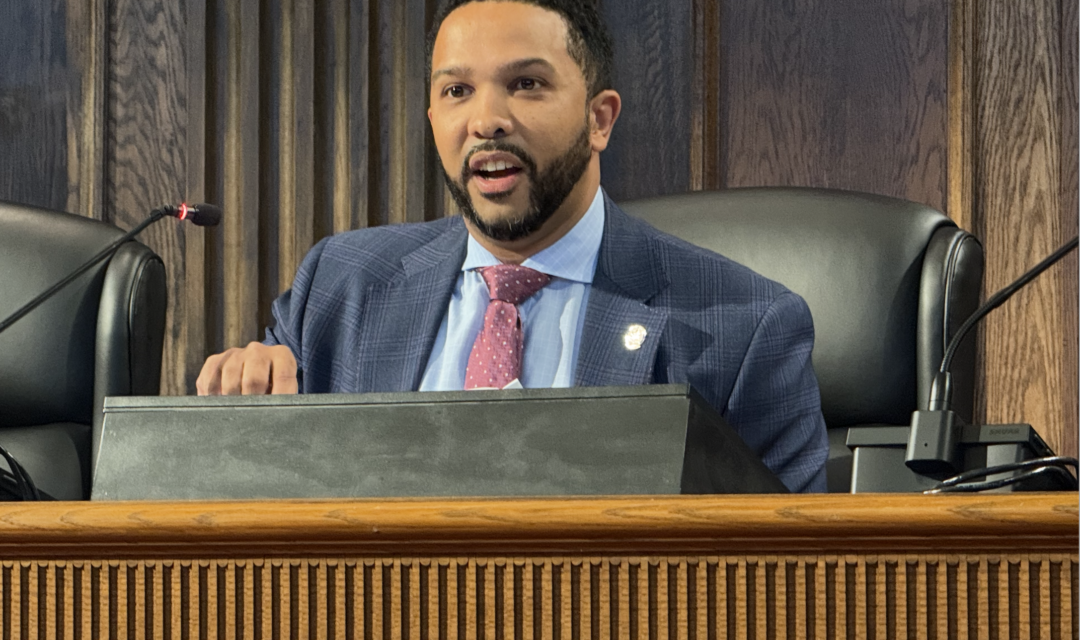
The strongest comments came from Commissioner Frankie Jones, who was visibly animated throughout his remarks.
Jones (pictured above) said the budget process “particularly stinks” because commissioners believed they had reached a workable compromise before state lawmakers “pulled the rug” out from under the county with last-minute legislation.
Jones argued that the commissioners were caught between residents demanding no tax increase and others asking the county to spend more money on services.
Jones also pushed back against comparisons some critics make between Guilford County’s tax rate and those of other large counties, arguing that those comparisons often ignore other revenue sources such as prepared food taxes and higher local sales taxes used elsewhere.
Jones noted Guilford County had kept its tax rate unchanged since 2017 before this year’s increase and said commissioners had tried to reduce the impact on taxpayers as much as possible while still funding required services.
The two Republican commissioners opposing the budget agreed that many parts of the spending plan were worthwhile but said the tax increase was simply too much.
Perdue said he supported funding for schools and behavioral health but believed commissioners could have further tightened county spending.
He said many residents living on fixed incomes fear losing their homes because of higher property taxes.
“Some say, ‘It’s not that big a deal.’ Well, it is a big deal,” Perdue said.
Tillman also thanked county staff for having to essentially restart the budget process after state lawmakers changed the rules.
He said transparency was important and noted that many residents who spoke during the revaluation process simply wanted local government to “give us a break.”
Tillman pointed to higher costs for food, fuel, fertilizer and utilities facing county residents.
“I cannot support the budget,” he concluded.
Chairman of the Guilford County Board of Commissioners Skip Alston said the chairman always wants to be “the closer,” but after listening to the other commissioners, there wasn’t much left to add.
“They have all said it well,” Alston said. “Remember what they said about this budget and let it sink in.”
Alston thanked Isler and county staff for repeatedly revising the budget, noting changes were still being made as late as 11 a.m. Thursday before the board approved the spending plan on the 7-2 vote.




Frankie Jones is my district representative. It saddens me to see him compare this latest increase in taxes to times when more fiscally responsible elected officials set the budget. He should go far on Guilford county
————
And it’s Friday! As my old Latin master used to say, “Nunc est bibendum!”.
Cheers!
wut does he say now ? will he even talk 2 U ?
——————-
Dead.
finis
————
This kind of legerdemain is just obfuscation.
When I buy a car I always and only negotiate the total, bottom line price. So last year I told several Subaru dealers that I’d give them $30,000 “Out the Door” for a new base model WRX. I couldn’t care less if the Documentation Fee was $29,000 and the car was $1,000 – the offer was $30K all in.
How they choose to describe the bill, or break it down, is no concern of mine.
In exactly the same way, when I get my Property Tax bill I don’t care a jot how they characterize it. Why would I? I have to pay the total bottom line amount, regardless. Don’t tell me you’ve cut my taxes when my bill goes up FIFTY PER CENT (my valuation has actually gone up 79%).
There was an Oak Ridge Councilman who repeatedly claimed he had NOT voted to increase our taxes, when he knew full well that the last revaluation resulted in hugely higher values, and so hugely higher tax bills, but he ignored attempts by real Republicans on the Council to implement a revenue neutral rate. He stuck by his lie.
He lost his re-election bid and is now bagging groceries at the local Lowe’s Foods.
We are sick of being gaslighted, by lying bureaucrats and Democrats.
…. and RINOs who are closet Democrats.
i am marklsparkl in name only . . .
my kind of obfuscation is just legerdemain !
————-
Nah, your obfuscation is your unique form of self-expression.
Whimsical, idiosyncratic, and often unintelligible.
You’re… special.
Nothing but the usual lies and BS.
Thralls of Guilford County,
What happen on December 16th, 1773 is the reason REAL American history isn’t being taught in school. God and the Great Jehovah forbid that We the People should get ideas from our ancestors that stood up against those who truly believe we OWE them everything they are stealing from us.
Sons of Liberty where are you?
Have not raised taxes since 2017 that’s a big lie. In 2022 they raised our property taxes by the greatest margin ever. They again hid behind a reevaluation but would not keep the natural rate. These democrats on out board have no clue who they work for it’s the voter. If the voters don’t want their taxes raised then the county government should live within its means. We are the tax payer for goodness sakes.
If you tell a lie over and over, people tend to believe it. It’s call The Big Lie. Chairman Mao.
. . . & every preacher
Greensboro does not know how to spend money correctly. The tax rate for Raleigh and Charlotte Combined is .89 and .94%. And we’re a 1.58…How? And we still have terrible schools
Skip Alston, Carly Cooke, Mary Beth Murphy, Brandon Gray Hill terms expire 12/31/28, election November 2028. So candidates will file December 2027 to run for those positions. I want county board candidates who are opposed to the huge increase in Assessed Value and huge increase in property taxes — and 100% support and protect our homeowner wells — most important. It is not too early to get more active in your area and attend county board meetings to learn more. I easily found $1-$2 +million savings and I bet you can too. How much did they pay themselves recent fiscal year or calendar year?
Democrats tax, tax, tax and spend, spend, spend…no surprises here. The little guy and gal living paycheck to paycheck is left with the burden of paying for their spending spree and trying to keep their family fed and clothed and in their house or rental property without being evicted due to hefty property tax increases or rent increases due to taxes. You elect a Democrat!! You pay with your family’s hard earned dollar.
What we have here is a spending problem.
Also part of the approved budget, the county cancelled the contract with the Town of Summerfield for the $5.5 million water tower. Town refuses to comply with Public Record Requests for one year — so not sure how much money the county is keeping in the country treasury — about $4.5 million? Per ARPA funds the projects must be completed by 12/31/26 and town would not comply. Per county document the town was required to complete
Easement Approvals by April 2025 — and appears town was planning to just take property and call it easements and no disclosure by April 2025 and no disclosure in 2026 — just take property and co-mingle wells. Water Tower was said to be for “FIRE Suppression” “FIRE Prevention” — but the few disclosures would show co-mingle existing wells for high density. Summerfield FIRE was not a partner to this extravagant scheme. Almost all town business is conducted in Closed Session–no taxpayer participation. The ARPA funds did not cover cost and Lynne Devaney has said for years — “County will have to pay any cost over $6.6 million.” ($5.5 from county ARPA and $1.1 million from NC.) To this date the true cost is just another town secret.
John Bust said he is trying to get money from the State for a “water system for Summerfield” — but not enough money — When I asked about protecting our homeowner wells, John Blust said state funds are for “water system,” and NOT protecting our wells. However no one will sell Summerfield water and $350,000 is nothing toward the cost. With the drought now and water restrictions most important to protect our property owner wells in Summerfield — and keep low density — but Summerfield manager and council are gung-ho for higher density. Summerfield is “Governmnet in the Closet” and “spendahiolics.” The town budget is hidden on the website — about five steps to find it and when I asked “What about the Capital Projects?” The mayor was screaming at me and they still refuse to disclose that information.