

If you live in Greensboro, then you live in Guilford County, so you of course pay the taxman for each of those location rights and, now that the city manager and the county manager have put their proposed budgets out there for everyone to see, it’s not looking good for Greensboro homeowners.
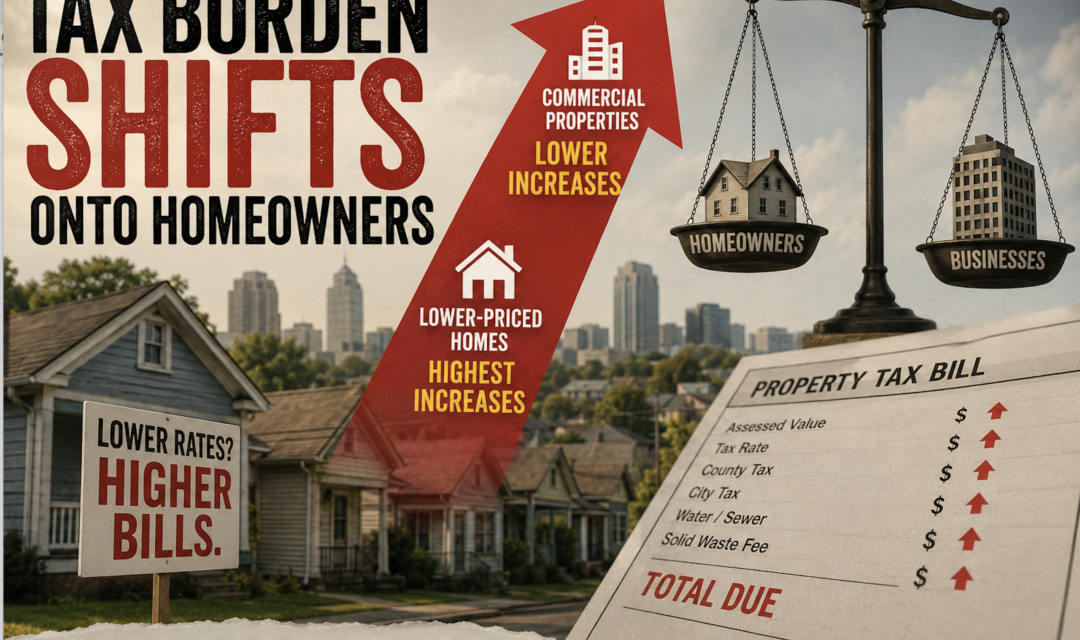
First, gas is over $4 a gallon, food prices are way high, and the economy is ruthless on the lower classes right now. Second, data collected by Greensboro tax accountant George Hartzman shows two trends that also pile onto those who own less valuable houses in the city: the tax burden under the proposed revaluations appears to shift much of the burden from commercial real estate to housing and, it’s the lowest-priced houses on average that have appreciated the most in value.
So even if both Greensboro and Guilford County held the tax rates revenue neutral – which isn’t going to happen – it would be those with the least, people who own low-cost homes, who’ll have to bear more of the tax burden.
And if the City Council and county commissioners give the managers what they want – well, some Greensboro residents are going to have to make some very tough financial choices.
Guilford County is proposing to lower its property tax rate from 73.05 cents to 61.9 cents per $100 of assessed value, while Greensboro’s proposed rate would drop from 67.25 cents to 58.3 cents.
But numbers obtained through a public records request by Hartzman tell a much more complicated story – especially for homeowners in lower-priced neighborhoods.
That data suggests that many homeowners will still see substantially higher overall tax bills despite the lower rates. And perhaps even more significantly, the biggest percentage increases appear to be concentrated among lower-valued residential properties.
According to the figures compiled from county data, residential property values overall increased far more than commercial property values.
Residential properties saw median increases of 59.7 percent, while commercial properties increased just 22.7 percent.
That means homeowners will be absorbing a larger share of the property tax burden than businesses.
And within the residential market itself, lower-priced homes are getting hit the hardest.
The data shows that homes valued under $150,000 experienced median increases of more than 86 percent. Homes in the $150,000 to $225,000 range increased nearly 75 percent.
Meanwhile, the percentage increases become progressively smaller as property values rise. Homes valued above $2.5 million reportedly increased about 44 percent – still a major increase, but far below what many lower-priced homeowners are facing.
Those rising assessments translate directly into higher tax bills even with lower tax rates.
The estimates included in the records request show the combined annual impact of Greensboro and Guilford County property taxes, plus utility and fee increases, could rise by:
- about $941 annually for a $100,000 home
- about $1,700 for a roughly $175,000 home
- about $2,582 for a $300,000 home
- more than $4,000 for a $500,000 home
Those estimates also factor in proposed water and sewer increases along with higher solid waste fees.
The monthly increase estimates are eye-opening – ranging from roughly $78 per month for a $100,000 property to nearly $900 per month for multimillion-dollar homes.
Still, the most politically sensitive issue might not be the size of the increases themselves but where they’re concentrated.
So why are lower-priced homes rising faster than expensive ones?
One reason is that many lower-cost neighborhoods were undervalued for years compared to today’s housing market. During the post-pandemic housing surge, demand for affordable homes exploded as buyers searched for anything within reach financially.
In many cases, modest homes appreciated rapidly because there simply weren’t enough entry-level houses available.
At the same time, wealthier homes often had less room to rise percentage-wise because they were already highly valued to begin with.
For example, a $100,000 house increasing to $180,000 represents an 80 percent increase. A $2 million home rising to $2.5 million is still a huge jump in dollar terms, but percentage-wise it’s only 25 percent.
Housing supply shortages, investor purchases, rising rents and migration into Guilford County also likely pushed demand especially hard in historically affordable neighborhoods.
That creates a difficult political reality: If lower-priced neighborhoods are seeing the biggest assessment jumps, then many of the people least able to absorb major increases may be the ones being hit hardest. That includes retirees on fixed incomes, longtime homeowners in older neighborhoods, and working-class residents whose homes may have surged in value on paper – even though their incomes haven’t risen at nearly the same pace.
But the numbers also raise broader questions about affordability in Guilford County as rising assessments combine with higher insurance costs, utility bills, food prices and other inflationary pressures.
The issue is particularly sensitive because many homeowners in older neighborhoods may have no intention of selling their homes. A rapidly rising valuation may make them wealthier on paper while simultaneously making it more expensive to stay where they are.
With the economy already squeezing many working-class and retired residents, the shift in the tax burden from commercial property to housing could hit some of Greensboro’s least affluent neighborhoods especially hard. And because many of the biggest percentage increases are occurring in lower-priced homes, some of the residents least able to absorb higher costs may wind up bearing more of the burden.
For those who want to see a complete breakdown of the numbers put together by Hartzman, they can check them out here: https://www.publicintegrity.watch/




I wonder when we’ll here news on whether SB889 is going to pass.
I must say one good thing about this planned rape of the tax paying homeowners of of Skip the Omnipotence’s Fiefdom of Guilford County…he’s showing little favoritism. He and his collection of sycophants (D and R) on the Board of Commissars are intent on screwing everyone equally.
I realize I will receive plenty of criticism for including Republicans in that Mob-like bunch, but they can prove to We the People they truly are on our side, they truly care about us, they truly are our REPRESENTATIVES, by standing up in these orchestrated gatherings of the loyal referred to as Board meetings, publicly making it known to the people they are supposed to be representing that they do not agree with this ceremonial sexual assault on The People. The probability of losing is great, but so was the Revolution.
The Omnipotent will get his blood money from us,reluctantly, but we must not allow ourselves to go quietly into night…this time. If/when we do, we must get up, patch our wounds, pick up our sword and shield, reform our ranks and fight again, and again, and again. Otherwise we admit we truly are slaves, we truly are serfs of Skip Alston the Omnipotent and his band of Lords and Ladies.
As Patrick’s favorite poster over his desk says… “Stand your ground. Don’t fire unless fired upon, but if they mean to have a war, let it begin here.”
Captain John Parker, April 19, 1775
—————–
A little old lady struggling to get by on just her Social Security in the family home – no chance.
The self-employed guy who’s trying to raise a family, and whose business never recovered from COVID – no chance.
The immigrant family who have lost one income – no chance.
The “Public Sector” parasites who get generous raises (incl. 18% for State Troopers) – no problem.
*
Don’t tell me the Democrat Party represents ordinary people. They represent the interests and desires of government and The Parasitic Sector.
You left out one other group Austin…themselves.
I don’t disagree with you but don’t tell me the Republican Party represents ordinary people either. They represent the interests of the wealthy sector. Otherwise, they would a) raise taxes for the wealthy or b) rewrite the tax code to give ordinary working citizens the same tax breaks the wealthy get
You can’t blame the Republicans for the tax code, I personally don’t like it but it is a very partisan issue. The wealthy in the US have always been given a leg up. A good example, look at N. Pelosi and her net worth when she took office or the Obama’s or the Clinton’s
————-
Both political parties are subject to the influence of big money. Money is the mother’s milk of politics, in this country and others.
But at its core, the Left represents the government, the Right represents the governed.
The right favors deregulating large corporations and wealthy interests, prioritizing profit margins over environmental protections and working-class welfare. Conversely, the left focuses on closing the wealth gap and protecting labor and environmental rights, seeking to balance corporate profits with individual well-being.
streb,
On that I would simply say although I’ve left the Republican Party, we can agree to disagree.
As for the tax code, I believe it should be junked and replaced with the Fair Tax. Just my opinion.
cheap homes increase taxes the most expensive homes the least? smells like socialism…
I will keep beating the drum to end property taxes. Why do property owners without children in public schools pay for public schools? Why do property owners who are law-abiding pay for a sheriff’s office that uses property tax money to waste on a video that is playing in previews at a local movie theater that shows fancy cars and gnarling dogs? Why do property taxpayers pay for the unconditional organizational discrimination named DEI rather than merit-based hiring and promotion? Why do property taxpayers and for-profit businesses foot the bill for public services provided to nonprofits, as they must cover the tax revenue lost when tax-exempt organizations do not pay property taxes, which includes fancy retirement homes that the average Guilford County property taxpayer cannot consider moving into; country clubs (501(c)(7) that a non-member property taxpayer cannot consider playing a round of golf, swimming in a pool, or play tennis; and property occupied by religious organizations, many setup to avoid property taxes and including mosques that are for Muslims their foundational religion; churches, synagogues, and even the a Church of Satan should one choose to expand from Virginia.
There is no ordinance, statute, or federal law that states if an entity is federally tax-exempt, states must also grant tax-exempt status, which Virginia recently proved how states will pick and choose what is property tax-exempt or not, which proves my point that property taxes should be ended.
Preach on Brother Termlimits
We are arguing about the wrong thing—as usual.
Tax rates, homestead exemptions, renter taxes, revenue neutrality, and the shifting of the burden from commercial to residential properties—none of it changes the bottom line. The county still needs $935 million. You can rearrange who writes the check all day long, but the check is still the same size.
It is not a collection problem. It is a spending problem.
In a single year, the county budget ballooned from $847 million to $935 million, while our population grew by barely 1%. Furthermore, 64% of the amount collected above the revenue-neutral rate is allocated to school spending. This is for a district where enrollment has dropped from 72,000 to 68,000 students, and proficiency in grades 3 through 8 hovers around 30%. More money, fewer kids, and worse results.
That single line item is the primary reason your tax rate isn’t dropping to match the revenue-neutral baseline. A Boone Street homeowner whose property assessment just rocketed from $49,200 to $118,000 might not even have children in the school system, yet they are the ones funding this unchecked growth.
Look at the mechanics of how this happens. Following the 2022 revaluation, commissioners held the tax rate flat at 73.05 cents, quietly absorbing $92 million a year in windfall revenue without ever having to take a public vote on a tax increase. Now, the newly proposed rate of 61.90 cents is being marketed to the public as a “tax cut.” In reality, the true revenue-neutral rate is 53.26 cents. That 8.64-cent gap is a massive spending increase, cleanly laundered through a property revaluation.
Here is what should actually happen: we need zero-based budgeting tied directly to the revaluation cycle. Every time property values are reassessed, the county budget should be reassessed from scratch. We should start with mandated services capped at the revenue-neutral rate—that is our baseline. Every single dollar requested above that baseline must be presented as a separate, visible, and strictly justified line item. Let the public see it and vote on it openly, rather than burying it on page 247 of a budget document nobody reads. If a program costs millions of dollars, show us what it does and let the community decide: Do we actually want to buy this, or not?
I have lived here since 1994, and it is the same outrage during every single revaluation cycle. We see the same packed auditorium chairs, hear the same angry public comments, and then watch the same people get reelected—or witness the community simply choose not to vote at all. The commissioners who held the previous rate and pocketed $92 million in unvoted revenue won their gamble because the voters ultimately rewarded the exact behavior they claimed to oppose. Thirty years. Same cycle. Same result. It is time to stop blaming the tax department and start looking at the ballot box.
And one final point: if you are someone who shows up at budget hearings advocating for increased school funding, higher teacher pay, expanded programs, and more county services, that is your right, and I respect it. But you have to own the financial consequences of your advocacy. Every dollar you demand ends up printed on someone’s tax bill. You cannot demand a billion-dollar public system and then act blindsided when the county comes to collect.
If you truly believe the spending is worth it, then stand up and declare that the tax bill is worth it as well. Just do not stand in line at two different meetings—one demanding that more money be spent, and the other demanding that less money be collected. That math does not work, and the rest of us are tired of paying for the contradiction.
————
This Mongo Jerry guy is absolutely right.
The problem is the electorate.
Mongo JERRY,
I really can’t argue with you. You make very good points
You make my point that NC counties should be funded by a source other than property taxes.
“Every single dollar requested above that baseline must be presented as a separate, visible, and strictly justified line item. Let the public see it….”
Even if the taxpayers dont directly vote on thr line items, it makes clear the accountsbility in where the twx increases are going. Great concept. Will never happen but a great concept.
Publish the data gathered by Hartzman. Referring to it but not linking to it is bad journalism.
Another excellent article Scott, I know it’s not easy being the bearer of bad news. I appreciate you shouldering the responsibility. As for the rest of us, GET OUT AND VOTE AND GET INVOLVED, As Mr Marshall said; DO NOT GO QUIETLY INTO THE NIGHT. How many can even tell me who your City and County representatives are?
Thank you for the kind words. Scott
You speak the truth. I urge someone to run against Skip Alston in the next election. He has no opponents on the ballot so he is a shoe-in. I heard someone again to run against this man because I think one of the main problems Starts at the top which is him. We all have to live within our budgets that we have so why can’t the government do the same and quit wasting our money and quit giving her money away to organizations that do not deserve it.
Have someone run against Alston all you want, but he will still win. District 8 is Alston’s district, period. Given that, another commissioner can run for chairman against Allston. The commissioners elect the chairman at the end of the year.
You speak the truth. I urge someone to run against Skip Alston in the next election. He has no opponents on the ballot so he is a shoe-in. I urge someone again to run against this man because I think one of the main problems Starts at the top which is him. We all have to live within our budgets that we have so why can’t the government do the same and quit wasting our money and quit giving her money away to organizations that do not deserve it.