Guilford County officials and state lawmakers have spent more than a year working on 52 words of ballot language. It’s impossible to imagine that, in the history of Guilford County – or perhaps even the history of literature – so much effort has gone into shaping one small paragraph.
The Guilford County Board of Commissioners is absolutely 100 percent positively doing everything it can to see that the voters of the county vote themselves a quarter-cent sales tax hike in early November – and, to that end, the commissioners continued tweaking the ballot language for about a year and half to make it as appealing as possible to county residents.
About half the counties in the state have voted themselves a sales tax hike, but Guilford County voters have proven very recalcitrant in that regard: The board has put the issue on the ballot time and time again for almost two decades and, each time, the voters have said no – you can’t have even more of our money.
Estimates are that a quarter-cent sales tax would give the commissioners $30 million or so extra to spend each year.
The election is just around the corner, and Elections Director Charlie Collicutt has to start printing ballots soon, so the commissioners were pushing it a little when they made their latest changes to the language at their Thursday, Aug. 6 meeting.
The Guilford County commissioners have already decided what they want voters to do with a proposed quarter-cent sales tax increase in November. Now – after more than a year of work with the North Carolina General Assembly – they’ve got the exact wording.
The Guilford County Board of Commissioners will replace the resolution it previously adopted calling for a Nov. 3 referendum on a quarter-cent local sales and use tax.
The tax itself hasn’t changed. Neither, for the most part, has the list of groups that would benefit from the additional revenue.
What has changed is the language that voters will see on the ballot.
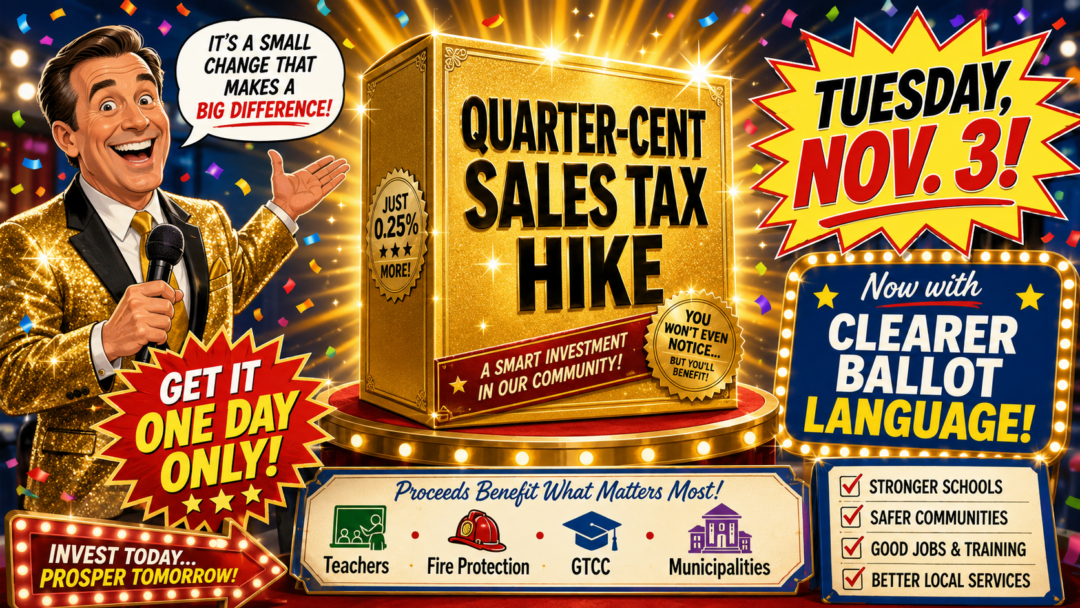
The revised ballot question states that the quarter-cent sales tax would be used solely for classroom teacher salary supplements, which would receive 70 percent of the proceeds; fire protection equipment and services, which would receive 18 percent; Guilford Technical Community College, which would receive 8 percent; and qualifying municipalities, which would receive 4 percent.
The final ballot language reads, “Local sales and use tax at the rate of one-fourth of one percent (0.25%) in addition to all other State and local sales and use taxes to be used solely for classroom teacher salary supplements (70%), for fire protection equipment and services (18%), for Guilford Technical Community College (8%), and for qualifying municipalities for allowable expenses (4%).”
That’s considerably more specific than the language approved by the General Assembly last year.
Under the 2025 legislation, the ballot would have asked voters to approve the quarter-cent tax “to be used solely for classroom teacher salary supplements, fire protection equipment and services, for Guilford Technical Community College, and to be used by municipalities for any public purpose.”
In other words, the earlier language told voters who would benefit from the tax – but not how much each group would get.
The new version puts the percentages directly on the ballot.
There’s a practical political benefit to doing that.
Instead of asking voters simply whether they support another sales tax, the ballot question puts the potential beneficiaries directly in front of them – classroom teachers, fire departments, GTCC and local municipalities.
It also attaches specific percentages to those uses, making the proposal look less like an unrestricted new source of county revenue and more like four designated funding measures packaged into a single quarter-cent tax.
County officials have said the purpose of the changes is to make the ballot language clearer and more transparent to voters.
At a June 18 commissioners work session, Deputy County Manager Toy Beeninga told the board that Senate Bill 1074 would amend the ballot language and listed the proposed 70 percent, 18 percent, 8 percent and 4 percent allocations.
Commissioner Pat Tillman asked whether the percentages had changed.
Beeninga said the earlier legislation, House Bill 305, hadn’t actually stated percentages. Instead, it established a series of calculations governing how the revenue would flow.
Beeninga said those calculations equated to percentages and that the commissioners had agreed to use percentages based on the original intent of the funding distribution and “to make it clearer on the ballot.”
That effort required another trip through Raleigh.
The General Assembly approved HB 305 in 2025, creating special provisions for Guilford County’s Article 46 sales tax referendum and specifying that the money could be used for teacher salary supplements, fire protection, GTCC and municipalities.
The commissioners and county staff continued working with the county’s legislative delegation to revise the language.
SB 1074, approved by the General Assembly this summer, changed the ballot question again and put the 70-18-8-4 breakdown directly into state law.
It also made some smaller wording changes.
The 2025 version referred broadly to money “to be used by municipalities for any public purpose.”
The new version refers instead to “qualifying municipalities for allowable expenses.”
Those municipalities currently include Oak Ridge, Pleasant Garden, Stokesdale, Summerfield and Whitsett.
The resolution states that 70 percent of the revenue would fund higher pay for classroom teachers and instructional support personnel, 18 percent would fund new fire trucks and firefighting and safety equipment, 8 percent would fund capital investment supporting job training and educational programs at GTCC and 4 percent would go to qualifying municipalities.
Some opponents of the tax on Facebook and on Rhino Times comment boards have pointed out that county funds are generally fungible: While money raised by the sales tax would go to its stated purposes, it could simultaneously free up other county money for entirely different uses – such as, say, providing additional funding to the International Civil Rights Center & Museum.
The resolution the commissioners adopted earlier this month also makes an argument for the tax, stating that Guilford County attracts non-residents for shopping, dining and entertainment – and that visitors would therefore pay part of the additional sales tax.
It states that the new sales tax would diversify county revenue and limit pressure for future property tax increases.
The commissioners have rescinded in its entirety the referendum resolution adopted June 18, 2025 and replaced it with the revised version.
So, the question headed toward Guilford County voters remains essentially the same one the commissioners have been preparing for more than a year.
The sales tax would still be one-quarter of 1 percent.
The proposed beneficiaries remain teachers, fire protection, GTCC and municipalities.
However, this time around, the commissioners want voters to see exactly how the multi-million-dollar money pie would be divided – and