


Greensboro traffic is getting so bad these days that it often feels like you are driving through the heart of Raleigh or even Atlanta. And even at 2 p.m. on a nondescript Tuesday, Battleground Avenue can feel like, well, a Battleground.
And with a bajillion more people expected to move to the city in the next five years, the traffic is only going to get worse. There’s nothing you can do about the fact that Greensboro drivers don’t believe in using turn signals or have no problem shining blaring bright lights in your eyes at night, but you will have a chance to give your input on what should be done about the road system.
Residents of Greensboro and much of Guilford County have a chance to help shape which major transportation projects receive state funding over the next decade.
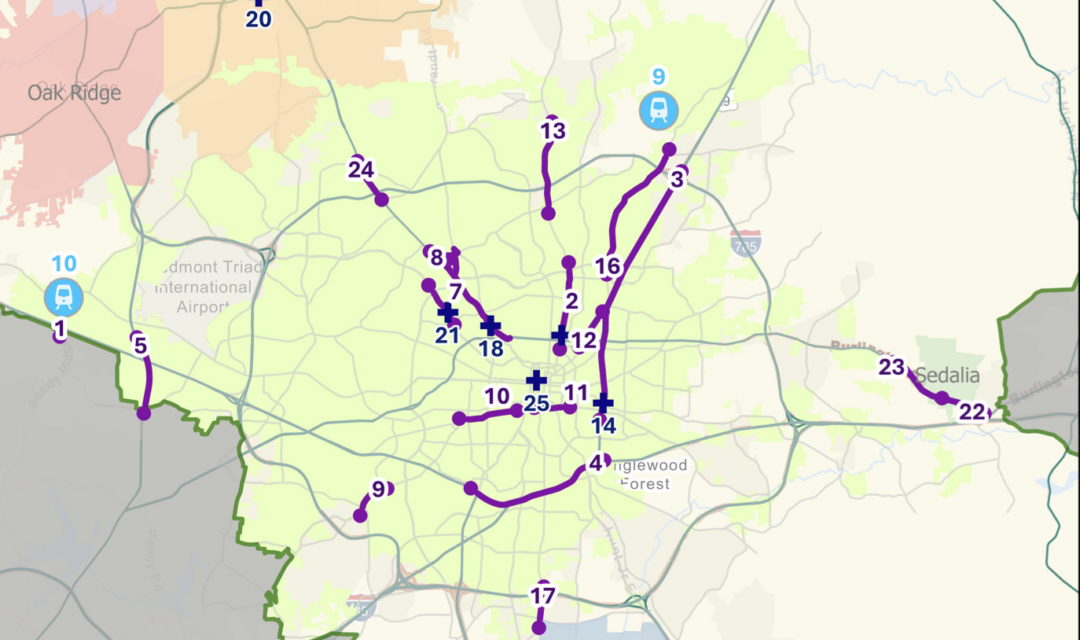
The Greensboro Urban Area Metropolitan Planning Organization (MPO) has released its draft assignment of local input points for Regional Impact transportation projects that will compete for funding in North Carolina’s 2028-2037 Transportation Improvement Program.
The public review period is open through Wednesday, Aug. 5, and includes a virtual public meeting scheduled for noon on Thursday, July 23. After reviewing public comments, the MPO’s Transportation Advisory Committee is expected to consider adopting the final point assignments at its Aug. 12 meeting before forwarding them to the NC Department of Transportation.
The process might sometimes sound like bureaucratic inside baseball – but these local point assignments can have a major impact on which projects ultimately receive millions of dollars in state transportation funding.
North Carolina uses a statewide system known as Strategic Transportation Investments to determine which transportation projects are funded. Candidate projects are first evaluated by the NC Department of Transportation using objective measures such as congestion relief, safety improvements, cost effectiveness and other transportation benefits. Projects compete for funding in one of three categories: Statewide Mobility, Regional Impact and Division Needs.
The state’s numerical score isn’t the only factor.
Metropolitan planning organizations like Greensboro’s, along with NCDOT divisions, also assign “local input points” to Regional Impact and Division Needs projects.
Those local points reflect regional priorities and are combined with the state’s quantitative scores to help determine which projects rise to the top for funding.
The Greensboro MPO developed its recommendations using a locally adopted methodology that considers a variety of factors in addition to the state’s scoring method. Those include how competitive a project is likely to be, whether it addresses a corridor with a high number of crashes, whether it supports multiple forms of transportation, and whether it appears on the MPO’s priority list as well as its potential economic development benefits.
The draft recommendations include dozens of highway and rail projects throughout the Greensboro metropolitan area.
Among the projects receiving the MPO’s highest recommended point allocations are modernization of Greensboro’s citywide traffic signal system; widening Interstate 40 between US 29 and Freeman Mill Road; upgrading Battleground Avenue from the Urban Loop to Horse Pen Creek Road; improvements to the Church Street intersection on Wendover Avenue; modernization of US 158 between N.C. 65 and the MPO boundary; improvements to several highway-rail crossings; modernization of portions of US. 70 – and safety improvements along the NCRR/NS rail corridor between O’Ferrell Street and Burlington Road.
The proposal also includes projects that extend beyond Greensboro, including additional Interstate 40 widening, upgrades to US 29, passenger rail service between Winston-Salem and Greensboro, a proposed bus rapid transit corridor connecting Winston-Salem and Mebane, and numerous other regional roadway improvements.
The current public review covers only the regional impact portion of the funding process.
According to MPO leaders, Division Needs projects—which generally focus on more local transportation improvements—will undergo a separate technical review and public comment period later this year before those point assignments are submitted to NCDOT. The draft statewide 2028-2037 Transportation Improvement Program is expected to be released in March 2027.
Residents who wish to review the proposed point assignments or submit comments can do so through the MPO’s website at www.guampo.org. Comments may also be submitted by email to guampo@greensboro-nc.gov or by mail to the Greensboro Urban Area MPO, Attn: Lydia McIntyre, P.O. Box 3136, Greensboro, NC 27402-3136.
The Greensboro Urban Area Metropolitan Planning Organization is the federally designated agency that’s responsible for transportation planning for the City of Greensboro, most of unincorporated Guilford County and the towns of Oak Ridge, Pleasant Garden, Sedalia, Stokesdale and Summerfield.
That organization coordinates long-range planning for highways, transit, rail, bicycle and pedestrian facilities and works with federal, state and local governments to develop the region’s transportation priorities.




a traffic light was recently installed on w market st @ greensboro college where the greenway crosses. as i stood there watching NO ONE crossing the street, 20 stopped vehicles waited patiently for NOTHING !
————-
Stop lights are an extremely stupid way to mange traffic at intersections.
Roundabouts (or “Traffic Circles”) allow vehicles to proceed without hindrance if it’s clear, use no electricity, never fail in storms, and never have their signal obscured by huge trucks moving slowly ahead of you.
Replacing stoplights with traffic circles would boost the US economy by billions in lost time alone, and be safer, and reduce power demands.
Exactamundo! They work everywhere, from L’Etoile to Ocean Isle back streets. But that isn’t as much make-work (jobs) is it?
Conversely, a Road Outta Town for the Council.
Drivers in Greensboro can’t manage to use turn signals. Traffic circles and roundabouts are out of the question. Would only lead to gunfire.
I disagree. I’ve seen roundabouts work everywhere. People know how to get on and off.
Are we going to just dismiss the first paragraph saying that Greensboro traffic is as bad as Raleigh or even Atlanta’s traffic. NOT A CHANCE!!! Greensboro traffic is not even a 10th of the mentioned above.
It’s not the traffic, it’s the fools that can’t drive and Greensboro is loaded with them.
You are right JV., and 90 percent of them only know one speed, FAST. Speed limits are a joke in Greensboro. Virtually no enforcement of traffic laws, laws that are in place to keep us safer on the roads. New roads aren’t going to help us in that regard.
They are everywhere, not just here.
For example, I was cruising east on The Wendover Superhighway this morning. Limit of 45 is ignored by all but the infirm. Based on my speed, I got passed by everyone; I would guess at 60-75mph.
if they all manage to do it safely/successfully who cares ? do u think aircraft overhead mach 2 need a cop with radar ? we will soon see Mach 3 & 60k feet. YIPPY! our nasty virus/mold/bacteria/uv /ozone r up there ready to greet u
i can’t/don’t drive – i bike past the carnage of COG collisions at least twice a month – WHO ARE THE FOOLS
It would help if the city would stop unbuilding the roads we already have. Every time a lane is scrapped to make a bike lane, it makes it harder for the motorists who have been using the already crowded roads. With people moving here from other states and creating more traffic, we need more lanes, not fewer.
How often do you see cyclists in the bike lane? For me, virtually zero. More make work (jobs) for the City. Cyclists can use sidewalks as necessary, it is NOT safe on the street.
there are so few pedestrians in our urban i can safely fat tire bike between path, sidewalk & street staying a safe distance from everybody & everything. skinny tire asphalt bikers r courting ‘death by austin’ & i consider them presmashed. add motorcyclists
Why don’t the people who ride on the back of the trash truck make the same amount of money of the people who ride on the back of the firetruck?
Same skill level
Same education level
Same level of danger
J R what part of this article has anything to do with Firefighters or sanitation workers, just curious. And why are you so fixated on them. Are you still PO’d because you got turned down for the Fire Department. Get over yourself
Even though this is not in keeping with the news article, I’ll say it anyway. The majority of our fire fighters have college training and over 80% have at least one undergraduate degree.
Thanks for your response Mr. O , I personally know several who come to the downtown Y and yes they all have a college degree. JR got turned down by the the fire department and has a bee up his butt about them.
there r many forms of corrosion/rust – u are 1
which roads will be removed first ? marklsparkl wants to know
The one at your house…………
i don’t need it & would rather have more ‘green’.