

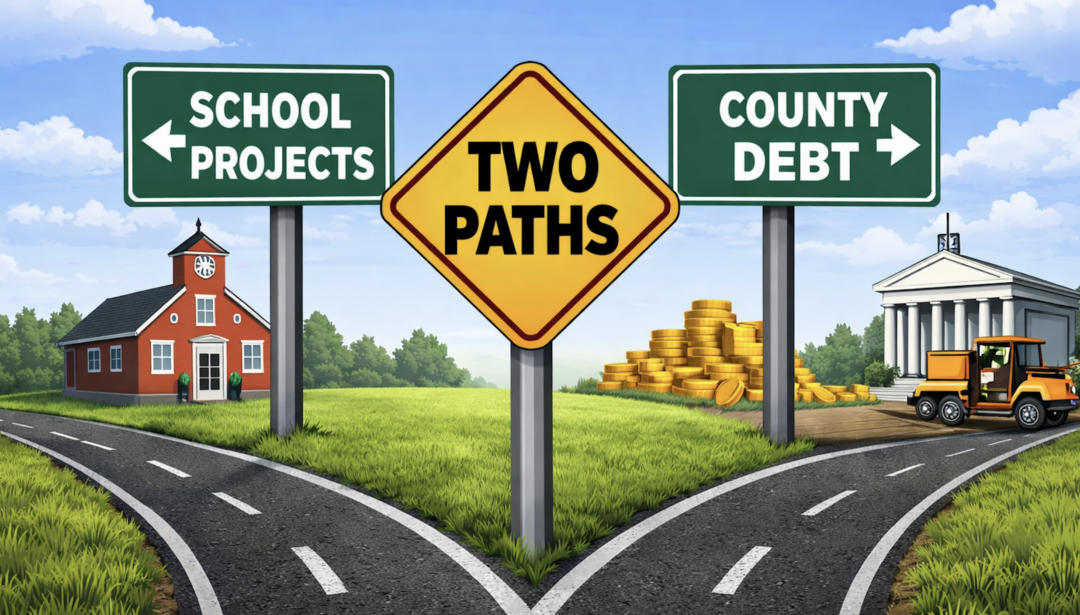
There’s been a lot of talk on social media lately claiming that Guilford County is planning to take money away from school bond funding to pay for new county buildings and a massive, consultant-recommended, countywide renovation and capital project.
If county staff and commissioners move forward with the project – or even major parts of it – the county will need to take on more debt. However, that debt would be on top of, rather than in place of, the more than $3 billion in school bond debt the county is already taking on to fund school projects.
Voters have approved $2 billion in school bond debt in recent years and, with interest, that puts the total payback at over $3 billion.
The confusion seems to stem from the county’s use of what are called “two-thirds bonds,” which were discussed earlier this year in a county work session and reported on in a recent Rhino Times article.
Consultants identified roughly $572 million in capital improvement needs that include everything from building repairs to possible new downtown government complexes in Greensboro and High Point.
However, on Facebook, Instagram, X and neighborhood-specific apps, some posters are claiming those projects will take money away from schools. That’s simply not the case: Two-thirds bonds won’t pull a single dollar from the more than $3 billion in school bond funding that voters approved.
You can think of it like this. Say you have a credit card and you’ve been approved to use it, but the entire limit – say $2,000 – can only be spent on school supplies. So, you go out and, just like you promised, you spend that $2,000 on school supplies. That never changes. That money is spent and it’s spent on its intended purpose.
However, after you start paying off that credit card, you still have a $2,000 limit. So if you pay off $300 one month, the next month you might have, say, $250 in available credit again.
Now, no one ever made a promise that that new available credit would go toward schools.
Likewise, state law allows local governments, after they pay down debt on voter-approved bonds, to borrow back up to two-thirds of the amount they paid off in the previous year without going back to the voters. It may not be how most people would run their household finances, but it is entirely legal – and it doesn’t affect at all the amount that county schools receive.
Schools get the full $2 billion.
Guilford County Deputy Manager Toy Beeninga said this week that school bond money is legally tied to the bond orders that voters approved and must legally be spent for that purpose. He said that funding can only be used for school projects – period.
“There’s no mechanism where we can take that money and shift it over to county buildings,” Beeninga said in a recent interview with the Rhino Times in an effort to address the misinformation being spread on social media.
So where is the confusion coming from?
It largely comes down to how two-thirds bonds work – and they are complex, not widely understood, and rarely discussed in detail.
Two-thirds bonds allow a county or other local government in North Carolina to borrow additional money without going back to voters, but only up to a limit based on how much existing debt the county has already paid down.
In essence, when the county pays down debt in a given year, it can then borrow back up to two-thirds of that amount the following year.
That means the school bonds and the county’s proposed capital plan can exist side by side as completely separate streams of borrowing. One does not reduce or redirect the other.
However, that doesn’t mean there aren’t real concerns about all this debt.
Because even though the county isn’t “taking” school money for these proposed projects, it is layering additional debt on top of an already massive amount of school-related borrowing.
County finances are under pressure after several years of increased spending.
County staff have made it clear that the roughly $572 million capital improvement plan presented earlier this year isn’t a final recommendation but a needs assessment compiled with the help of an outside consultant.
Staff have indicated to commissioners that fully funding that entire list would likely push the county beyond its own debt policy limits – though the board could choose to change those limits and do the full slate of projects anyway.
That’s why commissioners and staff are now in the middle of an ongoing debate over what should actually be included in the county’s final capital plan.
Some projects – like critical repairs to aging facilities, jail infrastructure and failing building systems – will almost certainly rise to the top.
Others – like the proposed “$2 million treehouse” at a county park – may not survive the final cut.
Given current financial constraints, it’s widely expected the board will have to scale the plan back before formally adopting it.




So, really “two-thirds bonds” is a way of keeping the county in debt up to its debt limit. If a household uses this debt limit ploy, they will never get out of debt because the interest on the debt will never allow it. That’s why so many of the households who practice this never-ending cycle play the lottery constantly believing the next time will be the charm. Problem is, with the county money, that money belongs to the taxpayer. It is so sad that the same commissioners get elected over and over.
well it’s better than pretending we arent in debt like those screw ups over in winston did..i still have no idea how they managed to displace 30 million dollars. dang libs
—————–
I love this country, but I swear I can’t understand why it blows absolutely massive amounts of money on the worst education system in the advanced world.
India does better than us.
China too.
At a fraction of the cost.
Guilford County Taxpayers,
Apparently Skip the Omnipotent has channeled the ghost of P.T. “There’s a sucker born every minute” Barnum with a bit of Marie “Let them eat cake” Antoinette thrown in.
Come to think of it, Marie Antoinette a great handle for the “Vice Chair” instead of Igor.
Just a thought.