

Just as Guilford County leaders are preparing to set a new property tax rate that’s expected to come in higher than revenue neutral, lawmakers in Raleigh are moving forward with legislation that would temporarily block the use of the county’s newly increased property values.
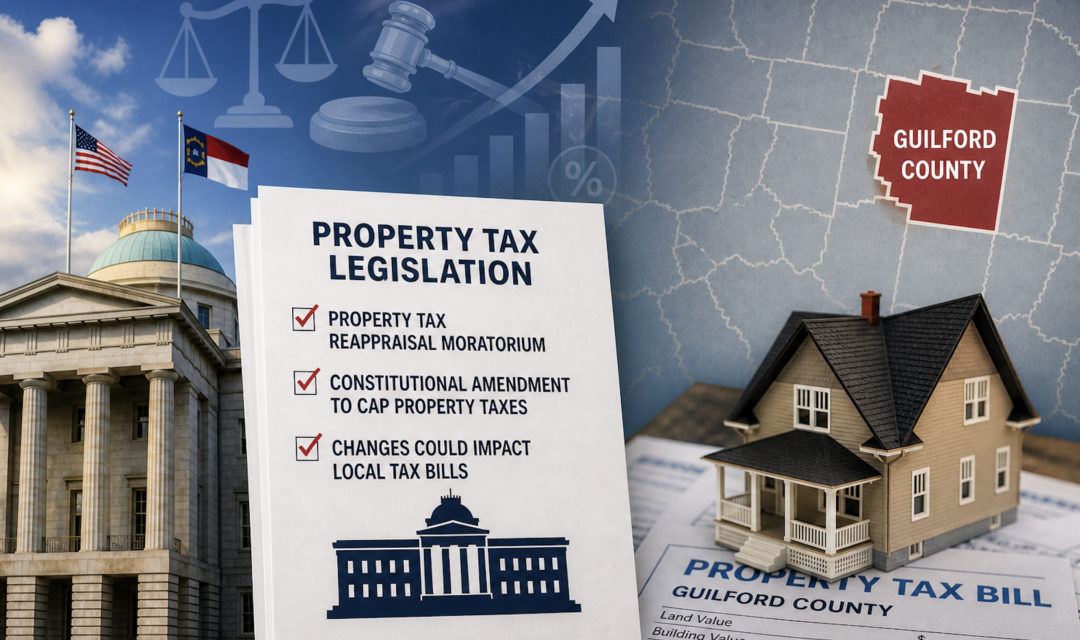
The proposal – Senate Bill 889 –would require Guilford County and 11 other counties that completed reappraisals effective Jan. 1, 2026, to ignore those updated values for the upcoming 2026-2027 fiscal year and instead use older, pre-2026 property values when calculating tax bills.
In other words, after months of homeowners opening notices showing sharply higher property values, the state could step in and say: not so fast.
The bill was filed April 28 and has already moved quickly through the early stages of the legislative process. It passed its first reading in the Senate and was referred to the Senate Rules and Finance committees, a sign that leadership is taking it seriously and could bring it up for a vote in the near future.
And it doesn’t stand alone.
A separate proposal in the House – House Bill 1089 – would go even further by asking voters to amend the North Carolina Constitution to require limits on how much local governments can increase property tax levies going forward. If that measure advances, it would appear on the statewide ballot in November 2026.
Taken together, the two bills represent a significant push by state lawmakers to rein in local property tax increases – something that could have major implications for counties like Guilford, where commissioners are currently debating how much to raise taxes following a revaluation that increased property values by roughly 45 percent on average.
Right now, the Guilford County Board of Commissioners is working toward adopting a new budget in mid-June that will take effect July 1.
Chairman of the Guilford County Board of Commissioners Skip Alston has already made it clear that the new tax rate won’t be revenue neutral – meaning the county intends to bring in more money than it did before the revaluation – though he’s said the increase will fall somewhere between revenue neutral and the current rate.
That has already set up a debate locally.
But Senate Bill 889 could upend the entire discussion.
Under the bill, Guilford County would be required to use its previous schedule of values – essentially rolling back the revaluation for one year — when calculating tax bills for the 2026-2027 fiscal year.
That doesn’t necessarily mean taxpayers wouldn’t see higher bills. The county commissioners could still set a higher tax rate. But it would dramatically change the math.
Instead of applying a lower tax rate to higher property values – which is how revaluations typically work – Guilford County would be forced to apply whatever rate it sets to the older, lower property values.
That would likely reduce the amount of revenue the county could generate unless commissioners raised the tax rate even more to compensate.
Under the bill, the new 2026 reappraisal values wouldn’t disappear entirely – they would simply be delayed.
Beginning in the 2027-2028 fiscal year, counties like Guilford would then be required to use the new, higher values going forward until the next reappraisal cycle.
So, the legislation doesn’t eliminate the impact of the revaluation – it just postpones it.
Still, even a one-year delay could have major ripple effects.
Guilford County is facing increasing demands for funding, including school funding, public safety, and other services. Commissioners have already been hearing at meetings and town halls from residents, many of whom are concerned about rising property values translating into higher tax bills.
At the same time, local governments rely heavily on property taxes as their primary source of revenue.
That’s where the tension lies.
Supporters of the legislation have framed it as a way to provide immediate relief to homeowners who were shocked by large increases in their assessed values.
However, organizations representing counties, including the North Carolina Association of County Commissioners, have raised concerns about preserving local control and ensuring counties have the ability to fund services.
Meanwhile, House Bill 1089 introduces a longer-term question.
That proposal would require the General Assembly to enact laws limiting how much property tax revenue local governments can raise – potentially tying increases to factors like inflation or population growth.
If approved by voters, it would put a permanent cap on property tax growth across the state, fundamentally changing how counties like Guilford budget and plan for the future.
For now, both bills are still moving through the legislative process.
Senate Bill 889 appears to be on a fast track, with expectations that it could reach the Senate floor soon for debate and a vote.
The House constitutional amendment is at an earlier stage, having been referred to committee.
But even at this point, the message from Raleigh is clear: property taxes are going to be a major issue this year.
And all this puts Guilford County in a particularly complicated position.
Commissioners are expected to finalize a tax rate in mid-June — a decision that will determine how much homeowners pay beginning July 1.
But depending on what happens in Raleigh, that decision could end up being based on a set of property values the state might not allow the county to use.
In other words, just as Guilford County is about to lock in its budget and tax rate, the rules of the game may be changing.
And for taxpayers, that could mean more uncertainty as to what their final bill will look like – and when the full impact of the recent revaluation will actually hit.




————–
I hope that these bills pass – all of them. We are tired of being sitting ducks for people like Skip Alston who dip into our bank accounts at will.
The larger question is whether the ownership of ANYTHING should create a tax bill. And why the turning of the calendar becomes a taxable event.
Property tax is more like a Mafia style shakedown than legitimate taxation. It violates all of Adam Smith’s Canons of Taxation.
when u venture out cho nontaxable castle on your non taxed horse what cooperative system creates the roads u haven’t created ? whose property are u allowed to travel thru ? pay a ‘tax’ to them ? i would like to tax every plane that flies over my head in the event ‘something’ off/from it damages me ?
————
Lots of viable alternatives, Markl (eg local sales tax). Do some research, if you’re interested.
guvmnt seems to b tussling with ‘viable alternatives’. tax nonconsumption ? all this data of poor economics for most people is contradicted by the huge & growing ‘gambling’ & vice industries vs ‘investing’ habits.
There are the sounds of bugles in the distance. There are the outlines of banners on the horizon. There is rumble of marching feet approaching.
Are these the sights and sounds of possible assistance for We the People? Or is it the forewarning of a different bunch of the same ilk dressed differently.
One thing is certain, Skip the Omnipotent and his Board of Commissars know their rule, not governance but rule, may finally be being challenged by someone they cannot (we hope) buy or be cowed.
Regardless, this overall situation is,IMO, our Boston Tea Party moment. No violence (unless pushed by outside forces), but a sign of “I’M MAD AS HELL, AND I’M NOT GOING TO TAKE THIS ANY MORE!!!”
And to paraphrase the next line ” I’M A HUMAN BEING WHO WORKS FOR MY FAMILY AND MYSELF, GODDAMNIT, NOT THE LEECHES WHO CALL THEMSELVES COMMISSIONERS AND THEIR SYCOPHANTS .
Emperor Skippy will increase what he can frivolously spend on his pet projects. Guilford County homeowners mean nothing to him. If they postpone for a year, he will just raise the rate higher. After he got a taste of the Covid money, it was off to the races.
If the Guilfird county commission is stymied by this action by the state then they well may vote a rate hike in June. Then just keep that rate when they can consider the new valuations under whatever cap will be imposed.
———–
Yeah, that’s what I’m worried about too.
Sounds like a good plan.
If the greedy county commissioners would have found a fair and equitable tax revaluation, they could have proceeded with their budget/tax rate changes for 2026. Instead, they chose this methods of raising taxes on low to median income property, while only providing modest increases on the upper/high end properties. Rather than paying down existing debts, they want to “borrow” more from existing school bonds for other non-school projects.
Maybe this delay in utilizing the inaccurate miscalculations on property values will allow the “cap” on taxes to be voted on. And maybe this delay will also give the angry property owners to vote in a better set of commissioners that will create realistic budgets.
Why not add some fuel to the greedy politician tax and spend fire. Noticed the tax bill for a 25 YO auto that was market price $7,000. when bought over ten years ago. The same vehicle now is listed Tax Value by Guilford County at over $7,000. the car is worth <$4,000. private sale. Multiply this by the thousands of cars in the county similarly treated and you have tax robbery by this county. The county says the tax is $55, the NC State Vehicle Property tax estimator website says $12.00.
House Bill 1089 could be as good as calling an exterminator to get the roaches out of your house. It could kill our county leaders reckless spending habits!
Hopefully it will kill the reckless spending habits and get people off their duffs to vote all these commissioners out of office.
At a minimum, they will have to account for actually increasing taxes versus pointing to property values.
I stand by ending property taxes. Regardless of what Raleigh may or may not do with revaluations, the fact is still that retirement communities, country clubs, and other “non-profits” do not pay property taxes. Raleigh, find another way to finance county governments other than property taxes. Period!
————–
Agreed.
It’s an outdated and iniquitous system.
& ubiquitous
Well, not exactly. Only nonprofit “charities” are exempt: Section 501(c)(3) organizations. Country clubs, local swim and tennis clubs, etc are generally Section 501(c)(7) nonprofit organizations. They are generally exempt from income tax but still must pay property tax and sales tax.
Please pass these bills!!! We need to vote on school budgets as a county electorate. This is done in the northeast and it keeps the school system honest and out of the county commissioners pockets. We all know the school board and the county commissioners are hooked together each helping the other. This needs to end. I’m not sure why I owe money to a county just because I own property or live there. All I get is trash pick up some street maintenance every now and then and I never see a police officer in my neighborhood. They have never scrapped my street when it snows. So what the heck am I paying for???
—————
You’re paying for the generous salaries, retirement, and benefits of the easy money public sector parasites, Dave!
Like the song says, they “make their living off of other people’s taxes”.
No government agency or program exists to fulfill its alleged purpose. They exist as a mechanism to benefit and sustain themselves.
We are just the pretext for it all.
Correctomundo, Senyor.
My Thanks go out to Scott Yost of the Rhino Times for staying on top of this, and doing his part to properly inform the Citizens.
Thank You to all Government Officials who Support the Bill’s recently presented to reel in Guilford County, along with several other counties. This is a True example of Representatives working for the People.
That is Smart thinking.
Don’t allow any representative to simply Spend, Spend, Spend, and then impose more Tax, Tax and More Tax Burdens on the Citizens.
Anybody, I mean Anybody can spend Money.
However to set a Real Budget, one must Monitor and Limit Giving Away funds, make Smart moves to make the Budget fit the Income instead of Vice Versa, increase efficiencies, and properly provide the Citizens with Services.
The Lack of Attendance of Commissioners at most All of the Meetings, unfortunately tells me that the decision was made, as is said What Skip says goes, perhaps until April 28 and April 30th when two Bills were introduced in support of the Citizens, and save Guilford County. My hopes are that All of the commissioners think about this Themselves and not just do as encouraged to do and do what is just and right for all concerned.
Education is so Important. More so than many of the questionable ways our Tax Money is Given away. What happened to the Lottery Funds that Guilford County should be receiving. Just don’t hear anything about all those Millions anymore.
It seems that the Chair of the Guilford County Commissioners just keeps talking about the Tax Rate. It takes the Tax Rate Times the Property Values to arrive at the Tax Money available, coming from the Citizens of Guilford County. Why does the Chair of the Commissioners avoid mentioning the potential to TAX the Citizens who put you where you are other than to say, It will be more, between Some unknown figure Not Shared with the Citizens and $175,000,000. To only want to talk about the Tax Rate is as if to not Increase it is a gift,
At this point in time the Bottom Line is a potential of $175,000,000 Million Extra Dollars, I repeat, Extra Dollars. On top of $847,000,000 Million (Last years Budget including $90,000,000 Million received YEARLY from the 2022 Property Tax Increase), and then having to Raid the Savings Account in 2026.
This behavior has got to be reeled in by those at the State Level.
Otherwise, this is a Set Up for Failure for Guilford County and the people who live here. Period.
Thank you for the kind words Andy.
You are right, anybody can spend money, especially if it isn’t theirs.
I find the Rhino Times to be a good resource as well. I appreciate the local news. The property tax hikes the county is planning are a terrible for some. I’ve even looked at this as a reason to move. So, relief from Raleigh would be wonderful.
I’ll say more than one prayer that this goes through. There should be state level regulations for just this type of situation we’re all in. In my case I’m retired, with what I thought was just enough to get out of the rat race prior to my expiration date. I didn’t plan on raiders like Skippy rolling through town every year and taking everything they want, whenever they want like it’s the Game of Thrones . Literally, I can not afford even one Skippy in my budget! We need laws that protect people’s private property and accounts that they worked all their life for! We made our property tax appeal to High Point on I think… April 9th. Still havent heard back. If these proposals succeed, it will be the best news we will have had in a long time. Now, to get in touch with my representatives and let them know that I so much appreciate their much needed help!
Yes and thanks so much is due to Scott Yost. For his tireless efforts to speak the truth to our community.
Thank you Ralph for your kind words.
Let the Calvary come and rescue the citizens of Guilford County from these Democrat Board of Commissioners and Greensboro City Council tyrants. Sound the trumpets and let the citizens voices be heard!! Big government spending must be defeated!!
“The power to tax is the power to destroy”. City Hall is doing their worst.
Even worse is this insidious tax, that no one voted for, call inflation. All this is due to the Federal Reserve, enacted in 1913. It is not that prices are going up at a faster pace than ever, is that our dollar is worth less, day by day, year by year.
I recently finished reading “The Creature of Jekyll Island”. In lay terms, it explains the Federal Reserve act of 1913. No one is taught this in grade school, or hardly any higher level of education.
The Federal Reserve:
“is incapable of accomplishing its stated objectives.
is a cartel operating against the public interest.
is the supreme instrument of usury.
generates our most unfair tax.
encourages war.
destabilizes the economy.
is an instrument of totalitarianism.”
This act enabled an itty bitty income tax on the wealth, and has morphed into what we have now. No matter how much is extorted from us, they always want (need) more. It creates money from nothing, worth nothing, and lends it to the govt at interest (which is on the taxpayer). It is the lender of last resort to the banking system to that bankers can lend money they don’t have on deposit. ALL this goes into circulation, but nothing comes back. The govt buys votes with their fiat money, and bankers make money from fiat money the Fed supplies. Everyone upstairs makes money, downstairs, we receive all the debt.
The only answer is to invest in something that will beat the inflation man, and the tax man. Good luck with that. Think Weimar.
—————–
BITCOIN .
Really.
Why not add some fuel to the greedy politician tax and spend fire. Noticed the tax bill for a 25 YO auto that was market price $7,000. when bought over ten years ago. The same vehicle now is listed Tax Value by Guilford County at over $7,000. the car is worth <$4,000. private sale. Multiply this by the thousands of cars in the county similarly treated and you have tax robbery by this county. The county says the tax is $55, the NC State Vehicle Property tax estimator website says $12.00.
borrow $$ with overvalued collateral then when market collapses consider bankruptcy & keep some of it ?
if they ‘freeze my property value’, i can ice skate !
The top line number of $935 million isn’t getting much mention. That is $87 million up from last year. The property tax reappraisals, at the old rate, would have brought in $175 million in new revenue before appeals and the county kept half that number. You suspect that’s seriously how the county budget number was arrived at (government takes half and let rate payers have half). It is instructive to go back six years to when somehow county services were delivered at $630 million. Ironically, about the only explanation the county manager and commissioners can seem to muster is an estimate we’ll grow the population by 86,000 over 20 years (as if those residents won’t pay taxes or that the job group hyped in recent elections is now somehow a drag on the local economy). To his credit, the county manager did mention the $35 million in debt service from the gold plated school bonds. The county government and the schools always represent themselves as just scraping by and economizing, while taking money out of the local economy at a rate greater than inflation. I suppose Arlo Guthrie was right. Some will rob you with a six gun and some with a fountain pen.