
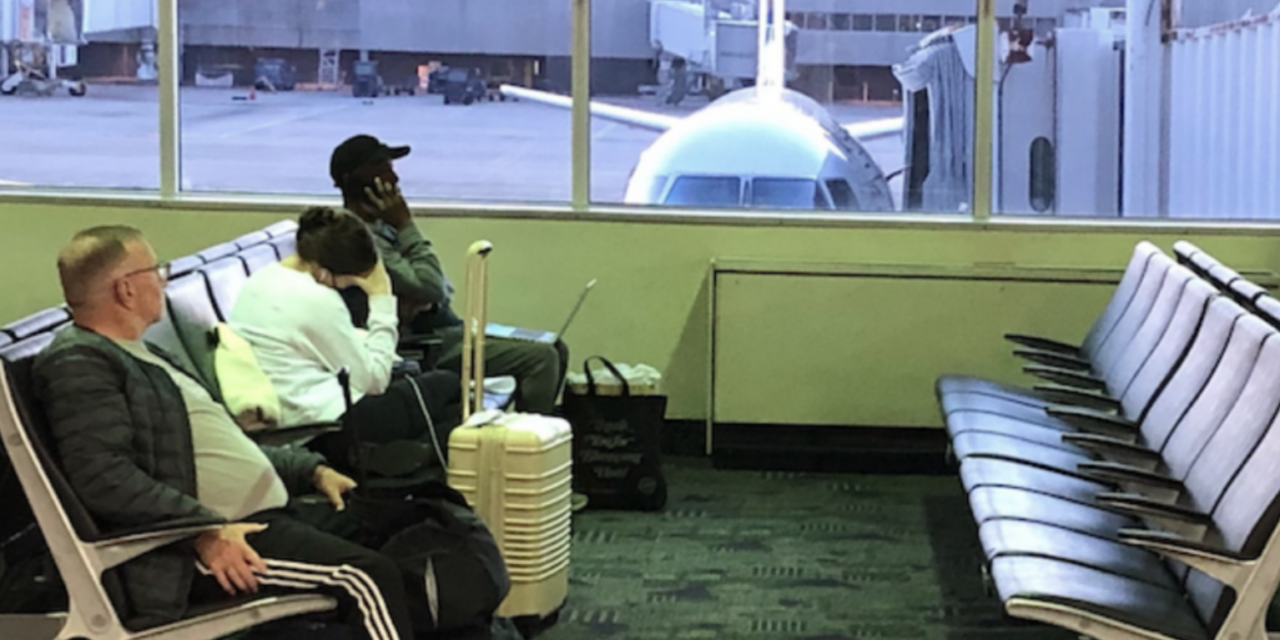
Airlines are cutting back on flights and available seats at Piedmont Triad International Airport (PTI), and the reductions may continue through the winter as carriers deal with rising operating costs and changing schedules.
Passenger traffic at PTI has declined for several consecutive months, with September traffic down about 7 percent from the same month in 2025. And while airport officials expect some improvement next spring, the immediate outlook remains challenging.
PTI Executive Director Kevin Baker said that the reductions aren’t limited to United Airlines’ decision to discontinue its nonstop service between Greensboro and Denver in January.
“We’ve also seen adjustments in flight frequencies and aircraft sizes on certain routes served by American, Delta and United,” Baker said. “These changes affect the number of seats available to passengers – even when demand for air travel remains relatively stable.”
According to Baker, the number of scheduled departing seats at PTI was down approximately 7.9 percent in September and 7.7 percent in October compared with the same months in 2025.
The reductions haven’t been uniform. Some destinations have experienced fewer flights or smaller aircraft, while others have maintained or increased their capacity.
“Some markets may have less frequency on a temporary basis, and that factors in here too,” Baker said.
The declining number of available seats helps explain why PTI’s passenger totals have been falling.
According to statistics published by the airport, PTI served 164,568 passengers in September, compared with 177,228 in September 2025. That’s a decline of 12,660 passengers, or about 7.1 percent.
August traffic was also down about 7 percent, following a decline of about 4 percent in July.
The trend isn’t confined to Greensboro.
Charlotte Douglas International Airport has also experienced declining traffic. Its passenger numbers fell approximately 4.9 percent in September compared with the previous year, and traffic was down about 7.4 percent during the first nine months of 2026.
Raleigh-Durham International Airport, however, has performed better. Transportation Security Administration screening data show departing passenger traffic at RDU increased approximately 2.3 percent during the 12 months ending in September compared with the preceding 12 months.
Although the RDU figures cover a longer period and use a different measure of passenger traffic, they suggest the slowdown hasn’t affected every North Carolina airport equally.
Nationally, airlines are adjusting their schedules even as overall seating capacity continues to grow.
According to aviation data firm OAG, scheduled seats on domestic US flights increased 2.3 percent in October compared with October 2025.
That contrasts sharply with PTI’s 7.7 percent reduction in scheduled departing seats for the same month.
One possible explanation is the rising cost of aviation fuel, which has increased dramatically since the war with Iran began in February.
Reuters reported on October 23 that U.S. jet-fuel prices had climbed approximately 90 percent since the beginning of the war, rising from $2.43 to $4.63 per gallon.
Higher fuel prices have prompted airlines to reconsider less-profitable flights and routes.
In September, executives with American, United and Southwest Airlines acknowledged scaling back planned flight schedules because of rising fuel costs. United said some flights previously planned for December wouldn’t operate, while American warned that higher fuel prices were adding substantially to its expenses.
Baker said it’s difficult to determine exactly how much fuel prices are affecting airline schedules at PTI, but he acknowledged that the higher costs aren’t helping.
“It’s hard to say if fuel costs are really impacting, but we know it’s not helping obviously,” Baker said. “If the airlines start trimming around the edges on flights, markets like ours can be the first affected.”
He said reductions might involve something as simple as eliminating one daily regional jet flight to a major connecting airport.
“Maybe one less frequency of an RJ to CLT or to ATL for instance,” Baker said, referring to Charlotte and Atlanta.
Those were examples of the kinds of reductions airlines might make, rather than confirmation that those particular flights have been eliminated.
The difference between cutting a flight and using a smaller aircraft is important: Both reduce the number of seats available, but fewer daily flights can also make travel less convenient – particularly for passengers connecting through major airline hubs.
The outlook for the coming winter isn’t especially encouraging.
“Winter months right now look like they could remain off a bit from last year’s numbers,” Baker said.
There is, however, some reason for optimism.
Baker said airline schedules currently indicate that seat capacity at PTI should increase as the airport moves into spring and summer 2027, although those schedules remain subject to change.
“As always, we continue working closely with the airlines to support existing service and pursue opportunities for additional flights,” Baker added.
PTI has never fully recovered to its pre-COVID passenger numbers, and it’s now extremely unlikely to do so in 2026.
It came remarkably close in 2025, but these declines have reversed some of that progress.