


The Trump administration thinks that “green” is a four-letter word; however, for the City of Greensboro and one department in particular, nothing could be further from the truth.
According to a newly released annual report from the city’s Office of Sustainability and Resilience, Greensboro officials spent much of 2025 pushing forward with projects aimed at reducing energy use, planting trees, increasing environmental education – and moving the city toward a long-term goal of running municipal operations on renewable energy.
The report – the 2025 Annual Progress Report & Strategic Energy Plan Implementation Year Three – outlines the progress made during the third year of the city’s Strategic Energy Plan, which calls for Greensboro’s municipal operations to transition to 100 percent renewable energy by the year 2040.
Especially now, with the federal “Drill, baby, drill” philosophy and Donald Trump’s skepticism about climate change and hatred of windmills, etc., many states and cities have been taking it upon themselves to continue these types of green efforts.
The City of Greensboro’s Office of Sustainability and Resilience was created in 2022 to coordinate those efforts and oversee a wide range of environmental and energy initiatives across city government.
Chief Sustainability Officer S. Shree Dorestant said that the city has continued to make progress in improving energy efficiency while also trying to reduce environmental impacts.
“Our progress in energy-efficiency initiatives continues to demonstrate measurable success, both in reducing operational costs and mitigating environmental impact,” Dorestant said in the report.
Among the highlights described in the report are projects aimed at everything from planting trees and educating students about sustainability to analyzing city energy use and modernizing the city’s vehicle fleet.
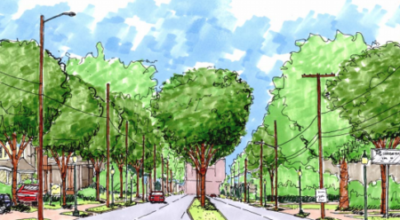
According to the report, one of the most significant accomplishments in 2025 was the completion of Greensboro’s first comprehensive tree canopy assessment since 2009.
The study found that roughly 44 percent of the city’s land area is covered by tree canopy, representing about 6 million trees across approximately 39,000 acres.
City officials say that the tree canopy is important not just for aesthetics but also for environmental and public-health reasons – including improving air quality and reducing the “urban heat island” effect that can cause cities to be hotter than surrounding rural areas.
The city also recently developed a new geographic information system tool designed to identify neighborhoods with the greatest need for additional tree cover. Officials say the tool will help prioritize future planting efforts in areas that are considered the most vulnerable to heat and environmental impacts.
During 2025, the Office of Sustainability and Resilience also organized three tree-planting events that added 52 native trees in targeted areas of the city.
Another major focus of the office has been analyzing how the city uses energy.
According to the report, the city hired a contractor to conduct energy audits of Greensboro’s 10 highest-energy-using buildings and identify ways to reduce electricity consumption. Those audits identified maintenance issues and possible improvements that could reduce energy demand in city facilities.
At the same time, the city has been looking for ways to reduce energy waste and unnecessary spending.
One review found that abandoned or unnecessary utility accounts had cost the city $294,609 over four years. By correcting billing issues and monitoring accounts more closely, departments could recover roughly $109,969 in direct savings, the report noted.
The office has also begun studying the efficiency of the city’s vehicle fleet: A one-year pilot program installed telematics devices in 100 city vehicles to track fuel use, idling time and other operating data. Early results showed that those vehicles accumulated more than 5,000 hours of idle time – consuming roughly 3,000 gallons of fuel at a cost of nearly $10,000.
City officials say that the data will eventually be used to help determine whether vehicles should be replaced with more efficient models, including hybrid or electric vehicles.
Greensboro has already begun moving in that direction in several areas: The report notes that the Greensboro Police Department purchased 32 hybrid Ford Explorer patrol vehicles, while the Greensboro Transit Agency purchased three battery-electric buses and portable charging equipment as part of its effort to reduce diesel use.
The city’s Office of Sustainability and Resilience has also been active in community outreach and education. Last year, the office hosted Greensboro’s Earth Day celebration at Keeley Park, which drew about 1,500 participants and more than 50 community exhibitors. The office also organized sustainability workshops and provided presentations and field trips for students ranging from middle school to college.
Another effort involved distributing more than 1,000 free water- and energy-conservation kits to residents through the city’s WaterWise program. That initiative allows customers to track their water use and receive conservation tips.
City officials say these types of programs are meant to encourage residents and businesses to reduce energy use alongside city government.
The just out report makes clear that Greensboro’s sustainability program is still very much a work in progress.
Some initiatives – such as improving building efficiency, expanding electric vehicles and updating greenhouse-gas inventories – are ongoing and are expected to continue over the next several years.
However, city officials say the annual report is meant to show that Greensboro is steadily moving toward the long-term goals outlined in its Strategic Energy Plan.




I’m glad we studied the tree canopy. I’m glad we have battery buses but who rides them? The buses I see have few if any riders. Abandoned or unnessary utility accounts wasting $294k tax dollars! Really? A good story Scott but just another created department of govt bloat costing more tax dollars.
turn ‘public transport’ over to gig drivers (uber etc) & create door to door transport with stops for pickups. capitalism & entrepreneurs get stuff done efficiently because of the profit motive & competition for consumers who are NOW free to choose sans guvmnt monopoly.
i have a transport/drayage business idea for all the COG & school system buses that will become the infrastructure for worker owned BEACH BUS transport from waynesville east west to all NC coast & myrtle beach modeled on uber ride share etc. owners drive, maintain, coordinate THEIR bus etc. in a network with some stops & 5 transfer points
ditto Jv
—————-
Oh dear.
Scott’s snide shots at the President are as irrelevant as they are unwelcome. Not only has The Rhino ceased to be a journalistic resource for Guilford Country – now essentially just rephrasing press releases – but the Editor has become comfortable enough to risk alienating his own core readership.
I liked The Rhino better when it exemplified journalism, not lazy regurgitation.
I just said the president doesn’t like green, which is true.
Austin doesn’t like or believe in anything that doesn’t agree with him…..the ‘think for yourself crowd’ only believe you are ‘thinking for yourself’ if you 100% agree with them.
————
Not relevant to this local story… unless you just want to take gratuitous swipes at Trump.
.
Austin, it is only a swipe if you assume he is wrong on the issue. I would assume that you agree with him on this. I am not sure though. I don’t think you have commented much on this matter. Scott
———–
No Scott, your piece obviously swipes at Trump. Your opening sentence is: ” The Trump Administration thinks that green is a four letter word”.
You couldn’t have staked out your opinion more clearly.
This story has nothing to do with Trump. It is a local government initiative in Greensboro, North Carolina.
Your swipes at the President are gratuitous and irrelevant to the story.
Right?
Trump thinks of green the same way he thinks of DEI. It is totally relevant that local governments across the country like Greensboro are upping environmental efforts because the feds have stopped and pulled out of climate change agreements.
———–
And whether I agree with Trump in a general sense about the Green agenda is not the point.
—————–
The Paris Agreement has nothing to do with this.
At least you have confirmed the profoundly different editorial stance since John Hammer left the helm, not that we haven’t noticed.
But hey, it’s your newspaper.
I just prefer to have Opinion and News separated. And I hope The Rhinoceros Times doesn’t suffer a long slow suicide like the News & Record.
Scott, isn’t it frustrating how Austin (or whatever his real name is) ignores your rationale for including the Trump comment in your articles and just focuses on his point of view by repeating himself….zero real engagement, just repeating his point of view with no real concern for your thoughts on the subject. Zero ability to actually engage. Oh well.
Best wishes.
It is a little annoying.
————–
Then again, maybe a local government initiative in a small city in North Carolina had nothing to do with Trump. You know, because it has nothing to do with Trump.
The cheap shots at the President are as gratuitous as they are unwarranted and irrelevant – -as commenters PACLOC and Esra agree.
But at least we all now know where the new Editor of this publication stands politically.
With “Professor Chris”, and his values.
Trump has the lowest approval ratings in the history of use of the metric. A wide range of people with very different political views, dislike Trump and many of his actions as President. Lumping them all into one bucket just shows how little respect you have for other people’s point of view.
Identity politics is destroying this country.
The funny thing is, I never took a position on environmental issues in the article stating that Trump thinks green is a four letter word, which is totally true. (I often think environmentalists go way too far). The president also thinks DEI is a four letter word. If you agree with him on those issues, which most of his supporters do, why is that a swipe in any way. It’s just a simple fact. If he does something good, like shut down the boarder, I acknowledge it, however if he does something not so good, like tell people you can’t have your legal gun with your valid carry license at a protest, well, that’s where we split ways. He said, after the shooting of Alex Pretti,
“You can’t have guns (at a protest) . You can’t walk in with guns,” – well, I believe the second amendment is an inalienable constitutional right and you absolutely do have the right to take it to a protest or a rally or in a crowded group of celebrants, or any legal venue or street corner for that matter because that’s exactly where you may need it most. So yes, you do have a right to conceal carry in those situations no matter what the president or Kristi Noem says. What people should remember is that I was the Libertarian candidate for governor in 1996 and I am still a Libertarian. To me, most Rhino readers are big government people to the left of me on the political spectrum.
I would think most Rhino readers are small government but agree to the left of a hardline libertarian.
I will forever believe big business needs regulation and without government, they would rape the environment, abuse the workers and in the end tank the economy. But even when I voted republican, I was fiscally conservative and socially liberal.
————–
Thanks for the extensive, if rambling, reply. Scott, we agree on many of the issues you refer to, and other things that are objectively true. The fact that they are true is irrelevant The Sun is 93 million miles from the Earth, but you failed to mention it – because it’s irrelevant!
Your characterization of Trump’s beliefs about the Green Agenda is true, I dare say, but they have nothing to do with this initiative in our town. Trying to connect the two is a stretch.
And that’s why your swipes at Trump come across as “unnecessary”, “sad” (PACLOC), and “cheap shots” (Esra).
Because they are exactly that, and I’m not the only one who noticed. It’s a shame you can’t see it… or won’t admit to it.
It’s bleedin’ obvious.
.
———–
PS
I had overlooked “Socrates” who also complained about “poking the Trump base”, and now “Jim” has gone to the trouble of complaining about it too (“Unnecessary and alienating”).
So that’s five of us, and for every person who chooses to comment there are dozens who just shake their head.
Hey, it’s your newspaper Scott, and you have every right to randomly and gratuitously smear Trump.
But at least admit it.
Austin, I’m asking because I’m interested. Do you agree with Trump that going green is a big mistake because of the cost and downsides, or do you lean more toward it better to err on the side of caution and preserved the environment even if doing so creates big problems in other areas – such as economic prosperity.
———
Scott, I’d answer the question if it were germane. The issue we’re debating is whether your disparaging references to the President were relevant or just cheap pot shots.
It looks like several commenters agree that they were unwarranted.
And Scott, we don’t have a Mexican boarder – unless he’s living in our house.
We have a Mexican border.
Stating the truth is cheap shot? Weird.
—————
Professor Chris, the word twister.
Wow! I had no idea you ran in 1996 Scott. That is so great.
Yes, it was an experience. I always like to say that Jim Hunt only got to be governor by beating me. LOL.
austin, i can make relevant swipes @ t)rump
I do not agree with you that Trump does not like “green.” I think he is an extraordinarily practical person and views problems based on immediacy. Based on his decisions made to date, I believe he is trying to balance what is important to help America get over the encumbrances put in place by environmentalists to make the environment more important in the present than the average American’s way of life. The environment is a complicated issue. Mankind has been destroying the environment incrementally for thousands of years.
Trump clearly hates Green Energy. I can provide you a hundred quotes of his ‘anti-green’ energy position, or his anti-climate change point of view, or give you the numerous Green energy programs his has tried to kill (many of them illegally)….Drill Baby Drill, the lie about clean oil and how we need to burn more coal.
To be fair, Trump doesn’t care about green energy, the environment, or coal jobs, etc….he just cares about big oil money. Nothing more, nothing less. Peter is dead right….only Green Trump likes is money. Greed is his only motivator other than his ego.
Professor, you might need to look at our power systems in America. We have neither the resources or infrastructure to go green. Look at Texas a few years ago, how many died because of a ill advised wind field to supply homes without backup. Liberals love rubbing each other on the back saying how good it is.
Wait, you are blaming the power outages in Texas on wind power?
While there were some wind turbines that froze up during the winter storm, it was a system wide event where every source struggled due extreme cold.
Other data points you seem to have missed:
– Wind is expected to only represent 7% to 10% of total capacity during peak winter reason
– The loss from thermal sources was nearly double that of wind with 30 GW of capacity failing.
– Natural Gas Failures was the largest cause of the blackouts. Natural gas wellheads and pipelines froze (known as freeze offs) and power outages at compressor stations further chocked the fuel supply to power plants.
– Even Coal and Nuclear plants lost 10 GW of capacity as pipe and sensors froze, even one nuclear reactor tripped and was shut down due to the lack of winterization of infrastructure in TX.
Hope this helps you understand that in TX, the lack of winterization lead of ALL types of power infrastructure failure.
Note that Denmark generates nearly 60% of it power from wind….but they winterize their infrastructure for obvious reasons while Texas didn’t make that investment for obvious reasons.
Numerous countries have proven that Green energy works (and is cheaper) if governments just allow the investment and stop using ignorance to demonize change.
Scott, this is in response to your comment about carrying a firearm concealed or open to a protest. As a lifetime NRA member I fully support the 2nd amendment and also feel that I should have the right to carry when I attend a protest , parade or whatever but in Greensboro it is illegal to do so. It is a class 2 misdemeanor to have any type of weapon that can cause injury to others President Trump may be right and apparently he’s not the only one who feels that way
Good point. I agree we should follow gun laws of course; however, I think in Minnesota you are within your rights to have gun at a protest. It is also important to note that he never reached for it and he was completely disarmed before being shot and killed.
————
Yeah, I also agree that a legal firearm owner has every right to carry a gun at a protest.
Even in Greensboro.
rebel, i am retired military & the most powerful weapon i ever experienced was my mother’s mouth. if u have any neurons use THEM
Actually I think Trump loves it when he hits the green.
Good point Scott and yes you are correct. In Minnesota you are legally allowed to carry a concealed firearm at a protest as long as you have a permit. But, as always the but please take a moment and goggle if carrying a gun is allowed at a protest in Minnesota, then read all the way through to the last paragraph and tell us what it says. I’m just curious about your opinion on this. I do appreciate the opportunity to have a objective discussion on this topic
Rebel, this is the last paragraph I found when I googled that: “Limitations: While the act of carrying is legal, it is still unlawful to brandish a weapon, threaten individuals, incite violence, or use the weapon to interfere with law enforcement.” Is this what you are referring to. If so, this is sensible to me — it should only be used in self defense. From my view of the film, he didn’t do any of this that I saw, so in my view he remained within his rights all the way up until he was shot and killed.
scott, what is green, 1 1/2 mile long & has an ~IQ of 80 ? . . . a st patrick’s day parade !
i don’t like ‘green’ between my toes
Seriously? You can’t write a positive article about the environment without maligning President Trump? That was absolutely unnecessary. Sad,
————-
PACLOC seems to agree….
Truth hurts I guess.
Scott I wasn’t on that site the one I was on, the last paragraph said even though it IS legal to legally carry a weapon to a protest one should use common sense especially in very high profile and volatile situations. I think this was just common sense advice that most rational thinking people would follow. Just my opinion but after Ms. Goode was killed I don’t think I would have considered carrying my gun to that particular protest especially given the previous actions of ICE agents and the emotional strain that they were under. I support ICE and the duty they are charged to perform, but i don’t intend to put myself between them and anyone else That’s the same with stupid people who choose to fight with Police, most of the time there are always more of them and the outcome is never good
This is a thoughtful statement and I think we agree on a lot. Whenever I am pulled over I keep my hands on the wheel where they can be seen, I don’t make any sudden movements, I respond politely with things like “Yes officer,” and “No officer,” and “In order to show my registration I need to reach into the glove box.” I am always amazed at people who get out of the car frantic and screaming at an officer. I also agree that, while it is your right to carry a gun to highly charged political protest, it is not a good idea to do so. I support whole heartedly the deportation of violent criminals who are here illegally. Unlike some readers, I also believe people have a right to protest and that ICE officers and other law enforcement officers have to also make wise decisions. In the case of Pretti, he was filming ICE with his phone (also his constitutional right), he tried to help a woman who was being manhandled, got thrown to the ground, by, what, five masked agents, got pepper sprayed in face, and disarmed. During that time he never once went for his gun; he was helpless on the ground and disarmed and shot in the back ten times – four times while still moving and six times while already lifeless. Administration officials immediately called him a domestic terrorist and said he was out to kill as many ICE agents as possible. Even though that was clearly not the case, to this day they have not appologized for maligning his name after executing him in the street. Also, the federal government announced initially that there would never be no investigation and they thwarted local officials from investigating. It is amazing to me that so many people who support Trump see nothing wrong with any of that. The reason it amazes me is because, that type of action and reaction completely undermines the effort to get more criminal aliens off the street. Deportation was once Trump’s strongest approval ratings and now he and ICE are way underwater on that issue, Kristi Noem has been fired, and the efforts in Minnesota have met more resistance than ever. For those support ICE and what they are doing, they should support them doing their jobs in a professional manner, showing some restraint, and be able to admit a mistake when they make it and apologize.
Thanks Scott. I personally agree with everything you’ve said. I am not trying to defend ICE, in some ways there is no defense but unless you have been in the same type of hyped up volatile situation it’s easy to Monday morning quarterback. In combat there are times you try to square things later in your mind about pulling that trigger 1 time or a full auto burst. I think true Karma is the late night thoughts about what you feel about the actions you have taken in your life. A lot of nights it not peaceful, that’s my thoughts on what those ICE will always feel. Thanks Scott
——————–
Well stated, Reb.
I also thought that guy’s killing was atrocious, but it looked like one cop opening fire was the cue for the others to join in. The guy didn’t have a chance.
It was impossible to see exactly how it went down though.
Scott here’s a handy tip. Clip your registration and insurance card on top of of your sun visor, then there’s no reaching for the glove box
Good idea!
As a heavy-footed driver, I can advise that State Troopers no longer request your registration and proof of insurance. I assume they have that tied to your drivers ID on the computer.
i have not seen a single new tree planted when driving around greensburl. how can these city officials lie to our faces and get away with it? they tell us theyre raising taxes to “help the environment” yeah right. for all i know this is probably how they launder the drug money in from the east side. and what is with that office’s name? “office of sustainability and resilience?” just name it something normal like the environment office or even better get rid of the dang thing. why cant the city dot manage treeplanting? most city land is roads anyway just put them trees in the median
yesterday it was the fire dept and their “people and culture” position and today it’s the “office of sustainability and resilience!” completely meaningless alphabet soup deliberately designed to mean nothing and conceal real purpose. what a big joke
ditto twang
the greenway just made existing sidewalks twice as wide in my downtown neighborhood. why? because many people are really obese ?
those trees are one of the little things that make me love my hometown so much. thank you greensboro!
Green IS a four-letter word when you believe electric vehicles are less pollutant than those which are hybrids or gas engines. EV batteries cannot be recycled. Further, in order to create an EV battery, the mining of the materials needed for the battery creates far more pollution than a gas engined car any day. Do the research! Further, these batteries are currently only produced in China, which means every purchase of one sends money to the CCP and the Chinese Armed Forces. Wind turbines are also only produced in China. However, that is not the worst of the issues. They cause interruption with the natural life cycles of most sea life, cannot be recycled, kill thousands of birds annually–all in the name of very expensive electricity and not much of it. For all the money wasted on wind, solar, and other forms of green energy, we have approximately 400 years of oil under us with nearly as much coal, both of which are much cheaper forms of energy. This doesn`t even include natural gas. Stop being stupid with taxpayer`s money and return to using gas-powered buses and cars for the city.
EV batteries can very much be recycled. Modern methods can recover 95% of key metals that are reused in making new batteries. The industry is fast ramping up with the increased use of these batteries in both cars and stationary energy sources (such as AI data centers). Most recent estimates are that almost 60% of batteries that have reached end of life have been recycled or are ‘owned’ by recycling plants being ramped up. Interesting enough, China is the leader in this industry so the US continues to give valuable resources to China because people such as yourself refused to ‘believe’ in the importance of alternative energy.
Also keep in mind that EV battery life has been greatly increased with the newest batteries and that most batteries manufactured in the US remain in use. So, you if care for our environment (as you claim) maybe you should listen to the actual scientists that study how our oil-based economies have and are doing far more damage than the current alternative energy solutions being developed.
Maybe you should expand YOUR research.
Best wishes.
Recycling batteries is a complicated process and can and does present methods that are environmentally unsafe. As far as your “actual scientists,” all activists can find a scientist(s) who can put fourth an argument in support of their view. About an oil-based economy, oil is a gift that has resulted in a better and more advanced way of life, from farming to pharmaceuticals. Rather than looking at just your local environment, look around the world; oil is a life saver all over the world. Is oil a polluter of the environment? Of course, it is. And so is fire from a bonfire, so is barbequing in your backyard, and so are data centers, which will be used in the future to spy on the local population along with pinging towers.
And driving a gas powered car is bad due the environment. And driving a car is something you do daily with the car versus any potential environmental risk from recycling a battery after 15 years if clean use.
Weird the twists conservatives take to protect big oil in light of massive amount if sciencitific evidence that it is destroying our environment.
Your comments are directed at gas-powered vehicles. I acknowledge that they pollute the environment as do airplanes. It is interesting that environmentalists don’t seem to focus on polluting air traffic. I suspect that’s because environmentalists’ favorite mode of transportation is air travel. We peons now have the means to own and drive a vehicle and this chaps the butts of people who like to believe that they are superior to wee peons. It is my view that hardcore environmentalists engage in class warfare. Now governments have entered the fray by trying to ban vehicles by surreptitious means such as removing parking.
Why do you think that pointing out the obvious makes me conservative? A broadminded person can weigh both sides of a debate without labeling.
Environmentalists very much focus on overuse of airplanes. Sadly, there isn’t much of an alternative as the US seems unable to invest in highspeed rail and electric planes aren’t really an option as far as I understand the limitations of the tech. I for one travel far less by air as my industry has embraced remote work. THAT is real progress.
The conspiracy theory of local governments making cars more difficult to own by reducing parking cracks me up. No evidence of this being real and frankly, as someone living in the southern US where we have little public transportation, it is an absurd idea.
I call out the weird twists of logic you use to demonize change as the sign you are conservative versus your willingness to embrace needed change required to preserve a better future for our kids and grandkids.
Hope that helps.
ditto, term limits
ditto professor. my comments r brief because of short attention spans (mine)
biking downtown is fast easy peasy & the greenway is attracting many users on foot & bike reducing need for parking
I love the greenway. Biking is a healthy hobby of mine and the city government has done such a wonderful job in maintaining the greenway. It’s little things like this that make me love my hometown.
EV bikes n scooters r rapidly increasing on the greenway saving the $12k to $25k per year that AAA says it costs for MV ownership. i saw richard petty fly by on one !
& i didn’t HAVE TO hear him or smell him go by but he did drop trash like ~5% of all traffic? just kidding. all traffic using the greenway are QUIET & DON’T STINK eg wheeled EV’s, bean powered bikes, RUNNERS !
Totally agree on the Trump remarks. Unnecessary and alienating. Also does anybody buy that windmills are good for the environment anymore? Love the focus on trees and have no problem on hybrid vehicles to save gas except the batteries come from China and are major polluters but Scott if you start going TDS on us I’m unscribing. It’s fair to criticize but keep it in perspective. Trumps not the only one realizing the boondoggle of windmills and environmental cost of them.
The whole world is suffering from the Green Hoax. Reduce energy usage? Great. How about adjusting city thermostats to the same that the citizens use at home? Reducing unnecessary trips? Super. Electric cars? Not only no but hell no.
Sadly, the world (and you) are suffering from willful ignorance at the hand of big oil propaganda.
Best wishes.
Sadly, the world (and you) are suffering from willful ignorance at the hand of the environmental propaganda.
Show many evidence that the massive acceleration of global temperature isnt happening, or isn’t the direct result of man’s overuse of carbon energy.
There isn’t any. Just random none climate scientists playing critics. Show me realndsta thst proves rapid climate change isn’t happening, isn’t bad, or isn’t the result of man. Bet you can’t.
Climate is changing. No debate about that. The debate is how much is attributed to humans and, just as important, what can be done about it. Environmentalists’ reaction is to shut down or alter human behavior without allowing for the consequences of that change. I have no statistics at my fingertips, but I’ll bet that water and air are cleaner today than 20 years ago.
There really isn’t a debate among people who actually study climate. Only those on the sidelines who resist the change for either profit or ignorance. The data makes very clear that man is driving the massive acceleration of global warming that has NEVER been seen in the history of our planet. Some facts to help you understand the problem:
– The planet is currently warming 10x faster today that it did the last post-ice age warming period
– New data from 2026 confirms that global warming has significantly accelerated since around 2015 with the warming rate nearly doubling compared to the 1970’s.
– 56 million years ago a massive carbon release (PETM) is often cited as the best natural analog for current warming….temperatures jumped 5 to 8 degrees Celsius…but that occurred over thousands of years. Current human carbon emissions are estimated to be 9 to 10x times higher annually than they were during the peak of the PETM.
Clean water doesn’t fit into the climate change equation. Why bring that into the debate? Weird.
terml: > knowledge has < my happiness
Mark advocates ignorance ! Take your Soma and neutralize yourself.
Ignorance is bliss… to the ignorant.
Tune out, Mark, if you want foggy euphoria.
terml, stupid is forever but 4 the ignorant there is hope ?
5 high temp records have been set here in the past 2 months & don’t eat the apex predator fish if u are pregnant because of pollution from coal burning & industry pollution. move back to the rust belt or NJ
—————
And several record lows set this winter.
ditto austin: a low temp record of 6* set in the 1920’s was BROKEN by 3* . i wore thermals & a warm hat to bed just like all frugal people who understand CLOTHING. cooking on gas stove helps heat my house
——-
Many years ago I watched a BBC documentary about new homes in Sweden that were designed to be heated solely by the heat produced by appliances. The reporter was an obvious environmentalist, but I never heard anything more about these houses.
Perhaps he was exaggerating.
My grandfather was a coal merchant, and good Welsh anthracite will make your home incandescent with heat! We used to open the back door for a while in January, just to let some of the heat out.
A good Welsh anthracite also poisons our air and warms our climate.
———————-
It’s a miracle we all survived, ain’t it?
.
Are you pretending that use of coal didn’t negatively impact communities that overused it as heat? Are you pretending that coal isn’t a contributor the climate change?
You can look up the study that showed how communities relying on coal for heating reduced average life spans by 3.1 to 5.5 year due to higher particulate pollution.
Or the studies that showed how air pollution was 55% higher in communities and cities that relied on coal for heat.
Or the study that showed 19th century Britain coal use for industrial and domestic heat was found that have reduced life expectancy by over 5% in heavily polluted cities like Manchester and Sheffield
Or the study that showed that particle pollution from coal is twice as deadly as previously believed, with over 460k deaths attributable to it in the US between 1999 and 2020.
Or the numerous studies that point to the strong link between coal smoke and increase respiratory and cardiovascular diseases?
Let me guess Austin (or whatever you real name is), all you can do to respond these facts is call me childish names and say na uh. But I am just guessing.
Best Wishes
—————
Well at least you’re right about one thing; I’m going to call you a childish name.
You’re a wanker. A right wanker, as they say in Yorkshire.
A pathetic, nerdy, navel-gazing, jobless little wanker.
Get a life, you loser.
Facts always make an anti-science nutter mad. Always. It really wasn’t a guess.
don’t confuse weather with climate. A mistake made by many that choose willful ignorance about climate change.
….. and don’t confuse reality with beliefs.
Leftists won’t allow the former to impinge on the latter.
I don’t. I believe in facts, science, and data. Unlike conservatives who believe conspiracy theories.
But you be you
Totally agree on the Trump remarks. Unnecessary and alienating. Also does anybody buy that windmills are good for the environment anymore? Love the focus on trees and have no problem on hybrid vehicles to save gas except the batteries come from China and are major polluters but Scott if you start going TDS on us I’m unscribing. It’s fair to criticize but keep it in perspective. Trumps not the only one realizing the boondoggle of windmills and environmental cost of them. The damage to a dwindling bird population and whale population is unforgivable and cruel.
You know this guy is a Trump supporter because everything he said is factually incorrect.
Office of Sustainability and Resilience. This is the group that helped the city council to decide to end loose leaf pickup. The slogan? “Leave the Leaves.” Nice. I read they now have a full-time staff of 11 employees. I couldn’t find the total budget for this office. I would guess between $1 and $2 million per year, minimum. Getting rid of loose-leaf collection saved the city only about $600,000 per year. And not counted is the cost citizen had to pay for private collection. I paid about $500. So the city got rid of a very economical service valued by many. And tell us to leave the leaves. Of course, for many of us, that is not an option. This is our city leadership in action. Time to move.
ditto ken & the collected leaves were composted & sold to the public in a virtuous loop.
Knowing something about gardening and trees, I would like to know what native trees that the Office of Sustainability and Resilience has planted and where. Most native trees are large, tall trees; think the mighty oak, red maple, and eastern red cedar. There are smaller trees that are native such as the flowering dogwood and the Carolina silverbell. There are very, very few locations in Greensboro where oaks and maples can or would be planted. So, that leaves very few smaller native trees to plant. Therefore, my question to Sustainability and Resilience, where did you plant the native trees?
term limits, tulip(yellow) poplars, my best former honey source, are almost eradicated in neighborhoods close to downtown where i had many stands. dumpster nectar from soft drink cans seems is being collected now. i laugh @ progress in old age. when was the last time u saw a healthy swarm that made it undiseased thru the winter
term limits, tulip(yellow) poplars, my best former honey source, are almost eradicated in neighborhoods close to downtown where i had many stands. dumpster nectar from soft drink cans is being collected now. i laugh @ progress in old age. when was the last time u saw a healthy swarm that made it undiseased thru the winter
Yes, bees love the nectar from tulip poplar trees. While I prefer clover honey, tulip poplar honey is hard to fine, maybe in the mountains. Poplar trees will be blooming in a month or so.
term limits, i have bait hives 4 swarms on my roof ready to go. my business: The Bee Good Company
The article writer is poking the Trump base about an issue he feels is relevant. Maybe he will also do the same about the prospect of a nuclear free Iran.
lol! Yeah, why the cheap shots at Trump???
esra, perhaps the third shot will b the charm
I, like almost everyone around the world, am in favor of a nuclear free Iran.
I have a difficult time squaring the outcry of Iran having a nuclear bomb when there is not a peep about Israel, Pakistan, India, France, North Korea, US, and other countries having nukes. Does the world believe there is no nuke risk from other countries? What if India and Pakistan go at it. Does that mean that the US will not be affected? The oil in the ointment with Iran is Israel. The charge in the current conflict is Israel.
careful ! the game is whack-a-mole ! notice that when ‘medias’ shouted about iran’s nuclear program there was NOT A PEEP about israel’s ? medias have tribal ownership
The Islamist rulers of Iran disagree with you.
I don’t understand your comment.
i am in favor of nuclear free israel & iran
Let’s put a windmill in your front yard DA
I am building one to run the electricity in my barn. Rather excited about it really. Free electricity to run heaters for chickens, lights for me, and fans in the summer for the chickens. Woohoo!
this is a poor location for sailboats & windmills .
this is a poor location for sailboats & windmills .
If Greensboro is such a “green environmental friendly city” can someone please explain how the practice of having all the city trash trucks dump their trash at a dump site near the airport where it then loaded onto large dump trucks and driven over 70 miles to a Republic owned dump site in Biscoe and then drive 70 miles back to Greensboro. Hilco the trucking company that has the contract with the city runs multiple trucks daily on this route 5 days a week. Please explain how this is environmentally friendly or sustainable, not to mention extremely expensive. Scott whenever you get time look into the cost of this contract with Hilco trucking and see if you and I agree. Greensboro had a landfill that had at least 40 more years of useful service life left.
I’ll check into it.
I think the Rhino covered the landfill expansion several years back. While designed to be expanded and the land already zoned appropriately, local residents fought off the expansion as if they didn’t realize they lived neared a landfill.
Also Scott I’m pretty sure the trash transfer station has been open over 15 years but it seems Hilco is the only Co. to ever have the contract to haul the city’s garbage to the landfill. That just seems a little odd to me.
will, the white st landfill had low income black residents who VOLUNTARILY lived closeby that played their RACE card & caused the situation u describe. dun
I am just waiting for Austin to come riding in on a donkey to fight my windmill. Do you think Trump will block my project?
Professor again you have no idea what you are talking about. The landfill had been there more years than most of the people who moved there were old. Also maybe you don’t know but a couple of the newer neighborhoods off of 16th Street, people were given incentives to move there including low interest rates, lower home prices as well as upfront cash. They were very much aware of the proximity to the landfill. Maybe you should do some more research before posting again.
LOL, ok Will……maybe you need to try and research yourself. It really isn’t that hard to do…
….but ’95 they did complain about the expansion of the White Street Landfill (technically reopening to household trash) and the city did not expand the landfill as a result. Yes, they should have known that was an option when they moved into that area but they complained and whoops, the city backed down and here we are transporting trash. It was covered here in the Rhino in several articles.
Want help in how to use the internet? Go to your local library. They are very helpful with any research topic.
——–
Please try to get over me, buddy.
Your weird, creepy fixation is showing.
Good luck with your mental health issues – but you probably should seek help.
Best Wishes,
– Austin
LOL, I can’t help it….every time I think of a moron MAGA type, you come to mind. LMAO
—————-
One of us is certainly a moron.
Pitiful, too.
Sorry you think so little of yourself. But if the shoe fits.
———-
I’m not the one who’s inadequate, insecure, and inarticulate.
You are.
Unfortunately, as usual, this turned into arguments amongst the comments section. I’m in no way a tree hugger or left leaning environmentalist; but I hate when I see these neighborhoods thrown up with houses on top of each and no trees and it’s only going to get worse as the lack of housing issue is worked on. Can we have regulations that make neighborhoods be built and not clear out all the trees. And the industrial warehouses being built, especially in eastern Guilford County, is ridiculous and most of them sit empty. Then you have ones built for a business to locate here, give that business incentives, and then the business closes a couple of years later. How about we take the empty warehouses and turn them into housing.
welcome to left leaning trees hugging, wood fires n singing birds have SOMETHING concrete lacks
Chris white Street landfill was opened in the early 40’s it started accepting household waste in the.60’s and yes it was rural then and lots of families lived in the area. My grandfather was one of those right off of McKnight Mill Rd. And as far as people knowing they were buying homes near a landfill all the homes in the Nealtown neighborhood were sold with a document attached that had to be signed acknowledging that the buyer knew what they were buying. That’s how they received the incentives to buy in that area. The landfill closed to residential waste in 2000’s But the state had approved the new expansion before then. All landfills are state regulated I know the reason it was closed but I’m sure you would love to give us your long version of the story so by all means indulge us.
Gald we agree on the history of the landfill. You were the one bent out of shape when I pointed it out. Weird
What are you talking about. We never agreed on anything. You never once talked about the history of the landfill. Then you said that people didn’t know about the landfill when they bought property close by which is factually wrong They knew and agreed then it became a black political issue. With the city council at the time it was a done deal. You such a sad little thing on our planet
ugh…do you read my comments before replying? I said they complained not that they didn’t know….and their complaints were successful in getting the council to cancel expanding the landfill. THAT is the history I discussed.
But you be you.
————
This guy “Professor Chris” deliberately mis-states your position in an attempt to smear you and “win” the argument.
It’s his M.O., Will.
Scott were you able to find out how much Greensboro is paying Hilco to haul the trash to the landfill