


The Carpenters once had a nice song called Rainy Days and Mondays – and while rainy days will continue in the future, Mondays will not, at least not for the printed edition of the News & Record.
The announcement came in the form of an email to print subscribers on Monday, Oct. 6, with the paper notifying readers that, starting the week of November 3, the News & Record will stop printing on Mondays. It will still publish Tuesday through Sunday, but the first day of the work week will now be digital only.
The company’s leaders explained that it was a cost-saving move brought on by industry pressures, advertising challenges and rising print costs.
To longtime readers of the paper, it feels like a very large sign. It feels like one more nail in the coffin.
For over a century, the News & Record printed seven days a week. The vanishing of the Monday print edition is just the latest stage in a slow, painful shrinkage that’s been obvious for years.
The paper’s letter to subscribers tried to put a positive face on the change. Executive Editor Dimon Kendrick-Holmes wrote that the digital e-edition will still be published seven days a week, complete with comics and puzzles, and also wrote that “your story lives here.”
The email included phone numbers, links and reassurances that the staff “live here, work here, and are part of the fabric of this community.”
All of that may be true – but anyone watching the trajectory of the News & Record could not help but notice that the fabric of the paper is fraying.
Over the last two decades, the Greensboro paper has grown thinner and thinner. The width of the pages literally shrank. The number of sections declined. Some holidays were skipped, breaking the old streak of 365 papers every year.
The best-known comic strips disappeared. The prominent downtown headquarters was abandoned and demolished and many operations were moved to Winston-Salem.
Even the typos grew more frequent. Every newspaper makes mistakes, but the News & Record in recent years reached the point where there were some very obvious ones in headlines and its editors even had to publish explanations telling readers why typos and other errors were showing up so often and why a newspaper didn’t make it to their driveway that day.
Then there’s the content. Local reporting that once filled the pages has steadily dried up over the years. After the first two pages, much of the material consists of the Associated Press stories that were on the television news two days earlier. There have been fewer stories with actual Greensboro ties.
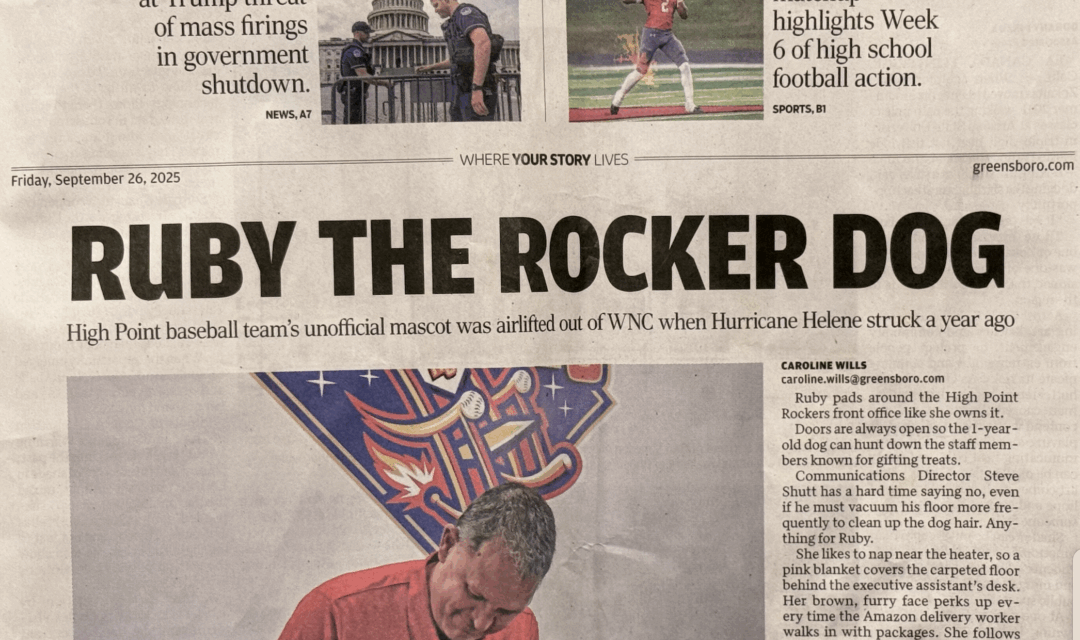
Even those front page stories sometimes seem trivial. Recently, the Greensboro paper ran a front page, above the fold story about Ruby the Rocker Dog, which was about the mascot dog for the High Point baseball team.
Not that many years ago, if a big story happened just before midnight, it could still make the morning paper. However, about eight years ago, deadlines were rolled back to 8 p.m. – so, by the time the paper hit doorsteps, much of the “news” was already yesterday’s news. The story about the big Saturday evening Duke-Carolina basketball game, for instance, would be stale by the time it was in the printed issue of the News & Record on Monday.
The paper’s retreat from the local beat has been easy to see at public meetings of local governments. Twenty years ago, as the Rhino Times covered the Guilford County Board of Commissioners, there would always be a News & Record reporter at the table – and, usually, one from the High Point Enterprise. Over time, the N&R stopped showing up to commissioners’ meetings. These days, it’s almost always the case that the Rhino Times is the only media outlet in the meeting room.
The circulation numbers tell the story even more starkly.
In 2006, the News & Record had a daily circulation of about 90,400 and a Sunday circulation around 111,000.
In 2021, it claimed a daily circulation of 21,510.
In 2023, the paper reported a daily circulation of 15,151 and a Sunday circulation of 16,725.
In 2025, one report showed a daily average print run of just at 7,000 for the N&R. That’s in a county of roughly 550,000 people. And keep in mind that some of those 7,000 copies go straight from driveways to recycling bins. Others languish unbought on racks or in stores.
To anyone who lived in Greensboro in the 1960s or 1970s, the new numbers are almost unimaginable. Back then, it seemed as though every household got the paper – actually, got two papers. The Greensboro News landed on the porch in the morning, and the Greensboro Record hit the doorstep around 3:30 in the afternoon. In the early 1980s the two paper’s merged into the Greensboro News & Record, which was still thick with local stories and ads.
Years ago, the paper dropped the word “Greensboro” from its name. Many in the industry thought it was a mistake.
Former Rhino Times editor and former owner John Hammer used to call it the “Eleven County Area News & Record” whenever he wrote about it, because it seemed to cover everywhere in central North Carolina, with just a little Greensboro news thrown in.
That expansion of focus stretched the staff thin – and Greensboro readers paid the price.
The Rhino Times began to cancel its News & Record print subscription several years ago but was then offered a special rate of $8 a month. Last week, the Rhino Times was informed that the price of the subscription would now be going back up to several hundred dollars a year. That means the N&R will be losing more subscribers as those discounted rates are taken away.
The new cutback in print for the N&R comes on the heels of a similar move by the High Point Enterprise, which has already dropped two days of print.
Across the country, local newspapers are folding, shrinking or retreating to online-only operations.
The Rhino Times itself ended its print edition in 2018, and while the Rhino is never pleased to see another local news outlet slip, the trend line is obvious.
The N&R’s own subscriber letter promised that the seven-day digital replica will be “waiting for you to page through, zoom in on, and print stories from.” It assured readers that comics, puzzles and syndicated columnists will still be there, along with hundreds of online strips and dozens of crosswords. “Your stories have always lived here and been at the heart of what we do, and that will never change,” the editor’s note declared.
But even those words underscored what has changed. The commitment is now to an e-edition, not to a physical paper. And once a newspaper breaks the seven-day habit, history suggests it rarely goes back.
It’s worth pausing to remember just how dominant the paper once was. In the 1970s, the News & Record was everywhere and packed with all sorts of things: grocery ads, job listings, high school sports scores, obituaries, court reports – the paper was the main conduit for community life in the area. If you wanted to know what the Greensboro City Council had decided, or which local business was opening, or which candidate was running for county office, you found it in the News & Record.
You can still do some of that with the paper, but the fall of the Monday print version may well be a sign of more evaporation to come.




A propaganda rag shrinking into the irrelevance it deserves.
To be fair, the Rhino Times has to cancel its print entirely well before the News and Fishwrap did….what does that tell you?
———-
That the environment for free alternative newspapers was even more difficult than for established mainstream newspapers that charged money.
ok
n & r didn’t move fast enough
When I was a child (back during the Hoover administration), the News & the afternoon Record were packed with ads, domestic, national, and foreign news. Comics, baseball box scores, pages of classifieds, obits, everything. We took the Record because my parents didn’t have time for the News.
People just don’t read anymore, we have our social media & DumbPhones. My wife reads online with her DumbPhone, she reads topical books also. Many are now just DumbPeople (actually ignorant).
“If you don’t read the news, you are uninformed. If you do, you are misinformed.”
It really is about timeliness. By the time things hit print, the news has already fully circulated online or on cable news cycles. Print is a long is a dying medium and those thst dont figure out how to transition to online are doomed. This regardless of political leanings or fairness of reporting.
When you lie all the time and push homosexuality and communist views, what do you expect.
hater
All the more important for The Rhino to cover local news in GSO.
Good story Scott and the N&R has been dead for many years. I stopped my subscription years ago for the reasons listed by others. The Rhino print edition was always a favorite and still is in the current foremat. Please continue the great work where any and all can express their opinion.
an opportunity for growth for the rhino ?
Sorry to say but this is a self inflicted gunshot wound. We dropped the paper years ago when I finally realized most of their values,direction and yes slant did not match mine. While they were endorsing many liberal policies and liberal candidates, I think they forgot -in my opinion-that their take, while might have been with popular with many in Greensboro did not line up with most of their old long time yearly subscribers who were paying the bills.
Ditto on my part as well. Was a subscriber since I’d moved to Greensboro until about 2011 for the same reasons.
—————
I don’t think they’re even in the building on S. Elm-Eugene any more. If I drive by around lunchtime, I always look out for Allen Johnson who likes to talk a walk outside during his lunch break. He knows my truck, and would always wave back when I tooted the horn. Late last month I drove by, and the building appeared empty. Who knows where they’ve moved.
And I wouldn’t be too smug about typos, Mister “Tarriffs” and “Thursday Oct 3rd”….
that structure is long gone but we are going to lure you back into town with a PRIMO casino/buffet for the whole (hole) family. parking won’t be an issue
————
No, you’re wrong. The building on S. Elm-Eugene is still standing and now has a sign in front declaring that it’s for sale.
And I don’t know why you’re talking about casinos and buffets.
Are you okay?
dh griffin was rooting around in that area doing something . . . i stand corrected. put a casino/buffet in that area & push the homeless/mental out to adequate habitat. < habitat
the n&r building i am talking about is/was by the bus/train terminal. i do remember they had some structure/operation on s elm-eugene. reconsider the area i am talking about for this casino/buffet for families et al by our BRAND SPANKIN NEW LUXURY HOTEL & PARKING DECK. i’m smart only because i’m older with more time with the sacred EDU
.
Yeah, we can all see that you’re a genius…
Talk about a money maker for the city……will they have live dealers? Those casino buffets can’t be beat.
it’s a doable thing with a huge employment for assorted talented people making > $ hotels/ amtrak, PART GTA PTI closeby & ready. we have so much infrastructure in place that one ‘complex’ will make it. visit casino then tanger center then coliseum natural science center asheboro zoo carolina theatre cosmos civil rights museum then any of 20 restaurants within walk/bike distance then universities.
Don’t forget the hookers
sure we will design it here @ this site & earn ownership rights
design it. yeah U i know what i want in there bridge chess board games virtual golf putt putt etc. i hate bingo
Thank you for this story, Scott Yost, and for all of the community reporting you have done over the years.
Another leftist news paper getting ready to bite the dust. Oh well I stopped buying and reading it along with the other people 10 years ago. When will TV shows and news outlets begin to realize that when they slant so far to the left they alienate 75% of their customers/readers/watchers and then begin to die.
N&R: You have been weighed on the scales and found wanting.
There are too many bad things about that rag to be listed here. Let the door hit them in the fanny on the way out.
they will come ROARING back @ their website (notice austin that a ‘period ‘ adds nothing & adds another unnecessary keystroke/electron/photon ( ? unnecessary here) clean up & reduce your symbols – it’s called ‘brevity’
————
I’m not taking lessons in English from a semi-literate moron like you.
———–
yes u are. i am trying to brevity & < energy waste
———
good better still idea use punctuation yes? maybe then good
Grammar no mean lots words / flappy lips You savvy?
Hope U lurn proper speakee won day
slang forms language. it is used by capable ‘influencers’ consider acronyms ? a debasement or time saving ?
I, for one, will not miss it. Ever since the days of Susan Ladd I was certain it was too far left to be credible. So I have my doubts I will lose any sleep over the demise of the News and Fishwrap.
The N & R is (was) a waste of time. Was always on the liberal side of politics, versus being in the middle.
The N&R kept raising the cost of the print edition that I finally switched to digital and read it on my phone. Not my first choice, but paying for newsprint, the cost of the press and manpower and finally, the delivery was just too much. They raised the e-edition price and yet, all the local writers are long gone. It has been sad to watch but times change.
why did local contribution disappear – fear of retribution by THE RIGHT WING FANATICS.
A sign of the times, print news is indeed yesterday’s news.
Coverage of local government is nonexistent, which is a shame since local government more directly affects citizens’ lives than any other and citizens are therefore most interested in it.
The obvious reason for the decline of News and Record is its overtly left-leaning bias. All of the stories sourced from the Associated Press are editorialized and show a clear animosity towards President Trump and the administration’s policies. The mental decline of Joe Biden and the ongoing corruption scandals are barely mentioned. Instead, they enthusiastically publish any propaganda that portrays Republicans in a negative light. Consequently, they have never been, nor have they ever been, a fair and impartial news source.
I would think tech making news print obsolete was the downfall. Greensboro is a liberal city so cant think a liberal biased pampered struggles for being liberally biased.
they will just put it all on their website, contributors/web admin will work from home, fewer vehicles/pollution/blood on road, material will change/update 24/7, archive easy peasy & i will value both of you & send you both $.
Just like the Rhino. Funny how a few folks mentioned a failed left wing paper when the right wing weekly (which i enjoy more than I ever did the N&R) failed in print long before N&R.
Truth is it isn’t the right or left slant of either paper. It’s just the times. (Pun intended) Consumers simple don’t value print as it is long out of date compared to online media.
Not everything is political.
the rhino acted faster to the digital age & created a < energy/$$ sucking product
they will just put it all on their website, contributors/web admin will work from home, fewer vehicles/pollution/blood on road, more materiaL/categories material will change/update 24/7, archive easy peasy & i will value both of you & send you both $. 50 comics in color every day with humor, comment, local art. i would invest, can i?
We also had dropped our subscription to the N&R recently. It was an easy decision, because the cost clearly had exceeded the value. And yet it was difficult to do, because we had developed a “newspaper habit” over the past 80-some years. It had become obvious that of late we were reading only the comics, hence it was time to cut the cord. (One can download, at no cost, an 8-page collection of comics from the Stars & Stripes website each week.) The newspapers of 100 years ago were produced by people who knew what a newspaper should be, and they did it with a cumbersome technology, but also with genius and efficiency. Today, one sees stupidity at work in the decline of the newspaper and many other institutions, a decline that is self-inflicted.
————–
I got tired of having my beliefs and values insulted on a daily basis.
So I dropped the newspaper.
Don’t worry. I am here to point out your hypocrisy, willful ignorance and hate. 😉
————
You’re not doing a very good job.
But you do come across as an angry, bitter little man.
me 2
———-
Me 3
not me my dad advised ‘read widely read well’ & then DO WHAT !
i seek to have my beliefs n values insulted every day but they usually fail while i put the ‘smacky’ on their ‘crappy’
i seek what u shun because i get a better view from uptop every fence
Where to begin. The death of the Noise and Broken Record (aka News &Record) began years ago with the cancellation of the afternoon paper The Record. That was the version which gave the Conservatives and Moderate Democrats in the city and county a voice. And The Daily News has gone downhill from there.
1. The Editorial pages were reduced to basically one and a half, so that letters which were one two pages were reduced to half a page, then severely edited, then reduced to only those which represented one viewpoint.
2. Cartoons used to fill 2 pages and were actually humorous. That was reduced to one page, then three-quarters and humor was left to the beholder.
3. Readers could always count on reading local stories of interest written by local writers. Yet, almost everything today from Sports to local and national news carries an AP byline.
4. Speaking of Sports, the Section used to have at least 2 columns written by local sportswriters on local sports, while carrying news/scores/game recaps & analysis f all local and state high school and college teams and those of the ACC. Today, you would be lucky to find anything beyond UNC, maybe Grimsley, Carolina Panthers, and one or two other teams and no columns in the 3 pages.
5. We all used to look forward to columns written by Jerry Bledsoe and many others. Where are those columnists today?
6. Finally, the one reason I kept my subscription as long as I did until some 20 years ago was the Obituaries. Then they cut those down to next to nothing. Did people stop dying in Greensboro?
Let the paper. And to the owners, if people don`t won`t to pay for the paper, don`t expect them to pay for the digital version. Take a hint from The Rhino and make your digital form available to the public. You have already streamlined the content anyway.
baloney. your ‘we’ is a cabal of right wing mythologists
Go woke, go broke.
Weird. Rhino folded up print first and the Rhino is certainly not woke. Odd.
———-
“RHINO TIMES leads way in Internet Journalism. N & R drags feet”
ditto should i add a ‘period’ this . ?
I was a big reader going back to the ‘60’s, but quit the subscription about ten or more years ago because it moved way to the liberal side and the content shrunk and the pricing went up. Just a matter of time before they go all digital. Suggest that they move to two digital versions…conservative and the other dark side if they so desire….you give the people what they want and most people want to hear how they think!!! Good bye Print and Ink!!
we seek ‘echo chambers’ but birds of a feather flock together.
It’s telling that “much of the material consists of the Associated Press stories that were on the television news two days earlier.” The AP has been far left since back into the 60’s. Were it not for the AP, the N&R would cease to exist. There are no journalists at the N&R. The writers do not follow the who, what, when, where, why, and how much drilled into first semester journalist students. To wit, there was no mention of the brutal murder of the Ukranian woman on the Charlotte Lite Line train by the drug addicted thug. None. It did not mesh with liberal gaslighting.
N&R should be renamed The Triad Urinal. Better yet, save the trees and bandwidth. Yes, I am a subscriber due to a very low rate and I wan to see what the liberal pinko commie leftist democratic socialists are saying. The comics are a joke like the “editors”.
when ‘a picture is worth a thousand word’ – their comics ARE a joke
Ok. After all of these comments and without further comment, I’ll give you an answer to your story headline which is in the form of a question. YES!