
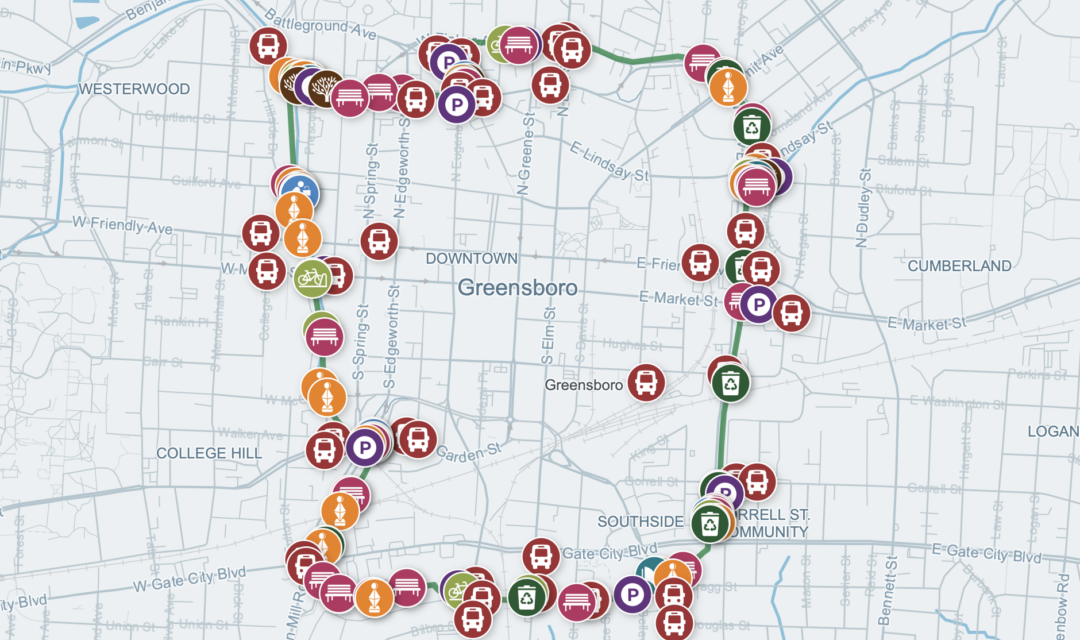
Greensboro spent 25 years and $54 million getting the Downtown Greenway built. And now that the four-mile loop around downtown is finally finished, the city is turning its attention to what gets built around it.
On Tuesday, Sept. 15, the Greensboro City Council approved a new voluntary rezoning initiative meant to make it easier for property owners along and near the Downtown Greenway to redevelop their properties with housing, businesses and other higher-density uses.
Under the program, the city will approach property owners who might be interested in having their land rezoned to Central Business, or “CB” zoning.
Unlike the normal process in which a property owner initiates a rezoning request, Greensboro will initiate the process for owners who choose to participate.
Nothing will happen without the property owner’s approval. The program is voluntary, owners have to give written consent – and the proposed rezonings will still go through the city’s normal review, public notice and hearing process.
But the city’s decision to actively seek out property owners interested in changing their zoning makes it very clear that Greensboro doesn’t view the completed Greenway simply as a nice place to walk, run or ride a bike.
The city clearly also sees it as an economic development tool.
CB zoning permits a broad mixture of uses and more compact development than many of the zoning districts currently found around downtown. Among the possibilities are offices, retail and service businesses, institutional uses and higher-density residential development.
The idea is to remove some of the zoning obstacles that could stand in the way of redevelopment along the Greenway.
City of Greensboro staff will begin contacting potentially interested property owners on Wednesday, Sept. 16.
Other owners in the area will be able to express interest through an online form.
Once an owner agrees, Planning Department staff will examine the property, its current use and the possible effects of changing the zoning.
The first rezoning hearings could take place as soon as October of this year, and the city expects additional properties to come forward in later rounds.
This new initiative comes only a few months after Greensboro finally completed the Downtown Greenway – one of the longest-running and more expensive civic improvement projects in the city’s recent history.
As the Rhino Times reported in June, the Greenway was conceived more than 25 years ago and ultimately became a $54 million public-private project.
That total was more than twice an early estimate of about $26 million.
By 2019, the projected cost had risen to about $43 million – including roughly $30 million in public money and $13 million in private contributions.
When the final section opened this year, city officials and Action Greensboro put the completed project’s value at $54 million.
Supporters have long argued that the Greenway’s value goes well beyond recreation. The project was promoted from its early years as a way to connect neighborhoods, improve the area surrounding downtown Greensboro and encourage private investment.
By the time the Greenway was completed, city officials and Action Greensboro were crediting it with helping spur more than $612 million in completed and planned development along the corridor.
Tuesday’s City Council rezoning action represents another attempt to keep that development going.
In fact, the timing couldn’t have made the city’s intentions much clearer.
On Tuesday morning – just hours before the City Council meeting – the Downtown Greenway held the latest event in a four-part speaker series celebrating the completion of the project.
The topic was “Trail-Oriented Development.” The featured speaker was Brian Leary, executive vice president and chief operating officer of Highwoods Properties and the former president and CEO of Atlanta BeltLine Inc.
The Atlanta BeltLine is a much larger version of the basic concept Greensboro has pursued – a system of trails and public spaces around the center of the city that’s also been used to encourage surrounding development.
According to the City of Greensboro, the Atlanta project has helped catalyze $14.2 billion in private investment over the past two decades.
Action Greensboro Executive Director Cecelia Thompson said that, with Greensboro’s Greenway complete, the focus is changing.
“With Greensboro’s four-mile Downtown Greenway now complete, our conversation is shifting from building the greenway to building around it,” Thompson said.
Downtown Greensboro Inc. also quickly came out in support of the City Council’s rezoning initiative.
DGI Interim Executive Director Rob Overman said the change would help “unlock the potential of the Downtown Greenway” and could bring new investment, housing, gathering places and destinations to the area.
“We commend City Council for taking this important step to unlock the potential of the Downtown Greenway as outlined in the GSO35 vision,” Overman said, reffering the Greensboro’s long range strategic plan. “Growing the Greenway means better connectivity, new investment in surrounding neighborhoods, and the possibility of new housing, gathering places, and destinations with regional appeal.”
The rezoning effort also fits into the much larger GSO35 plan for downtown Greensboro.
That plan, unveiled last year after input from more than 2,500 people, sets some ambitious goals for downtown over the coming decade – including drawing in 5,000 additional downtown residents, 3,000 new jobs, more than 100 ground-floor businesses, 10 major redevelopment projects and at least $1 billion in private investment.
Greensboro Mayor Marikay Abuzuaiter has since incorporated many of those ideas into Vision36 – the broader framework she unveiled this summer for Greensboro’s growth through 2036.
The completed Greenway therefore appears to be moving into a distinctly different phase.
For a quarter of a century, the question was when Greensboro would finally finish building it. Now the new question is how much will get built because of it.