


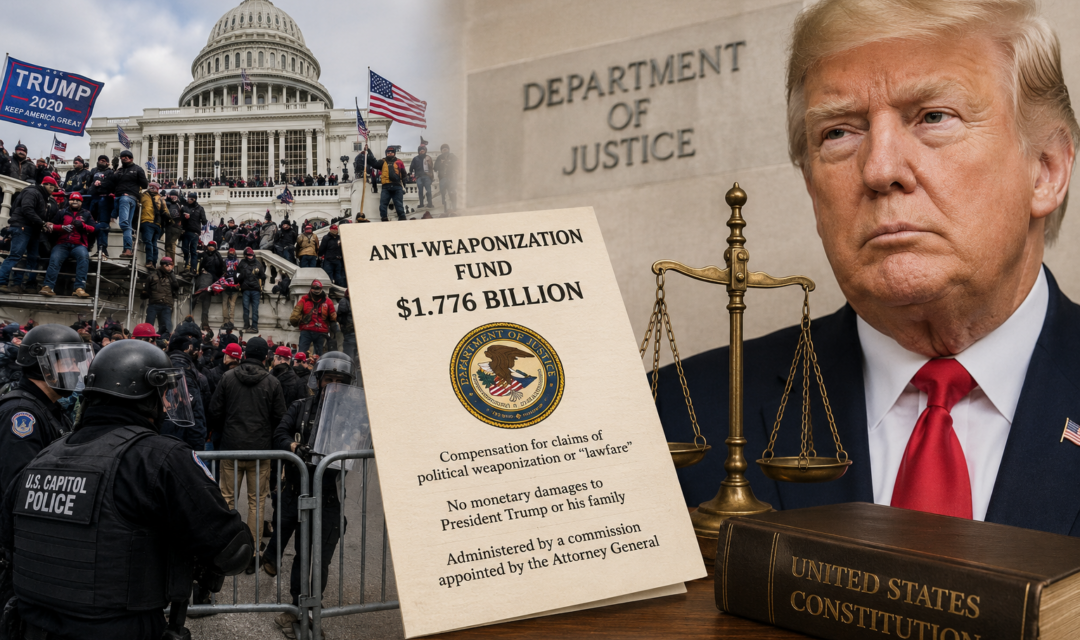
President Donald Trump’s new $1.776 billion “Anti-Weaponization Fund” is drawing criticism not only from Democrats but from some Republicans in Congress as well – including North Carolina Sen. Thom Tillis.
The fund was created through a settlement of Trump’s lawsuit against the IRS over the leak of his tax returns. According to the US Department of Justice, Trump, Donald Trump Jr., Eric Trump and the Trump Organization will receive formal apologies but no direct monetary damages.
Instead, the settlement creates a compensation fund for people who claim they were harmed by what the DOJ calls “political weaponization” or “lawfare” by the federal government.
Critics of the plan say that one likely effect is that some people charged in connection with the Jan. 6, 2021 attack on the US Capitol could potentially seek compensation from the fund after receiving pardons from Trump earlier this year.
That possibility has created discomfort among some Senate Republicans.
Senate Majority Leader John Thune, a South Dakota Republican, said he was “not a big fan” of the proposal and he added, “I’m not sure exactly how they intend to use it. But yeah, I don’t see a purpose for that.”
Tillis said there’s a “real risk” that Jan. 6 defendants pardoned by Trump could ultimately receive payments from the fund. Tillis called that possibility “absurd.”
Utah Republican Sen. John Curtis told the Deseret News that the proposal “doesn’t pass the smell test.”
Sen. Lindsey Graham of South Carolina, one of Trump’s closest allies in the Senate, also expressed caution, saying, “Conceptually, I understand what he’s trying to do, but I don’t know. I think we need to ask more questions.”
Louisiana Republican Sen. Bill Cassidy called the proposal a “slush fund.”
The controversy escalated Wednesday, May 20, when two law enforcement officers involved in defending the Capitol during the Jan. 6 attack filed a federal lawsuit seeking to block the fund.
Metropolitan Police Officer Daniel Hodges and former US Capitol Police Officer Harry Dunn argue in their lawsuit that the fund is unconstitutional and exceeds the legal authority of the executive branch.
The lawsuit states: “No statute authorizes its creation, the settlement on which it is premised is a corrupt sham, and its design violates the Constitution and federal law.”
The suit also argues that the fund could ultimately “finance the insurrectionists and paramilitary groups that commit violence” in Trump’s name.
The legal and constitutional issues surrounding the proposal are unusually broad.
Typically, settlement agreements resolve disputes between the parties directly involved in a lawsuit. In this case, however, a settlement involving Trump’s tax-return lawsuit is being used to establish a large compensation program for outside claimants who were not parties to the original case.
The money is expected to come from the federal Judgment Fund, a permanent congressional appropriation traditionally used to pay settlements and judgments against the federal government.
Critics argue that Congress – not the executive branch – ordinarily creates major compensation programs involving taxpayer money.
Acting Attorney General Todd Blanche defended the settlement this week, saying the government “should never be weaponized against any American” and that the fund would create a process for victims of political targeting to seek compensation.
Blanche declined to rule out the possibility that Jan. 6 defendants who assaulted police officers could apply for payments. He said claims would be reviewed by a five-member commission appointed by the attorney general, which is him right now.
The Justice Department has stated that there are “no partisan requirements” for applicants and that unused money would return to the federal government.
Still, Democrats are expected to force votes in Congress aimed at preventing Jan. 6 defendants who assaulted law enforcement officers from receiving compensation through the program.
That could place Republicans in a politically difficult position.
For years, Republicans have argued that the Biden Justice Department unfairly targeted conservatives and Trump supporters. At the same time, many Republicans have also strongly backed law enforcement and have condemned assaults on police officers during the Jan. 6 attack.
The debate over Trump’s new fund now sits directly between those two positions.




Pure corruption out in the open for all to see. The swamp/sewer is deep with this administration.
Why not just send the bill to Minnesota or California?
I don’t know about Minnesota but California does pay far more in taxes than it receives back from the federal government.
Perhaps they do but that’s not accounting for the BILLIONS the government gave both states in Medicare/Medicaid funds
Yes. Yes, it does.
2024 Californians paid roughly $275 billion more to the federal government than they received back. That includes medicare and medicaid.
Don’t you just love how professor/Cxxxxxxxx X Rxxx/Chris/Polly Pocket/Sybil/whatever picks his ?facts? to try to justify his statements.
Pick facts that counter misinformation posted here…..yup. Do you have any data, facts or sources that counter what I have provided or are you just upset by the truth?
money aint just some number you can fudge to be 1776. why would our govt spend 1.7 billion dollars on this? i thought this administration was supposed to cut excessive spending. 1.7 billion dollars is no small price tag! and the fact that they changed the funding package to be exactly 1,776,000,000 should tell you that these congressional idiots dont care about us taxpayers. they just wanna have this new useless program and tell us it’s going to be good by using the price they set as evidence. whats next a $3,141,592,653 grant for math teachers?
Just another way for congress to bend a knee to Trump as he grifts the US taxpayer.
Chris just take a moment and connect the dots between AOC and all of the fraud in Minnesota
AOC serves in NY. What are you going on about?
It sounds as mysterious as Obamacare. Literally, there is NO money for this. There isn’t enough now to pay for entitlements, debt service, and defense.
No matter who is running this Republic, they will spend it into oblivion. Can you say “Weimar”?
Do you see what that fiat paper buys you now? “Jus’ yew wait, ‘enry ‘iggins, jus’ yew wait!”
What do you do with a hoard of cash: spend it for something you need (not want), or invest it in something that will beat the INFLATION MAN & THE TAXMAN. Buena suerte.
Hyper inflation will wipe out ALL those who are unprepared.
What a corrupt scheme and by the way I was informed the agreement provides no audit of Trump tax returns so he is above the law. What a crook!
Exactly.
Yep, the swamp/ sewer is deep….no matter the party.
this is why i voted perot in 96
.
Me too.
Me too!
Trump is extra special in this area.
ditto the unaffiliated majority is unrepresented
did you vote perot you seem like you would have
i tried too but mistook him for PARROT who are highly intelligent chordates
Trump and his two sons personally sued the IRS for releasing their tax returns. Trump dismissed the suit voluntarily and reached a settlement with the IRS. In exchange, the Justice Department set up a $1.776 billion (1776?) “Anti-Weaponization Fund.” But Congress must vote to fund the “Anti-Weaponization Fund.” Therein lies the rub. Even some Republicans are questioning the fund. Why? The explanation is in the name, to compensate individuals that have suffered from weaponization by the federal government. There is worry that January 6 individuals will receive compensation. Why? Remember Ashli Babbitt murdered by a federal officer for no reason, no provocation? Remember, many victims suffered through long incarcerations without charges. I have no problem with compensating January 6 victims. Trump knows that Congress will not vote to reimburse the January 6 victims directly, but the “Anti-Weaponization Fund” settlement money is his to spend including claims for reimbursement for loses filed by January 6 victims, including direct loses such as attorney fees and lost wages. There is no doubt there were federal workers involved on January 6 who were inciting violence and defiance. I would call this weaponization by the federal government. If Congress denies the funding, they will deny a settlement reached between the IRS and Trump, which the Justice Department agreed. Set up a committee to oversee the administration of the payouts from the fund, okay. But do not deny the victims of January 6 from receiving just compensation.
I would not give one cent to the Jan 6 crowd. Trespassing, assaulting police, Breaking into the cradle of our country politics, trying to overturn an Election, threatening Federal officers (“Hang Mike Pence”) and disrupting legal government vote counting functions are not grounds for any compensation. Maybe a jail sentence.
What about ICE victims?
ProPublica documented more than 170 U.S. citizens wrongly detained by ICE in 2025 alone. These included:
citizens who were dragged, tackled, beaten, tased, or shot, at least three pregnant women,
nearly 20 children, including two with cancer, and over 20 citizens held for more than a day without access to lawyers or family.
I wonder how many of these will get money?
ProPublica is considered by readers and writers to be left of center. Before I might agree that the events you listed were examples of victims of wrongdoing by ICE, I would like to know the details of what led up to the dragging, tackling, and shooting. I would start with your use of the word “citizen.” I would wager that the majority, if not all, persons involved with ICE were illegals. If they were illegals, they were not “wrongly detained.” As far as beaten, which means to hit or kick someone repeatedly, I would find that exceedingly hard to believe unless I saw unmistakable evidence of that action. Have you seen proof of that? Anyone can write or speak words, but it is the surrounding details that give the words truth.
“I would wager.” In other words you have no solid evidence for what you would like to be true.
We see what we want to see. We believe what we want to believe. If I saw ICE agents using force against an American citizen, I would think first that *the person was interfering with an ICE operation; *that the person was a protestor against ICE operations and allowed his good sense to lapse; *that someone is paying for the protestor to interfere with ICE, otherwise the protestor would be gainfully employed and working and not have time to spend interfering with and harassing ICE agents.
streb has no solid evidence if what he read was true, but he believed it. I choose to read something and put it in context with other information I have to arrive at an opinion. My opinion is that without being paid, the protestors would be few in number; when protestors are paid, the protest is not a grassroots protest and there is a hidden agenda behind the protests; and when the protestors engage in violence, which some have, the protestors’ goal is to incite. If you are interested, compare the protests against ICE with the Vietnam War protests; therein, lies the difference.
I don’t consider ProPublica anymore divergent from the middle than Fox News or the New York Post but the article I read said “U.S Citizens” I have not personally observed any wrongdoing by ICE but I’ve seen enough videos over the last year to know that it happens, and probably more than we hear about.
You used ProPublica as truth, not Fox News, not the New York Post. It is very probable that ProPublica was referring to protestors (U.S. Citizens) not illegals.
No, there are well documented cases of US citizens being detained for ‘looking’ Hispanic and not having paperwork in hand that proved their citizenship. Even when documentation was presented, ICE agents claimed the documents were forged.
These were not protestors. Just Americans and legal immigrants trying to live their life.
You want a link to the ProPublica articles?
So, professor, you get your information from ProPublica as well as People’s World.
The article by ProPublica was referenced by Streb, I don’t normally read it….but there are numerous sources and articles that backup the article in ProPublica. Hope that helps.