

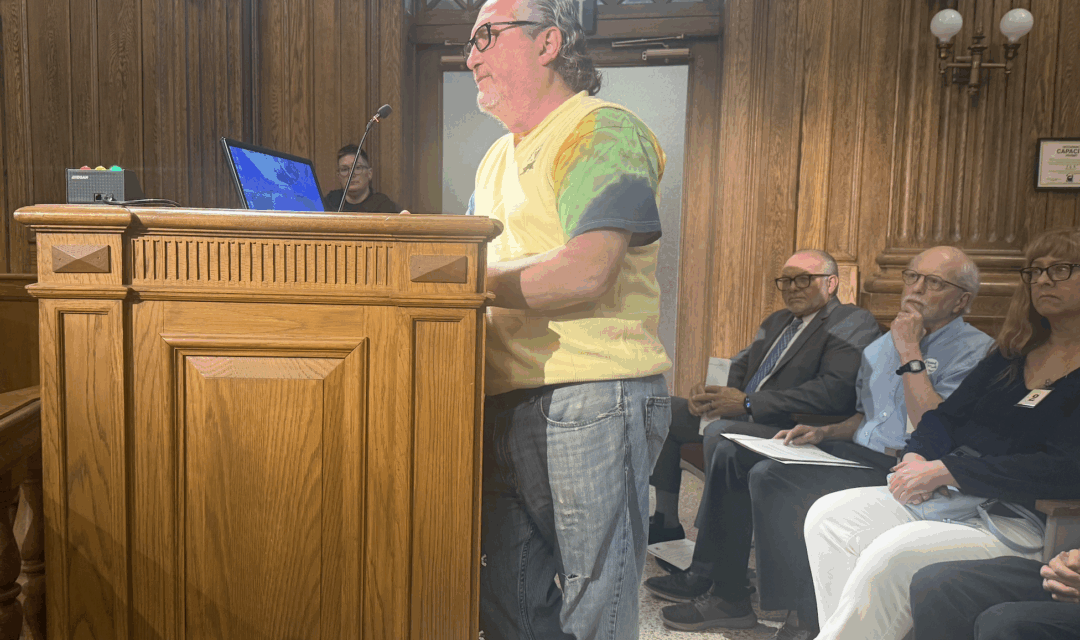
There was something of a taxpayer revolt at the Thursday, Oct. 1 Guilford County Board of Commissioners meeting, which was meant to be a hearing on the county’s schedule of values – the standardized rates and guidelines used to determine market value for the 2026 countywide property revaluation.
However, rather than a hearing on the methodology being used to arrive at property values, it turned into a hearing with a long line of residents taking the microphone in the Old Guilford County Court House to say, in one way or another, that enough is enough when it comes to skyrocketing property taxes.
Not a single speaker voiced support for the methodology being undertaken by the Tax Department to arrive at new property values. But one taxpayer after another pleaded with commissioners not to allow the new higher property values to become higher tax bills when the property tax rates are set in the summer of 2026.
Many speakers pointed to the bruising 2022 revaluation – when property tax bills shot up across the county – as proof that residents can’t absorb another financial hit.
The Democratic-led Board of Commissioners at that time failed to adjust the tax rate downward to a “revenue-neutral” rate (as the Republican-majority board had done before them years ago), which meant that, even though the tax rate remained the same, people ended up paying a whole lot more because their property was on the Tax Department’s books at a much higher assessed value.
According to data presented by the Tax Department earlier this year and then confirmed later in the year, the average home in Guilford County will be coming in at about 50 percent higher than it did four years ago.
The first speaker summed up the sentiment of many bluntly: “My taxes went up about 30 percent in 2022. Now you’re telling me we’re going through this again – I panic. Anything I do to my property means I’m going to pay more. We have to move to revenue neutral. Residents cannot sustain more taxes.”
He warned that the rumored 48 percent increase would push people out of their homes, and that renters would be hit just as hard because landlords would pass the costs on.
“People on fixed incomes won’t be able to sustain that,” he said. “You work for the residents of Guilford County, and you have to consider the impact your decisions have. Please move to revenue neutral.”
The room broke into applause at times despite reminders from Chairman of the Guilford County Board of Commissioners Skip Alston that clapping wasn’t allowed.
One of the most forceful speeches came from Billy Queen, a former federal agent with a master’s degree in criminal justice. Queen, who will be running for sheriff next year, told the commissioners they were on the verge of creating a new class of criminals.
“Good people are not going to let their children starve,” he said. “Good people are not going to let their children sleep out in the cold or in some dangerous homeless shelter. If you push people beyond their limits, you will turn law-abiding citizens into shoplifters, drug dealers and thieves. Don’t kid yourselves that it’s just ‘a little bit more’ that homeowners will pay. That burden will fall on people who can least afford it.”
Another man pointed out that Guilford County’s 30 percent assessment jump in 2022 was among the steepest in the nation.
“I was told we were ‘only’ second highest,” he said. “I guess now we’re wanting to beat California.”
He argued that 2026 assessments could be 40 to 50 percent higher than those in 2022 and blasted the Democratic majority on the board for spending hundreds of millions in recent years while letting property tax revenue balloon.
“This tax-and-spend freight train can be stopped,” he said, calling on citizens to push for House Bill 539 in Raleigh – a measure that would require revenue-neutral tax rates when counties do revaluations.
Local activist George Hartzman also spoke at the hearing, repeating several times that his tax bill is up 43 percent. He warned that the collapse in commercial property values would shift the tax burden even more heavily onto homeowners.
Hartzman criticized what he called a “secretive revaluation process” and said taxpayers deserve transparency rather than “a hidden rule book.”
Parts of the methodology being used in the revaluation are proprietary information of a company helping the Tax Department and therefore those formulas cannot be reproduced and distributed publicly.
Another speaker rattled off numbers comparing Guilford to other counties. He noted that Guilford’s effective tax burden is much higher than Mecklenburg or Wake despite median incomes here being far lower.
“You’re talking about moving the average property tax bill from $4,000 to $6,000 – that’s two Social Security checks per month,” he said. “That’s unsustainable for seniors. Please adopt a revenue–neutral budget.”
Several others echoed similar concerns, weaving in personal stories.
One woman said her taxes jumped 53 percent in 2022 on a modest 1,284-square-foot home. She called on the county commissioners to demand more accountability from nonprofits and outside groups receiving taxpayer funding.
“Anyone who gets county money should have to show their full budget,” she said. “People need to know this government is running lean before you ask us to pay more.”
A real estate broker who spoke warned that the influx of higher–income residents from other states during COVID has inflated local property values well beyond what native residents can handle.
“Our own children and grandchildren can’t afford to buy or even rent here; property taxes are going to crush them,” she said.
The theme was consistent: frustration, fear and pleas for restraint. No one defended the county’s process. Every comment circled back to the need for the commissioners to keep rates revenue–neutral when the revaluation numbers come in next year.
At the meeting, Tax Director Ben Chavis gave a presentation explaining how the process works. He reviewed the schedule of values – the manual that outlines how different property characteristics translate into market values – and he emphasized that Guilford County is following state law that requires reappraisals at least every eight years.
Chavis said the goal is equity, with values falling within 95 to 105 percent of actual market sales, ideally hitting 100 percent.
The tax director outlined a detailed timeline: notices for residential property will be mailed in February 2026, commercial notices in March, with appeals running through May. Informal appeals can be made directly to appraisers, and unresolved cases will advance to the NC Property Tax Commission.
Chavis encouraged residents to check their property data for accuracy, to review their notices as soon as they arrive, and to contact the department if they find any discrepancies.
He also highlighted new software tools that will let residents compare their property values to their neighbors’ online, as well as steps Guilford County has taken to make the appeals process smoother.




Wanna pull off a small revolt on Property taxes? Don’t pay your taxes until 12/31. Call your mortgage company to see if you can change your escrow account to disburse once a year and not quarterly. Thats a lot of money Guilford & Greensboro won’t see until the last day of the year. When I bought my home in the Lake Jeanette area, we were unincorporated Lake Shore so we paid no taxes to Greensboro. Greensboro sucked us up and the increase was over 100%. Nobody got to dispute this. This is that same crap that was pulled on Summerfield. A land grab. A MONEY GRAB!!! In my opinion and many in my area…. that was Crap!!!
MY PARTING WORDS TO THE LOONS THAT RUN THIS ASYLUM…
“FREE LAKESHORE”
This only works if most people refuse to pay their property taxes, not just a few.
Perhaps a mass march on City Hall? Every day.
I like your idea. Carry signs that read “FIND ANOTHER WAY TO FINANCE COUNTY GOVERNMENT…ELIMINATE PROPERTY TAXES.
The Rhino Times only publishes comments that they agree with. Now publish this if not true
The Rhino publishes every comment unless those comments are racist, laced with profanity, pornographic or libelous to an individual with no known basis in fact.
——–
Scott is telling the truth. The Rhino is a bastion of free speech and open, free debate.
it’s invaluable.
& i get free grammar, diction, linguistics coaching from austin morris (! unnecessary)
You want a real tax revolt? Do not vote for the D party candidates in the 2025 City elections who keep sticking it to the citizens shouldering these hefty property tax increases both property owners and renters.
Vote Robbie over MaryKay who has voted for every property tax increase.
Vote Richard Beard at large. (Vote only Richard and do not vote for others.)
Vote Zack in District 3.
Vote Nicky in district 4 over the lawyer.
Vote Jeannette over Tammi Who has voted a tax increase every time since she was elected in 2017.
Get your friends and neighbors to vote. Text them call them, offer to drive them tge next two weeks in early voting or on Election Day. Takes 15 minutes.
The eviction rates in Guilford County at 14% are the 4th highest of the 100 counties in NC.
Homelessness has increased 42% the last two years in Guilford County.
The property tax rate in Guilford County is $0.73/$100 with an average median household income of $66,000 vs Wake at $0.40/$100 and median household income of $103,000 vs Meck st $0.53/$100 with median household income of $85,000.
People from all walks of life cannot afford these property tax increases due to revaluations being approved by D party candidates. Do not vote these D candidates in or more misery will be placed on your shoulders. In 2022, Greensboro had one of the highest single bedroom rent increases of all cities in the USA after tfe 27% average property tax increase. 2026 could see an almost 50% increase with the D party in power. Wake up Greensboro and Guilford County!! We need revenue neutral candidates elected.
——–
You’re welcome! And it is necessary, trust me.
what % of ‘lake shore’ residents depend on city for work, play, school, shopping, etc. & pound COG infrastructure
————
Government needs taxpayers more than taxpayers need government.
————
My taxes on a 1,700 sq,ft. house in High Point went from $2,200 to $3,000 in 2022. That was an increase of 36.363%. This increase was AFTER I disputed the increase and was granted a smaller accessed value on the house!! We moved to High Point from Oak Ridge NC in 2017. We lived there for 14 years and saw a tax increase of $400 dollars… in 14 years. Prior to living in NC I lived and owned a house in Southern New York, until we moved in 2000, because NEW YORK had already decimated it’s businesses and private residences with State, local and property taxes, in addition to over regulation.
This disaster for home owners in Greensboro is due to one thing and one thing only – the Democrat majority that was swept into office in 2020 and the democrats gaining a majority in the Guilford County Board of Commissioners.
The only thing that will reverse this nightmare for the hard working, honest and decent home owners of Guilford County is to remove Democrat Skip and his Democrat crew from office. The longer they are in power, the worse it will be for all of us Guilford County home owners, period, full stop.
I agree, but with Skippy gone, property taxes will continue until they are eliminated. Write letters to your representatives in the NC General Assembly. Make telephone calls; if there is no answer, leave a message demanding the end to unfair and morally reprehensible property taxes. Ending property taxes will not happen without citizens’ involvement.
then do what to fund our guvmnt
Good for these citizens but most know that the liberal agenda is alive and well in Greensboro and Guilford County. We have multiples of freebie programs and pet projects which citizens are forced to pay for with excessive high taxes. Votes are bought and friends and family of politicians get jobs at all these programs.
————–
The political Left represents the government, the state and the Parasitic Sector.
The political Right represents the people.
That’s why the Left grabs more and more money for themselves, and the Right tries to reduce the tax burden on people.
———————
And dear Scott, please buy yourself a calendar. Last week it was “Thursday Oct. 3rd” and this week it’s “Thursday Oct. 1st”…. Try taking the mean.
After reading the many comments from well-intentioned speakers, NOT ONE demanded the end of property taxes. Property taxes are unfair, resulting in a property owner never owning property outright, even when paid off; causing property owners to pay taxes on unrealized gains, something even the federal government does not do; and allowing politicians to raise property taxes to pay for pet projects like public schools, which are failing and reaching a point of no return; and one really big UNFAIR, allowing designated nonprofits to receive all the benefits from government without paying property taxes: country clubs and retirement communities, really (?.) Furthermore, Billy Queen is wrong about creating a new class of criminals. People will sell their homes before resorting to crime to pay their property taxes. But the idea that people may be placed in the position to make such a decision speaks loudly about the need to eliminate property taxes by finding another way to raise money for counties. That would force county commissioners to be more accountable for their decisions. And by finding another means of financing public schools, it would eliminate the majority of the current county budget, i.e. 62% or more.
our new casino/buffet downtown ?
AKA the city/county Lords and Ladies Complex.
One example of taxpayer money being wasted is the funding of the renovation of the John Coltrane home. This group has already received over $400,000 to remodel the home. The home looks like nothing has been done and they are requesting another $500,000 to finish the project. Where is the accountability on this. The house shows on Zillow that it is worth a little over $100,000. How can our commissioners waste their money like this and then raise our taxes.
The commissioners AREN’T wasting their money– they are wasting OUR money!
because ‘nonprofit’ politicians infest guvmnt
VOTE THE BUMS OUT!
I recently found an old style country hardware store that sells tar,feathers and fence rails
Since I can’t get my comments posted on this site I will reply to yours. The taxpayers need to look into the money that is wasted with nonprofits. One example of this is the John Coltrane home that has received hundreds of thousands of dollars for renovation. I read where they need another 500,000 apostolate to finish the job. The home looks like nothing has been done ridiculous.
Comments don’t post immediately; they are first viewed for appropriateness. Patience, in this case, is a virtue. The RT does post all comments, even ones about penguins that cheerlead for Dallas.
Any revaluation needs to be revenue neutral
The article doesn’t mention any comments from the chairman of the county commissioners other than to reprimand the audience about clapping. Probably not one of Skip’s best nights in politics.
Until we get rid of school boards in this state nothing is going to change. Property taxes are driven largely by demands from grossly overpaid, insanely under-performing bureaucrats who care nothing about educating kids. If we can eliminate elected school boards and put a stop to hand-outs to non-performing ngo’s from the county commissars we could cut property taxes in half (or more!)
.
Bingo !
i thought ‘vouchers’ are fixing this
I have read in other places that when reevaluations are done, one should appeal. Is this correct? Should we all appeal this reevaluation? Would this slow the process? Is it detrimental to do so? I do agree that demanding the County and State to pass legislation for revenue-neutral reevaluation is appropriate.
Up the sales taxes and reduce or cancel the property tax. That way everyone has some skin in the game and in the long run, it gives homeowners and honest taxpayers a little break. More sales taxes also tags the sort of people who pay no taxes except sales taxes. Such as: Illegals, people paid under the table and laugh at us overtaxed chumps, (until they file for Social Security) criminals, drug dealers; Everyone pays the same amount.
I attended this meeting and your reporting was accurate. No one was in favor of increased thievery by government.
By the election turnout I’m not convinced that Skip Alston and the Democrats can’t get away with their increased thievery.
I have been a Guilford County homeowner since 1972. 8 bought this house as a recent college graduate. I had my college loan to pay off a long with a new mortgage and taxes, etc. But because I had a good job and was a good employee, raises made it possible to pay the taxes and insurance as those expenses increased. Now that I am retired I no longer have raises. Just a 2.7 percent cost of living increase. And yet my property taxes jump much higher which increases my homeowners insurance accordingly. Retirees that have worked in this county and paid their mortgage off should have NO property taxes after age 65. There are many states that do that for their retirees, but not money hungry Guilford County. It’s time this county starts appreciating those that contributed for so long. Maybe then we could afford to take advantage of programs and entertainment offered in the county.
If only the politicians in Guilford were so inclined
Make them enact a homestead act, over 65 years of age get a set amount of property value taken off the tax bill.
If you wanna vote the bums out, people have to get out and vote. This, they haven’t done in a while.