


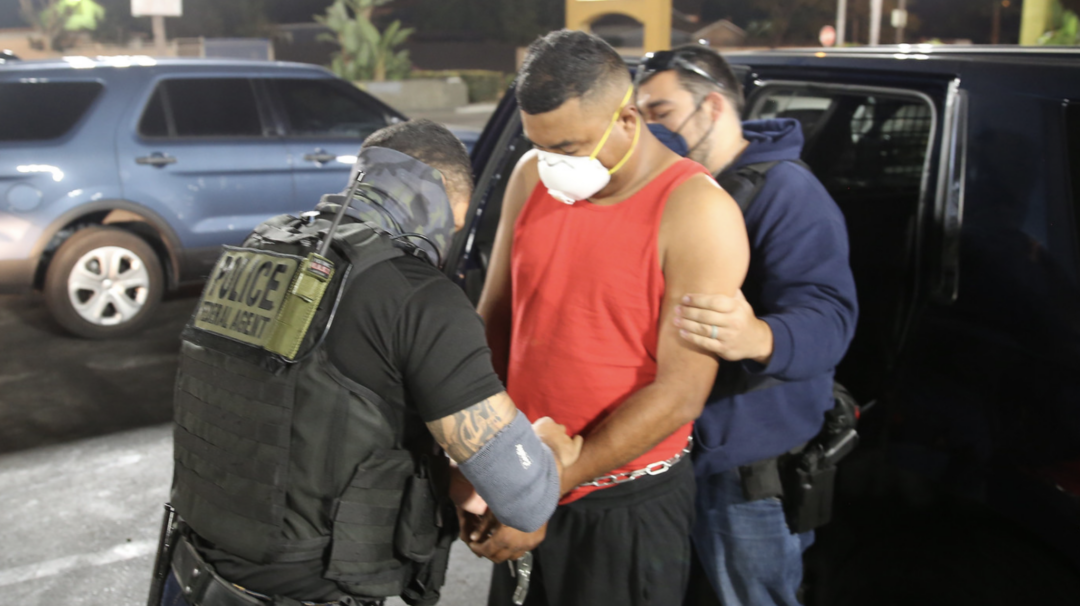
There was a very interesting moment at the Guilford County Board of Commissioners’ Thursday evening, May 1 meeting. US Sen. Thom Tillis had recently publicly accused Guilford County, Forsyth County and seven other counties in the state of being sanctuary counties – that is, ones that are generally uncooperative with federal immigration agents looking to deport people.
Both Guilford County Sheriff Danny Rogers and Forsyth County Sheriff Bobby Kimbrough, Jr. adamantly denied their county being a sanctuary county. Both said they worked well with the feds.
At the May 1 meeting, Commissioner Pat Tillman stated that there had been some public confusion around the matter and he asked county staff whether or not Guilford County was a sanctuary jurisdiction. The question was answered by County Attorney Andrea Leslie-Fite, who said that the Board of Commissioners would be the public body that would make that decision and she pointed out that the board had never taken a vote to become a sanctuary county and therefore it was not one.
In the US, the term “sanctuary city” or “sanctuary jurisdiction” refers to a city, county or state that adopts policies that limit cooperation with federal immigration enforcement officials – especially as it relates to undocumented immigrants. While there’s no single set legal definition, sanctuary jurisdictions usually decline to assist federal agencies like Immigration and Customs Enforcement (ICE) when it comes to detaining or deporting people based solely on immigration status.
These policies can vary widely but they often include practices such as not honoring ICE detainer requests – which ask local law enforcement agencies to hold people beyond their scheduled release date so that ICE can take custody.
Former Guilford County Sheriff BJ Barnes, a staunch Republican, informed the Rhino Times years ago that he was not legally able to hold inmates without a warrant past a certain number of hours and since ICE often did not show up during that legal time window for holding someone, he would have to release the person or face a lawsuit for improperly detaining people.
Some jurisdictions across the country currently avoid inquiring about a person’s immigration status during routine police interactions or refrain from sharing certain information with federal immigration authorities.
People who support sanctuary policies argue that they promote public safety by fostering trust between immigrant communities and local law enforcement. They say that, when undocumented residents feel safe reporting crimes or cooperating with deputies or police officers, it benefits the broader community. These policies, advocates argue, also ensure that local governments maintain control over their policing priorities.
Some judges across the country don’t like the current ICE policy of federal agents showing up at court appearances where a person thought to be an illegal is the defendant or is testifying in a case. Those in local judiciaries often argue that, if that practice becomes common, undocumented accused criminals and witnesses will be much less likely to show up for a court date.
Critics of the policy, on the other hand, contend that sanctuary policies interfere with federal immigration enforcement and in some cases allow people with criminal records to avoid deportation. They also argue that the hodgepodge nature of sanctuary designations can lead to confusion as well as inconsistent enforcement across jurisdictions.
This has been an issue for decades but, under the new Donald Trump administration especially, whether a place is a sanctuary jurisdiction or not has become a highly politically charged situation – as was seen in the case of Tillis versus the sheriff’s offices in Guilford County and Forsyth County.
The following explanation of the current legal landscape, which is quoted in its entirety, is from Eddie Caldwell, the executive vice president and general counsel for the NC Sheriff’s Association:
NORTH CAROLINA SHERIFFS’ ASSOCIATION STATEMENT REGARDING IMMIGRATION ENFORCEMENT BY NC SHERIFFS
General Statute 162-62 as amended by House Bill 10 [S.L. 2024-55]
effective December 1, 2024, provides certain procedures that must be followed when a person is confined in a county jail, including a requirement that the jail staff attempt to “determine if that prisoner is a legal resident or citizen of the United States.” If the jail staff is “unable to determine if that prisoner is a legal resident or citizen of the United States,” then the jail staff is required by G.S. 162-62 to follow certain specified procedures.
It is our understanding and firm belief that all North Carolina sheriffs are fully complying with the legal requirements in G.S. 162-62, and we have seen no information or indication to the contrary. We acknowledge that Immigration and Customs Enforcement (ICE) would prefer that sheriffs honor the request of ICE to voluntarily take additional actions beyond those required by State or federal law, including: (1) honoring immigration detainers for 48 hours beyond the time that the prisoner would otherwise be released from the jail; and (2) notifying ICE 48 hours before the prisoner would be released from the jail. Some sheriffs comply with these voluntary requests from ICE and others do not.
In either case, the sheriffs are fully complying with both State and federal law since the requests from ICE are voluntary and are not required by State or federal law nor by court order. House Bill 318, The Criminal Illegal Alien Enforcement Act, is currently pending in the North Carolina General Assembly and, if enacted into law, would require sheriffs and their jail staff to both: (1)honor immigration detainers for 48 hours beyond the time that the prisoner would otherwise be released from jail; and (2) notify ICE 48 hours before the prisoner would be released from jail.
This would align the state process for dealing with immigration detainers with the process preferred by ICE.
The North Carolina Sheriffs’ Association has worked closely with the bill sponsors to ensure that the amendments to G.S. 162-62 have been drafted such that the sheriffs do not anticipate the changes will cause any operational difficulties for the sheriffs nor their operation of the county jails. For these reasons, House Bill 318 is supported by the North Carolina Sheriffs’ Association.
While we sincerely value our partnerships with all of our elected officials, we encourage them and all others to refrain from making accusatory statements about any sheriff without first talking with that sheriff, and until becoming fully informed about the actual facts and information available from that sheriff.
Just as we believe that all North Carolina sheriffs are fully complying with the current legal requirements in G.S. 162-62, we are confident that if House Bill 318 is enacted into law all North Carolina sheriffs will fully comply with G.S. 162-62 as amended by House Bill 318.
We have all taken an oath to do so, and we will!




A new sheriff in town- DONALD TRUMP
You mean Old Criminal in town.
Ok Chris here you go, two examples of the fine ILLEGAL criminals you support. The Hispanic lady who was arrested this week for an illegal child care program at her home at which an 18 month old infant died was set for deportation in 2005 but she’s still here. The other one was the ILLEGAL driving the car on West Gate City boulevard last week, she was speeding ran a red light hit two other vehicles and one of the other drivers died. She has no drivers license, insurance and illegal tags on the car. She also needs an interpreter ( just so You understand, she doesn’t speak English) They both need bond money, you should go down and help them out. This info is, before you ask, courtesy of a friend of mine in the GPD.
What chris No response you mean you’re not willing to help two of your own kind no bond,compassion, nothing. Shame on you
Conservatives don’t care about facts. They will still claim Guilford County a sanctuary city without any real evidence or examples just because the county votes Democrat and it sounds scary to rally conservatives against local democrats using brown people as their boogeyman.
Just read the ignorance and bigotry against Hispanics here in the comment section of the Rhino Times. They love to call anyone with a Hispanic name an illegal. They recently assumed Spanish speaking students were illegals with zero evidence or facts to support their xenophobic statements.
Predictable.
Greensboro and High Point and Guilford County are sanctuary jurisdictions. How many illegals have the police and sheriff deputies arrested in the past year, two years, three years. Few to none? Does that mean there are few illegals here? There are nonprofits operating openly in Greensboro servicing illegals. It is not my duty to provide the names or address of these nonprofits. Greensboro police have investigated vehicle accidents involving illegals, but nothing was done even though the drivers had no drivers’ licenses and those involved spoke little to no English. They were on their way. The city of Greensboro and High Point have buttoned-up access to police reports that it is now almost impossible to get a copy of a police report. The cities will say it is for privacy and federal law. Do not believe that. It is a way to hide information from the public, including accidents involving certain groups. Accident reports should be available to the public the way they were for many, many years.
As far as your comment, “They love to call anyone with a Hispanic name an illegal. They recently assumed Spanish speaking students were illegals with zero evidence or facts to support their xenophobic statements.” It was you, Chris, who wrote “Hispanics,” no one else. Why would you focus on Hispanics when illegals from all over the world were allowed into the US? Write whatever you like, Chris. But keep it honest, no fabrication.
I’m thinking that not to far in the future Chris will declare his “farm” a sanctuary “farm” but that will be another counties problem since Chris doesn’t live in Guilford County.
Good thing I’m not a Conservative.
And why is that?
Maybe you should be. It’s a great life.
Apparently neither do Liberals Chris. Also if you want to talk about name calling, ignorance, and bigotry,and and go about painting EVERYONE you disagree with with a broad brush, take a long, hard look in the mirror Chris.
GSO & County are magnets for free-loaders. You can ‘splain it any way you like. Such as 37% Medicaid recipients who have no requirements for employment in order to get benefits (Federal policy). I call GSO a de-facto sanctuary city.
We can’t have these people in the precious deed restricted HOA neighborhoods in the northwest, oh no that would be a catastrophe. The ten cent millionaires will get their feathers ruffled. There are no Christians who sit on a HOA board, Slummerfield, snobtown or whatever you want to call it. Plenty of contaminated wells in that area that the media has kept quiet, plenty of contaminated soil from the tank farm that media has kept quiet about.
i wonder how much a property ‘devalued’ when their pristine well water was PFOS/PFAS contaminated by the airport ? did their property tax lessen ?
Jealousy is the Green-eyed Monster. Will destroy you from within.
I don’t think Summerfield is close to the tank farm
the tank farm contaminated the n buffalo creek & the airport contaminated reedy fork creek where i like to fish don’t eat them.
Open borders = brilliant thinking. What could go wrong?
“Some sheriffs comply with these voluntary requests from ICE, and others do not”. Duh. Therefore, those who do not are the “sanctuary” locations whether they admit to doing it or not. A correction in state law is needed for clarification, but a whole bunch of sheriffs already get it right.
another lie ! greensboro is, in fact, a bird sanctuary !
Markel are you referring to those two legged “birds” that walk around Greensboro in those really light loafers. Greensboro truely is a sanctuary city
wutz a light loafer ? shoes worn with a lightsaber ? i will re watch those movies style