


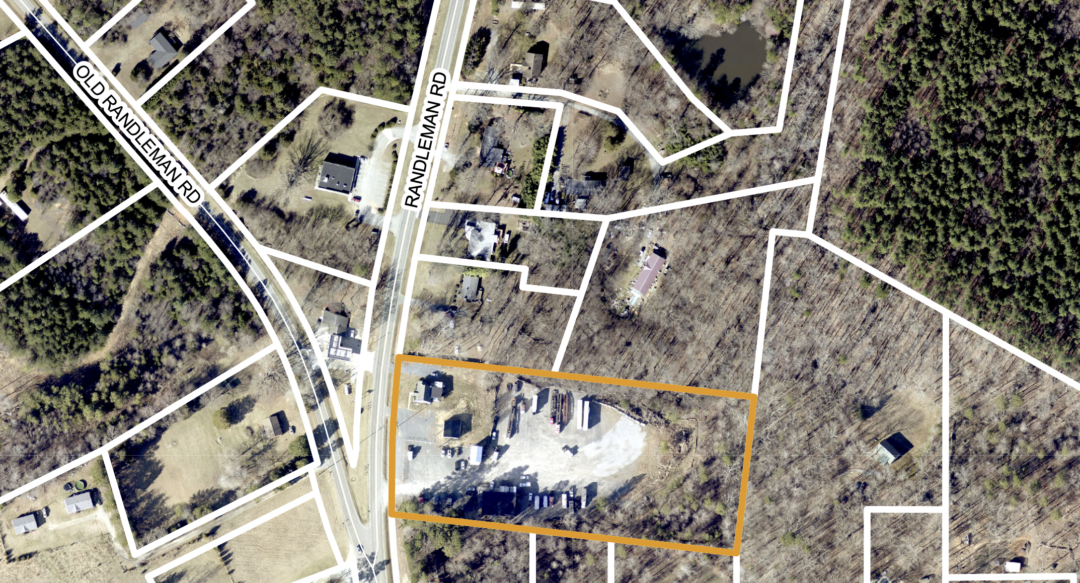
A divided Guilford County Planning Board couldn’t decide whether to allow a truck repair business on Randleman Road to expand its heavy industrial zoning, so the final decision will now fall to the Guilford County Board of Commissioners.
The commissioners are scheduled to hold a legislative hearing on the rezoning request at their Thursday, Sept. 3 meeting, which begins at 5:30 p.m. at the Old Guilford County Court House in downtown Greensboro.
The property at 5143 Randleman Road is about 4.64 acres and is currently split between Agricultural and Heavy Industrial zoning. Property owner Cliff Loflin is asking the county to rezone about 3.72 acres to Conditional Zoning-Heavy Industrial while leaving about 0.92 acres Agricultural.
The property is currently being used for truck repair services as well as a single-family residence. The surrounding area is a mixture of commercial uses along Randleman Road and lower-density residential and agricultural properties to the north, south and east.
The requested conditional zoning would allow automobile, truck and semi repair as well as light equipment repair.
The original request also included truck washing, but the applicant agreed to remove that use after nearby residents raised concerns about runoff and private wells. The property owner also agreed to limit repair activity to between 8:30 a.m. and 8 p.m. and prohibit trailers carrying hazardous materials from being parked on the property.
The Guilford County Planning Board unanimously accepted those changes to the application at its May 13 meeting.
But that was about the only thing the six members agreed on.
When Planning Board member Guy Gullick made a motion to deny the rezoning, the vote was 3-3. Chairman James Donnelly, Vice Chairman David Craft and Gullick voted for denial, while Nho Thi Bui, Gregory Drumwright and Ryan Alston voted against it.
Since that motion failed, Alston then made a motion to approve the rezoning.
That vote also ended 3-3, with Bui, Drumwright and Alston voting for approval and Craft, Gullick and Donnelly voting against it.
Under the Planning Board’s rules, the tie on the approval motion constituted a denial.
The property owner appealed the decision to the commissioners on May 27.
Planning staff had recommended a compromise: Staff supported conditional Heavy Industrial zoning for the portion of the property already zoned Heavy Industrial but recommended against expanding industrial zoning farther into the portion currently zoned Agricultural. They also concluded that expansion would remove Agricultural land that effectively serves as a buffer between industrial activity and nearby residential and agricultural properties.
According to the staff report, expanding Heavy Industrial zoning would “alter the existing development pattern,” remove that buffer and bring industrial uses closer to rural and residential properties.
They therefore recommended approval for the existing Heavy Industrial portion of the property but denial of the requested expansion onto Agricultural land.
The May Planning Board hearing also revealed that the rezoning request arose in part because the truck repair operation was already using more of the property than existing zoning allowed. Christy Harris, speaking on behalf of the applicant, told the board that Loflin purchased the property and leased it to a truck repair business before a zoning issue was discovered.
Only about one acre of the property could legally be used for the truck repair facility under the existing zoning, she told the Planning Board.
Harris said many neighborhood complaints dated back to a previous salvage operation on the property that generated considerable noise and left the site in poor condition. She said that the current owner had cleaned up the property and the truck repair operation was different from the former salvage yard.
Loflin told board members the biggest issue was parking trucks while they were waiting for parts or repairs.
Planning Board member Gullick noted that there were a large number of trucks on the property and said zoning enforcement officials had already discussed violations with the owner.
Business operator Heather Hayes told the board that the repair shop doesn’t operate around the clock, although its telephone line remains open 24 hours for emergencies.
Dustin McDaniels, who also spoke for the business at the meeting, said the company needs room to park disabled trucks and trailers while repairs are being made or parts are being delivered.
He told the board that without the additional space, the business wouldn’t be able to continue operating at the site.
Several neighbors objected.
One speaker, whose property is adjacent to the site, said trucks arrive at all hours and that he believed trailers were being parked on the property for rent. He also objected to seeing tractor-trailers next to land he expected to remain Agricultural.
Another raised concerns about traffic, property values, hazardous materials and trucks blocking Randleman Road while waiting to enter the site.
Tammy Seagraves, whose property backs up to the site, expressed concern about a creek, runoff, diesel fuel, oil and the effect contamination could have on nearby private wells.
Another nearby resident raised concerns about children living in the area and increased tractor-trailer traffic.
The property has private wells and septic systems and contains a mapped stream. It’s also within the Polecat Creek WS-III watershed.
County watershed reviewers found another issue during the review process: significant impervious surface appeared to have been added to the property without prior watershed development plan approval.
The county determined that the site as shown would require stormwater management to treat runoff from all impervious surfaces if the rezoning is approved and the project proceeds through site plan review.
The applicant pushed back against concerns regarding hazardous materials and runoff.
McDaniels said the business contracts with a company to collect and dispose of oil, coolant and other chemicals and said trucks displaying hazardous-material placards would not be allowed onto the property.
He also said the business wasn’t renting parking spaces and that most of the trucks on the property belonged to the company itself.
Planning Board members remained split even after the applicant agreed to the additional conditions.
Gullick said the Heavy Industrial zoning didn’t belong on the property and said expanding it would go against the county’s Comprehensive Plan and Future Land Use Map. He also expressed concern about groundwater.
Donnelly likewise said he couldn’t support expanding Heavy Industrial zoning in that area and was concerned about changing the Future Land Use Plan designation to industrial.
Bui, however, noted that the current property owner had made substantial improvements to the site and had agreed to every additional condition proposed during the hearing.
Supporters of approval argued that part of the property is already Heavy Industrial, that similar activity exists along the Randleman Road corridor and that the added restrictions would protect nearby residents.
The nine county commissioners will now have to decide whether those conditions are enough to justify extending Heavy Industrial zoning across most of the property — or whether the Agricultural land should remain a buffer between the existing industrial activity and the surrounding homes.




the portion zoned ‘agri’ last produced what food when ? is it growing ‘homeless’, trash ? what’s growing there now ?