


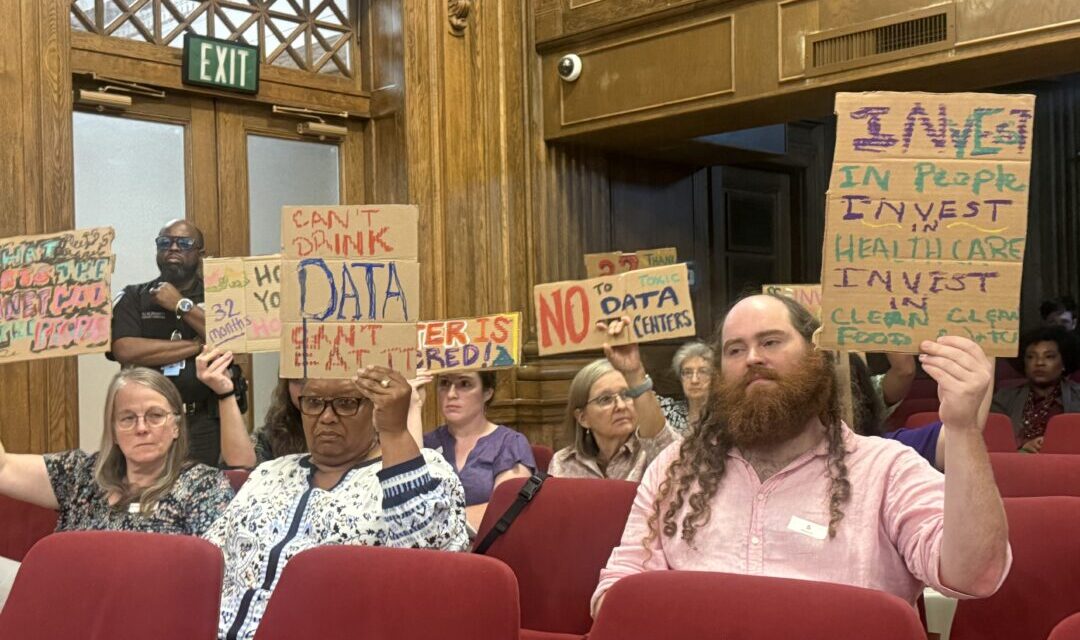
The Guilford County Board of Commissioners held a lengthy public hearing Thursday, Oct. 15, on whether to impose a six-month moratorium on data center development – but when the time came to make a decision, commissioners decided they needed a little more time themselves.
Rather than vote on the proposed 180-day moratorium, the board approved a motion by Commissioner Alan Perdue to postpone the decision until its next meeting.
The delay followed a public hearing in which numerous speakers urged commissioners to put the brakes on data center development, with several arguing that the proposed six-month moratorium was nowhere near long enough.
In fact, one of the more unusual aspects of the hearing was that even during the time allotted to opponents of the proposed moratorium, speakers weren’t necessarily arguing against a moratorium. Some opposed the proposal because they wanted a much longer one.
Under Guilford County’s public hearing procedures, supporters and opponents were each allotted 20 minutes. But those arguing against the proposed ordinance used much of their time to make the case that 180 days wouldn’t give the county nearly enough time to study the effects of massive data centers and develop appropriate regulations.
Several speakers called for a 32-month moratorium instead.
The proposed ordinance would temporarily halt development approvals for new or expanded data centers, cryptocurrency mining operations and related data processing facilities in unincorporated Guilford County, subject to certain exceptions.
County staff explained that the current Unified Development Ordinance doesn’t specifically define data centers or establish development standards for them. The moratorium would give the county time to examine potential effects on water supplies, electricity infrastructure, the environment and neighboring properties before writing new regulations.
The proposed 180-day restriction would run until April 12, 2027, unless the county adopted applicable regulations sooner.
Much of the testimony centered on the belief that the county should spend considerably more time studying the issue.
Susan Lindsey, representing the Guilford County Data Center Moratorium Coalition, supported temporarily halting approvals but questioned whether the county could adequately involve residents in the process within six months.
Lindsey urged commissioners to establish a formal public advisory committee rather than simply promising to seek public input. She pointed to similar efforts in Greensboro and Surry County.
Another speaker, representing the Holly River Assembly and Protect Guilford County Coalition, argued that 32 months would be a more appropriate period for studying the issue and developing regulations.
She used a school grading analogy, saying a 32-month moratorium would earn commissioners an A+, a 12- to 18-month moratorium would earn a C and the proposed six-month moratorium would earn an F.
“Six is too few; we demand 32,” she said.
Other speakers expressed concerns about the potential environmental effects of large data centers, including heavy electricity consumption, water demand, diesel generators, noise, air pollution and the eventual cost of decommissioning facilities.
One county resident, Bridgette Raspberry, argued that commissioners should resist the temptation to approve major developments simply because of the potential tax revenue – warning that decisions made for short-term financial reasons could leave long-term consequences for surrounding communities.
Guy Dunn, a former Natty Greene’s brewer, described changes he’d observed in local waterways over the years and urged commissioners to protect natural resources. He called for a citizens advisory council to examine the potential effects of data center development.
Another speaker read a statement written by a 14-year-old Greensboro resident who couldn’t attend the meeting. The statement raised concerns about the environmental effects of hyperscale data centers and argued that communities deserved development that improved their lives rather than imposing additional burdens.
The hearing wasn’t entirely one-sided when it came to the merits of data center development.
A High Point man argued that Guilford County needs new industries, good-paying jobs and additional tax revenue, particularly in communities that have lost traditional manufacturing employment.
He said the county should study the potential problems and establish appropriate regulations, but he also warned against delaying so long that companies take their investments elsewhere.
“I heard all the worst practices,” he said. I sat there and wondered if anybody had any good practices.”
He also used a football analogy to warn about losing economic development opportunities to neighboring counties.
“I don’t want to see us sit on the sidelines and somebody else scores a touchdown,” he said.
During the commissioners’ discussion, Perdue raised concerns that the proposed moratorium might be written too broadly and could unintentionally affect facilities associated with broadband, telecommunications, emergency communications and even government operations.
Perdue urged the board to consider both the intended and unintended consequences of the restrictions.
Commissioner Carly Cooke expressed her interest in establishing a more formal process for public participation and examining how other communities have negotiated community benefits agreements with data center developers.
Chairman of the Board Skip Alston emphasized that the county wasn’t rushing to make a decision and wanted to learn from the experiences of other communities before establishing its own regulations.
“We’re gonna get it right the first time, and not in a rush,” Alston said.
Alston added that commissioners wanted to hear from experts on both sides of the issue and examine both successful approaches and mistakes made elsewhere.
The board ultimately decided to give itself more time to do just that.




Subjects of the Board of County Commissars
Skip the Omnipotent saw that he was very much on the losing side of this Commissar’s Cash Cow project and decided they ‘need more time’ (read whip his thralls into line) to get this boondoggle.
My prediction…after a short amount of time and under the chaos of midterm elections His Lordship will get this payoff project passed and simply take a ‘too bad, so sad’ attitude and gin up another distraction.
Let’s change his nameplate to read “P.T. Barnum”
Just put policies in place that are so one-sided in Guilford County’s favor; it would guarantee a home run. Require them to provide their own power generation. Require them to use closed-loop, minimal-water-use cooling and strict noise control requirements. Also require the facility to pay property taxes on the structure and ALL the electronic systems. No leasing of equipment or components, chips within that equipment, to shift or avoid local property taxes. The entire project should agree to pay 100% of property taxes on 100% of the project to Guilford County. Projects to be built with no local incentives, tax breaks, or tax deferrals. Also require them to contribute a certain amount to selected local charities every year it operates. They either agree to the county’s terms…or they go elsewhere, no exceptions. Then the county should agree to isolate and earmark every penny of those property taxes to go directly into the school system for teachers’ pay and school supplies and equipment, free lunch for all, and then use the balance left over to pay down school bonds… no exceptions.
I looks like there are eight people, all holding look-alike homemade cardboard signs. How do eight people warrant any influence of the commissioners are some 400,000 voters?
Damn… if those are the kind of people who are against data centers, I’m in favor of ’em !
Let’s see…we have limited water now and county and city are pushing growth. I say another act to fool the citizens. Skip won’t give up potential tax dollars that he can waste on more pet projects.
Need more time to get the bribes locked down.
Believe it.