Guilford County, Greensboro, the airport and areas surrounding the county are already seeing a boatload of development in the last two decades and city leaders want to keep that development coming using everything it can – including participation is a federal Opportunity Zones program.
The Greensboro Coliseum already gives people a reason to come to that part of town and, starting Jan. 1, there’ll be a new reason for investors to look at the property around it.
The Coliseum area is one of four Greensboro-area census tracts that will become federal Opportunity Zones in 2027. The others take in parts of Randleman Road in south Greensboro, the industrial corridor in east Greensboro and a stretch of US 421 that reaches into Pleasant Garden and unincorporated Guilford County.
The US Treasury Department announced the designations recently after NC Gov. Josh Stein nominated the North Carolina tracts.
The state got all 204 of its nominees approved – including seven in Guilford County. These new designations run through the end of 2036.
The tax break is aimed at investors who have a capital gain they can put to work.
Say someone sells stock at a profit and puts the eligible gain into a Qualified Opportunity Fund. Under the new rules, that investor can generally put off federal tax on the original gain for up to five years. Holding the investment for five years can reduce the taxable portion of that original gain by 10 percent. Hold on for at least 10 years and the profit on the new investment can generally escape federal capital gains tax.
Around the Coliseum, city leaders see possibilities for hotels, shops, entertainment and mixed-use development. The tract includes the Coliseum complex itself.
Greensboro’s has given no details on specific projects or financing commitments.
On Randleman Road, the designation comes after the city spent a lot of time figuring out what it wants to see along one of Greensboro’s southern gateways.
In November 2024, the City Council adopted the second phase of a corridor plan covering 2.3 miles from Interstate 40 south to the city limits. That plan identifies a need for reinvestment along a commercial strip bordered by established neighborhoods – as well as improvements to safety, traffic and transit.
The new Opportunity Zone covers portions of that corridor.
In east Greensboro, industrial development was already moving before the new tax break came along. In January 2022, the Rhino Times reported that four annexation and zoning requests on McConnell Road were headed to the City Council while Publix was building its distribution center nearby. Wylie Capital bought 20 acres on McConnell Road in 2024 for a proposed 309,000-square-foot industrial development.
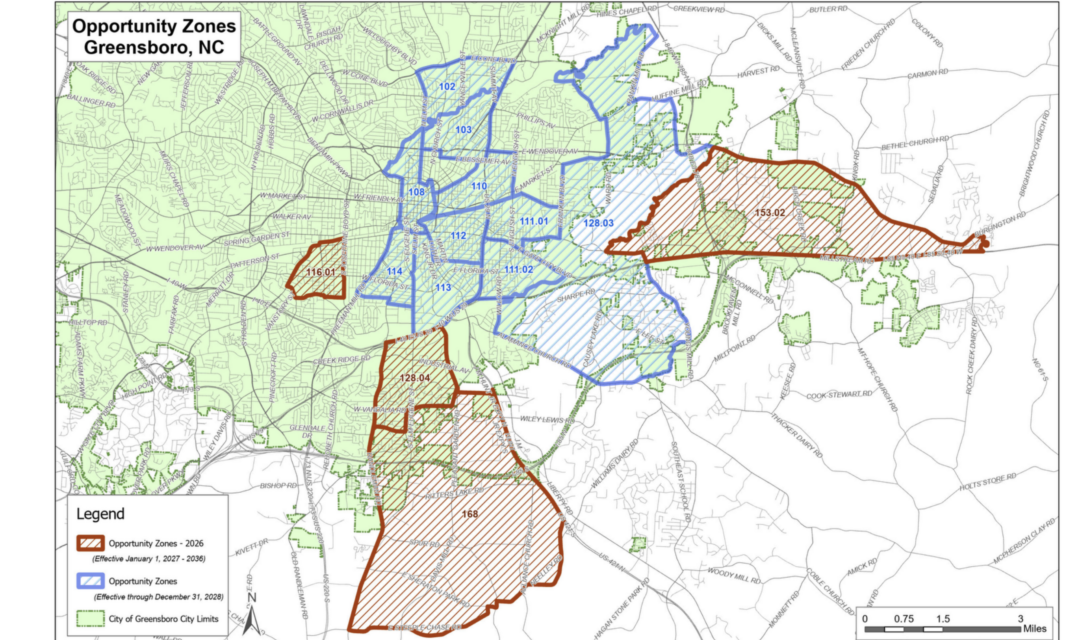
The city’s map shows that two of the new zones cross Greensboro’s city limits. The eastern tract stretches along the I-40/I-85 corridor toward Burlington Road.
The southeastern tract follows part of U.S. 421 and extends into Pleasant Garden and unincorporated Guilford County.
The Randleman Road and US 421 tracts meet near West Vandalia Road. Property owners can see where the lines fall on the city’s full-size Opportunity Zones map.
Greensboro had 10 Opportunity Zones in the first round in 2018. Those designations remain in effect through Dec. 31, 2028 – so both sets will be active in 2027 and 2028.
The map shows the new zones in orange and the original ones in blue.
What did Greensboro get out of those first 10 zones? The city’s announcement of the new zones gave no tally of how much money went into prior ones or how many jobs or homes resulted. That’s a question federal auditors have had trouble answering nationally as well: In August, the US Government Accountability Office reported that the original incentive appeared to fund mostly urban real estate development.
Some states reported gains in jobs or housing – but most were unsure as to the program’s overall effects. Congress added new reporting requirements when it made the program permanent in 2025.
In the map pictured above, Greensboro’s four new federal Opportunity Zones are shown in orange and take effect at the first of the year.
The original 10 zones are shown in blue and remain designated through Dec. 31, 2028. The dashed green line marks Greensboro’s city limits.