


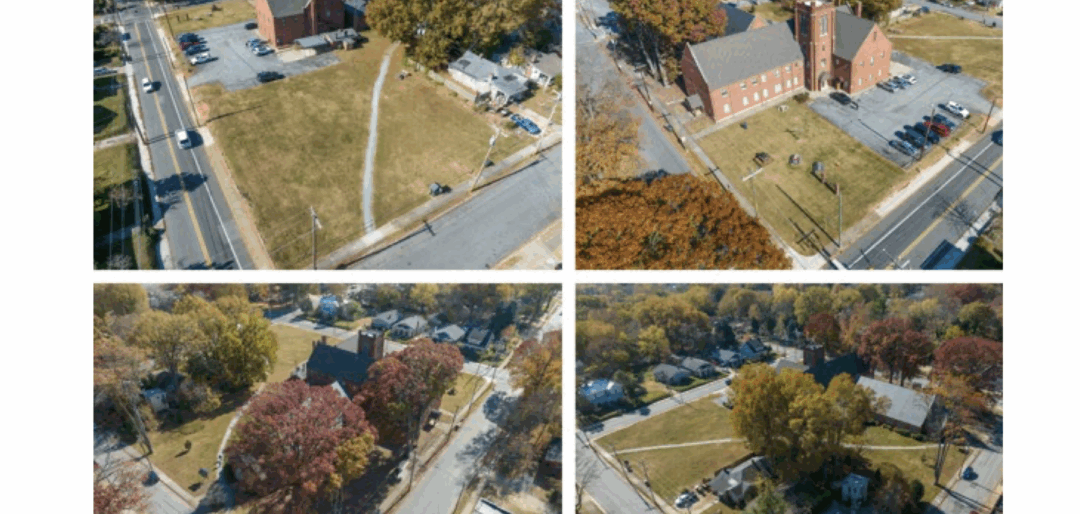
The City of Greensboro has launched a new effort that could shape the future of the Glenwood neighborhood for decades to come, issuing a Request for Interest for the sale and redevelopment of several city-owned properties – including the former Glenwood United Methodist Church site.
The RFI, released Wednesday by the city’s Housing and Neighborhood Development Department, is seeking qualified developers, nonprofit organizations or other interested parties to propose ideas for the properties at 1417 Glenwood Ave., 1115 Grove St. and 1104 W. Florida St.
The application period runs through 4 p.m. Friday, Jan. 30, 2026.
At the center of the process is the Glenwood Avenue property, a roughly 1.94-acre site that includes a 26,500-square-foot building constructed in 1954. The structure served as Glenwood United Methodist Church until 2022 and has since been owned by the city, which purchased the property in October 2023.
The site is currently zoned Single-Family Residential and will be sold as-is for adaptive reuse or redevelopment.
City officials say the property could be redeveloped for housing or other community-focused uses that benefit the surrounding neighborhood.
Since the city’s acquisition, the building has been used on a temporary basis by several service organizations that have been providing food and other resources to the needy. Those groups are expected to be relocated from the site by spring 2026 in order to allow for redevelopment.
The Glenwood neighborhood has long been a focus of Greensboro’s reinvestment efforts. One of Greensboro’s oldest communities, Glenwood was developed in the early 20th century and was once connected to downtown by a streetcar line.
Like many urban neighborhoods, it experienced decades of disinvestment beginning in the mid-to-late 20th century – prompting multiple revitalization plans and initiatives over the years.
This new RFI process represents another chance to bring long-term stability and more new investment to the area.
At the same time, longtime residents likely remain only cautiously optimistic since past redevelopment efforts that produced mixed results.
Greensboro Housing Strategy and Development Director Samuel Hunter said this week that the city is intentionally using a two-stage process to encourage broad participation and transparency. The RFI is meant to gather ideas and identify qualified respondents before the city moves forward with a more formal Request for Proposals in spring of next year.
“This process is designed to incorporate community feedback, provide a sense of clarity of the sale and development process, and encourage all interested parties to collaborate with the City of Greensboro,” Hunter said in a statement. “This will be a catalytic project for the Glenwood neighborhood, and we must ensure that the project serves the needs of the community.”
While the RFI doesn’t require detailed development plans, those who respond are expected to outline their vision for the properties as well as demonstrate the experience and capacity to carry out a project of this scale.
Only those who respond to the RFI will be eligible to submit proposals during the RFP phase next year.
The city will host a virtual information session at 2:30 p.m. Monday, Dec. 15, to walk interested parties through the process and answer questions. Attendance isn’t mandatory; however, city officials say it’s strongly encouraged for anyone considering taking on the project.
For residents, the announcement brings a familiar mix of anticipation and concern: Some welcome the prospect of new housing, community space or neighborhood amenities – while others worry about affordability and displacement as reinvestment accelerates.
The former church site has drawn particular attention because of its size, location, and symbolic role in the neighborhood. Originally envisioned as a potential hub for City of Greensboro services and community programs, the property is now being repositioned as a redevelopment opportunity – which naturally raises questions as to what form that investment will ultimately take.
City leaders insist that community benefit will be a central consideration as proposals are evaluated – though details about pricing, density and permitted uses won’t be finalized until the RFP stage.
Hopefully the project will strengthen Glenwood without erasing its character.
Additional information about the RFI and submission requirements is available through the city’s Housing and Neighborhood Development Department. Questions can be directed to B. Lamont Taylor at housingdevelopment@greensboro-nc.gov.




So apparently only the government would buy these properties. That speaks well for development prospects.
Glenwood was (is) a low income neighborhood. I had relatives on Glenwood Ave, which we visited often. When visiting on Sundays, we would attended services at Glenwood Presbyterian Church. My parents briefly lived in an apt on Glenwood Ave just after WWII.
Throwing taxpayer money at this neighborhood is yet another doonboggle.
I beg to differ with you. I was born and raised in Glenwood. Peck school was great. We had neighborhood stores. My favorite was the variety store. Rode our bikes all over the community. My dad worked for the post office and my mom worked at Ellis-stone department store. I guess you call that poor. Sad. We didn’t have a gold spoon to depend on, but sure had a great neighborhood. Ask anyone who grew up there.
I couldn’t agree more about Glenwood. I always enjoyed eating at Grove St cafe. Glenwood always had the old school neighborhood vibe about it. Too bad the cockroaches have migrated west and destroyed it. City of Gso. always knows what’s best. In the 70’s they tore down Lincoln Grove shopping center at Julian and Best St. to get rid of drugs, the drugs and users just moved west to the MLK area (Asheboro St.) That area was renovated and along with drug use and prostitution, just look at it now. Police cracked down and now the drugs and lowlife moved west again into Glenwood. Even a former club on Grove St was ran by a couple Gso. Police officers,one of whom was an assistant chief. There were lots of drugs and hookers in the club. City officials need to realize that the definition of insanity is doing the same thing over and over again expecting a different result.
is it better that they ‘concentrate’ in a few high poverty areas ? consider adequate ‘shelter’ & food provided where we would prefer they diddle. carrot vs stick ?
Markel in case you didn’t know. Asheboro St. now MLK and the Glenwood neighborhood were not poverty areas before the invasion of drugs, prostitution and the low life that came with them.
I think most readers know the city could care less about any ideas you may have. City has already decided what will be done at tax payer expense.
will, add rentals to the drugs, prostitutes, lowlife list that deteriorate these areas. guvmnt ownership is ‘absentee’ ownership ?
great photos, drone ?
rename it ‘moneywood’ – a christmas gift to realtors ?