

The City of Greensboro is good at some things and has a lot of practice doing them – building sidewalks, painting wide bike lanes and putting up four-way stop signs at minor intersections to name a few – and has some problems sometimes doing other things.
Hopefully, as the city gets into the commercial loan business with taxpayer money, this will be something it’s good at.
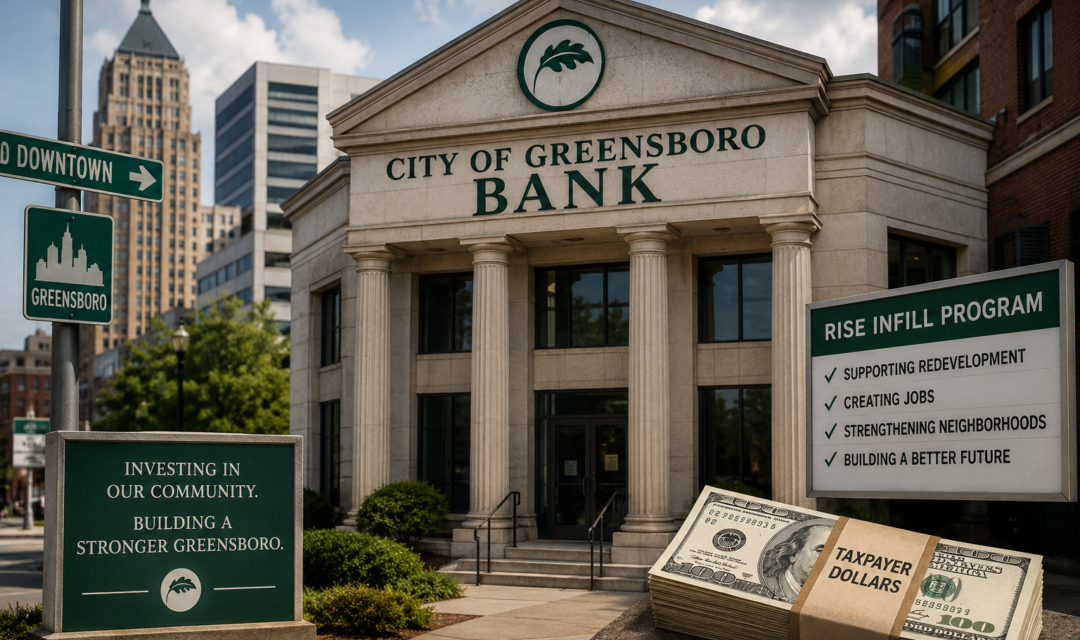
City officials announced on Tuesday, May 26, the launch of a new redevelopment financing program called “RISE Infill,” which city officials say is designed to help breathe new life into vacant, aging and underused commercial properties around Greensboro.
According to the city, the new program is aimed at helping developers and property owners tackle one of the biggest challenges in redevelopment projects: getting enough financing together to make complicated projects work financially.
City leaders behind the program stated that redevelopment projects are often a whole lot harder to finance than brand-new construction – especially in older commercial corridors and downtown areas where renovation costs can quickly pile up.
Here’s how the program works: The city will participate in loans alongside private banks. The loans will still be originated, underwritten and serviced by private lenders. However, the city’s participation is intended to help close financing gaps that might otherwise kill projects before they ever get off the ground.
Economic Development Manager Marshall Yandle stated in the city’s announcement of the program that older redevelopment projects frequently struggle even after developers have private financing and their own money committed to the deal.
Yandle used the example of a developer purchasing an underutilized two-story downtown building with plans to renovate the first floor for retail or restaurant use while converting the upper floor into apartments or office space.
According to Yandle, even when private lenders are willing to participate, there can still be a remaining financial gap that prevents the project from moving forward.
“RISE Infill gives the City a way to partner with lenders to help close that gap and support projects that can create long-term investment and community benefit,” Yandle stated.
The city says the new initiative is the first piece of a broader redevelopment framework called “RISE,” which appears designed to become an umbrella for future redevelopment and economic development efforts.
The focus of the program is on commercial redevelopment and mixed-use investment projects located within designated reinvestment areas and redevelopment corridors around the city.
The city hasn’t released detailed maps with the announcement, but Greensboro has spent years targeting redevelopment in older commercial corridors and struggling commercial areas where vacant storefronts and aging buildings have become increasingly common.
Programs like this are often designed to encourage redevelopment in areas where conventional financing can be difficult because renovation projects carry more uncertainty than new construction.
Older buildings can come with environmental issues, outdated infrastructure, expensive code upgrades and other unexpected costs that make lenders more cautious. That’s where your money comes in.
City officials are clearly hoping the program will encourage additional private investment while also helping improve commercial corridors that have seen years of decline or underinvestment.
The four participating banks are Towne Bank, First Bank, United Community Bank and M&F Bank.
Representatives from each of the participating banks praised the city’s effort in statements included with the announcement.
Scott Baker, Triad president for Towne Bank, said the program strengthens lending opportunities for investors and small businesses while improving Greensboro’s overall investment climate.
John Vestal, senior vice president and regional executive for First Bank, said the bank was excited to partner with the city, business owners and developers through the initiative.
Justin Spradley, senior vice president for United Community Bank, said the program could help redevelopment projects move forward that otherwise might not happen.
James Sills, CEO of M&F Bank, said the effort could help move projects “from the drawing board into something tangible that benefits neighborhoods and small businesses.”
City officials behind the program say that developers and borrowers interested in the program will work directly with participating lenders rather than applying through the city itself.
Additional information about eligibility requirements and program details is available through the city’s website




————
It is now perfectly clear that the City has more money than it knows what to do with.
I regretfully disagree. No matter how much money the extort from us, they ALWAYS want more.
Austin,
Please allow me to slightly correct you…the City has STOLEN more money then it knows what to WISELY do with.
Personal opinion…the City Overlord has received marching orders from the Omnipotent One. The next step for him is to clone, on a County level, what they have done.
“The liberties of a people never were, nor ever will be, secure, when the transactions of their rulers may be concealed from them.”
My namesake.
So, the government is going to use tax dollars to invest in something that private banks are not willing to invest in by themselves because they don’t deem the project viable at that price point. Sounds like an awesome use of tax money.
Well said.
I hope you know I was being sarcastic. It’s not an awesome use of tax money at all.
I’ve said it several times before Don, Chris is sooo slow.
—————-
Don,
Chrissy (“The Professor”) is much too thick to catch any nuance or undertones in language.
His proficiency in expressing himself and language comprehension are those of a rather backward seven year old.
Good grief. Yes, the idea of government filling in as a lender of last resort has never been a good idea. Look at the 2008 financial crisis as the best example. Can’t even agree without insults from you all.
—————
Oh… nice save. It was obvious that you failed to catch the sarcasm.
But hey, at least “us all” don’t insult you with the most vile epithets and slurs, which are repeatedly debunked but which you insist on using against us.
Perhaps we too should abandon all commitment to truth, and just start smearing you as a racist, bigot, hater, and moron. Also tin foil hat wearer, and beer swilling rednecks.
All those insults are yours, buddy.
The truth’s a bitch, ain’t it?
I made no disparaging remark, just asked a question. And to be fair, you do miss sarcasm in commentary sometimes.
I don’t recall missing sarcasm; I think the confusion is my habit of using sarcasm to respond to sarcasm as an attempt at humor. Seems too confusing for some here to follow.
But yes, you weren’t so bold to toss in the insults as the peanut gallery enjoys. Thanks I guess?
Obviously you are wrong yet again. I fully agree with Don’s comment. But I get it, haters gotta hate.
Happy to discuss yet again how the labels of racist and bigot directly apply to your belief that some races are lessor evolved than others (the actual definition of racism) and your bigotry against Muslims, immgrants and LGBTQ. Hint: Country does not equal race…..cleary.
Chris please calm down, get the knot out of your panties. Everything will be ok for most of us anyway.
—————
“Waycist!”… “Hater!”…. “Bigot!” ….. “Moron!”…..
You have become a parody of yourself, Chris. You’re so pretentious and smug you’ve even adopted the moniker “Professor”.
You’re a joke.
Go ahead Austin and defend your position that some races are more evolved than others and then claim that your argumemt for the actual definition of racism isn’t racist. Make your case or embrace the label. And again, stating diffefences of various countries avwrage performance on IQ tests isn’t about race since countries don’t define race….they define social, economic and environmental differences between societies which isnt bioloical as you claim races are……
Dont worry, I won’t hold my breath.
Cheers
Crickets. Not shocked. I guess the shoe does fit.
Now we know why taxes are going up. Money in search of projects and payments to the developers.
I think this might be a bad thing for the tax payers. Programs should never be financed at 100 %, the investor needs to have risk to insure a successful outcome. Failed projects using tax payers money.
This is no different than the waste of a massive amount of money on the Super recreational facility on East Lee St.
Sounds like blah blah
Where has government participation in lending for infill projects ever been successful? Please tell us if the City staff has developed this new lending program all on their own or is I using best practices of some other city’s successful lending program. Copying successful programs is a very smart thing to do!
Are the loans forgivable? I believe that our local government already has some experience with these transactions, and the borrowers always seem pleased when they don’t have to repay. Maybe as an experiment they should start with property taxes. Make them forgivable too?
Projects with 100% or near 100% financing have a dramatically higher failure rate. If the project fails……The bank will foreclose, have first position, and sell off the assets to make itself whole. The city may or may not get a dime back, so in that sense, it is for sure.
.
When the people promoting the project have no “skin in the game” – none of their own money – it is a huge red flag that it’s an uneconomic project.
This is a de facto gift to the non-white community. It’s just a matter of time before it becomes obvious, and by then this truth will be buried.
There’s only one thing incorrect in your statement Mongo, that being “…sell off the assets to make itself whole.” They will never make themselves whole and will never recover the ‘investment’ (read ‘free money handout’) and to anybody who believes they will I say can you train a flying unicorn for me too? (Not directed to you Mongo)
They would be ‘made whole’ by the High Council and the Board of Commissars, and guess where THAT money would come from.
Anothet major SNAFU for the tax payers to deal with. I believe most readers can read between the lines and see who and where these tax $ will go.
I feel that the city is stepping into something that a local government should stay out of.
The citizens do not need to be paying for the redevelopment of business property that is owned by businesses people. If the property can’t be redeveloped by the current owners the owners should sell the property to someone else who can make the property profitable with new or better ideas.
Why should the tax payers spend their money on taxes so that another tax payer can enrich themselves through the use of taxpayer money that is being taken for purposes that are not basic city functions.
If the he property is profitable after the use of taxpayer money is used do the taxpayers get a reduction in taxes after the project is complete and successful?
So the city is going to underwrite loans to people who couldn’t qualify on their own. And who would that be?
Name something our govt does well.
.
That would be those people who have bad credit….
Screw to tax payers
I noticed that the word your money is used in the description. Your money is saying your tax money. What a joke. I cannot wait to see you is at the front of the line to get our money.
‘struggling developer’: incompetent minority ? failing contractors ‘thin the herd’ for successful contractors
‘. . . a way to partner with lenders . . ‘ that isn’t specified !
I am always amazed at how governments rush “into the breech” to use tax dollars to fund projects that investors and lenders will not touch, often for good reasons: no market demand, ill-conceived plans or risk of a myriad of problems dealing with older properties, etc. Capital efficiency is best left to market forces. But governments operate largely outside of that dynamic and so take on projects with great hope but no “skin in the game”. It is the taxpayer’s “skin” and the result is usually always the same as when you are spending OTHER PEOPLE’S MONEY!!
one challenge investors face is the fickle PROPERTY TAX imposed by . . . ? what !
This sounds so much like other projects the city has been involved in
Project Homestead and Micheal King, St. James and Skip Alston, The Regancy Motel and Michelle Kennedy, the Summit Executive bldg. and a former city council member. These a just a few that come to mind. All have wasted taxpayer dollars and screwed the people of this city
ditto. i remember ! we remember ! the federal guvmnt has poured MILLIONS into A&T State University – WHAT are their accomplishments ? WHO are their accomplishers ?
How quickly the city forgets the Regency Inn fiasco. What’s 3 million plus dollars to us taxpayers. Is everybody enjoying the extra holes in our backs and butts put there by the city council. Remember this does not include the holes created by the county commissioners!
As the taxpayers of Greensboro will be shouldering some of the risk in these projects what will be the return if a project is successful? I heard a rumor that banks charge interest for this type of activity.
notice that all these proposals could appear on BALLOTS but they don’t ?
. . . & the ‘community (hood)’ grocery store that failed @ phillips ave & n o’henry blvd. theft & mismanagement & NOT a WASP around to blame !
I would like for the taxpayers to have a voice, through public meetings or the surveys they love to send to your phone, about what projects we would like to support. Because I’m sure that cronies of the powers that be will be first in line.
Any one heard of the Boston Tea Party. Revolt may be the only way.
As Patrick Henry has advocated, bring tea bags to the meetings of the County Commissars and the GSO High Council. Leave them on the podium.
STOP ’em before it’s too late.