

It’s getting down to prime time for the Guilford County Board of Commissioners as members begin hashing out a budget and, just as importantly, a new tax rate in the wake of the county’s recent property revaluation.
The stakes are unusually high this year.
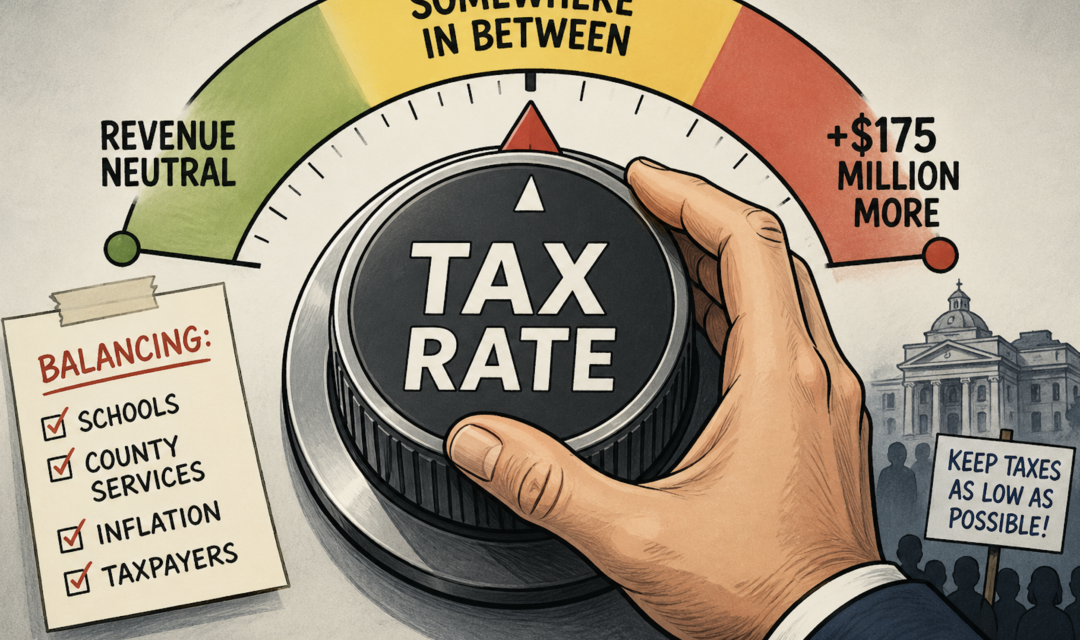
The revaluation pushed property values up sharply across the county, which means that if the current tax rate stays the same, Guilford County would take in roughly $175 million in additional revenue.
That possibility has set off alarm bells among residents and created a political balancing act for commissioners who are hearing loudly from constituents worried about higher tax bills.
At the same time, commissioners are facing increased demands for spending – especially for schools and county services, along with inflation that’s driven up costs across the board.
Two Republican commissioners – Alan Perdue and Pat Tillman – have been pushing to keep the tax rate as close to revenue neutral as possible, meaning the county wouldn’t take in more total revenue despite the higher property values.
Perdue said that’s where he’d like to start, even if the final number ends up somewhat higher.
“I’ve been telling folks I’d like to see us go revenue neutral if at all possible,” Perdue said. “We need to take a look at our expenses and figure out where we should be and tighten our belts like people are having to do in their own households.”
Perdue said Guilford County Manager Victor Isler appears to understand the pressure residents are under and has already taken steps to rein in spending.
“He’s challenged department directors to look for ways to streamline,” Perdue said. “They’ve already identified about $3 million in the current year that they could cut back. I think he understands the demand that’s on our citizens.”
Perdue also said a key focus of the budget discussions should be distinguishing between mandated and non-mandated services – that is, what the county has to fund versus what it chooses to fund.
But while Perdue says revenue neutral is his preferred starting point, he acknowledged that reality may push the final tax rate higher.
“We’ve got to look at the numbers and figure out where we land,” he said.
While commissioners debate the numbers, Perdue said the message from residents has been consistent.
“They’re all concerned about leaving the tax rate where it’s at – that’s the biggest thing,” he said. “What I can’t tell you is how far from there it will be. But nobody’s telling me they want their taxes to go up significantly.”
Perdue said that concern has come through clearly in town halls, emails, phone calls and everyday conversations.
“It’s a very consistent and clear message,” he said. “People are facing tough demands right now – food, fuel, just life in general – and then you add in a significant increase in property values. They’re worried.”
At the same time, other county leaders say they can’t ignore growing needs.
Chairman of the Guilford County Board of Commissioners Skip Alston has made it clear that the Board of Commissioners will not leave the tax rate unchanged and take in the full $175 million windfall – but he’s also been equally clear that revenue neutral is not going to happen.
“It’s not going to be $175 million extra, and it’s not going to be zero,” Alston told the Rhino Times earlier this month.
Alston said the final number will fall somewhere between those two extremes. He has pointed to the increasing demands on county services, driven in part by population growth and economic development projects like JetZero, as reasons the county needs additional revenue. The chairman also emphasized that inflation is a major factor in the county’s budget.
The commissioners have spent themselves into a corner over the last half decade. Since Democrats took control of the board a half decade ago, spending has increased significantly compared to the previous Republican majority, which went eight years without raising taxes and even reduced the rate to revenue neutral following a revaluation.
In the 2022 revaluation, the current board left the tax rate unchanged and took in more than $90 million in additional annual revenue. In the years that followed, the board approved a number of new initiatives and expanded departments, including public relations and minority- and women-owned business programs.
The board also placed a $1.7 billion school bond on the ballot, which voters approved.
Even with the additional revenue, county leaders eventually began drawing down the county’s fund balance.
By early 2025, even commissioners who supported increased spending began to acknowledge financial limits. The current fiscal year has been something of a “bridge” year, with many county leaders looking to the revaluation as a way to replenish county coffers.
That’s why concerns about the upcoming budget and potential tax bill increases are so widespread.
Several commissioners told the Rhino Times that the county is looking for ways to control costs and that the manager is having serious discussions with department heads about where savings can be found.
Commissioner Mary Beth Murphy said she wants to see a full picture of the county’s financial needs before committing to a position on the tax rate.
Commissioner Kay Cashion said she’s hearing many of the same concerns from residents that Perdue described. She said people are already struggling mightily in the current economy and that the board needs to keep that in mind as it crafts the budget.
Tillman, meanwhile, has been one of the strongest voices pushing for a revenue neutral approach and has been working to build support for that position.
However, based on recent discussions and public statements, it appears increasingly impossible that the board will land on a fully revenue neutral budget.
With Alston making clear that additional revenue will be needed, the debate now seems to be shifting toward how much of an increase county leaders and residents are willing to accept.
The school system is a major part of that equation.
Perdue said the request from Guilford County Schools this years appears more restrained than in previous years.
“It’s not to the level we’ve seen in the past with just a totally ridiculous number,” he said of one past year in particular. “I appreciate them not coming in with something off the wall and unrealistic.”
Still, even a more moderate request will require additional funding at a time when commissioners are trying to hold the line on taxes.
Beyond schools, the county is also grappling with long-term capital needs that could stretch over multiple years.
Perdue said those projects should be approached carefully.
“You can’t do it all at one time,” he said. “You’ve got to phase it in and do what you can.”
The timeline for the budget process is now coming to a head.
In mid-May, commissioners will hear the county manager’s proposed budget. In June, the board will hold a public hearing before adopting a final budget later that month for the fiscal year beginning July 1.




Good on Perdue! He has the exact perspective county leadership needs to have given the current economy.
Regardless of the economy, tax payers money should always be used in a responsible matter.
Thank you Scott for an excellent article.
I believe many citizens know they are screwed. These commissioners will do nothing to help the citizens unless said citizens belong to a particular voting block. I have not read where any commissioner has stated reductions are needed in schools, govt jobs, and the pet projects which are nothing more than paying for votes. Per this article, $3 million identified as a reduction. Mr. Isler,
You may think that is good but it’s no more than a chuckle. Until citizens get off their cheeks and vote the current commissioners out of office , you will be continually be financially raped.
You suggest we spend less on schools? NC is already one of the lowest funded school system in the country.
I suggest they can find plenty of other places to reduce spending. As with most large private corporations bloat in middle management and some staffing is normal during profitable times….so when thing turn negative, its time to trim. Same applies to governement. But in schools, some trimming of administrative bloat can most likely be reallocated to things like adding more school nurses, improving comp compared to nearby states, etc….
At a min for schools, keep spending per student level + inflation but try to better allocate spending.
Chris taking into account the recent school bond issuances I’m not sure that statement applies to guilford county. I believe I read here that was the single largest municipal bond issue in the country at the time. Surely you don’t suggest the guilford school system is hurting
The bond is just for capital to make up for years of neglect to the school buildings. When my wife worked at a local elementary school, her job after hours was to put trash cans under the spots that leaked from the roof when it rained because we lived so close to the school. She did that for 5 years before some bond money was used to repair the roof.
For operating budget, yes the schools are hurting.
Unbelievable. Then that puts GCS squarely in the ” never to be satisfied ” column. Just can’t wait to see how much my property tax will rise to pay for these bonds while the schools only want more while attendance is trending lower.
Budgets are allocated on a per student basis I believe. Greensboro has been consolidating schools but the decline is really on slight. Last numbers I saw were 66,474 in 2025 which as only about 3000 students less. Long-term projections put enrollment at ~63k by 2035 but I would think that optimistic given the growing trend of homeschooling and private schools as public schools continue to struggle across NC.
—————–
Peter’s right.
The late Carolyn Coleman once unwittingly uttered a truth when she said “We never seem to find enough money for our schools!”
Ain’t that the truth? It’s a bottomless Black Hole for hard earned taxpayer Dollars. And still they demand more, even as 55 % of the State Budget is eaten up by education – if you can call it that.
Now that the DEI sham has been brought to light and declared not good policy, we should be seeing great savings from that alone in Guilford county. Well, maybe not.
What exactly do you think the school spent on DEI? Hint, nothing really. The myth of DEI in schools was just a way to demonize public schools to reduce funding and push for private schools that would neglect the most vulnerable kids in our communities. Unless you believe teaching a kid to be accepting of other kids that are different is DEI? Then that is another issue all together.
“Mull” doesn’t sound like anywhere wants to go. A perfect place for the Council.
Emperor Skippy and his minions never met a tax hike they didn’t like! Once Skippy got a taste of that Covid money, we were off to the races! The only way we can get back to the reasonable tax rate is to vote these people out of office! Sadly, it will never get reduced to as low as it should be.
.
I also face “increased demands for spending” – from my wife.
But I demand reduced or stable spending. I always win, because the money has to come from me.
Maybe the Commissioners should try this, even if it’s a radical sentiment that the people paying the bills should control the purse.
Imagine that !
No imagination necessary.
Just because my house MIGHT sell for more now than it wiuld have a few years ago does not jusify the county taking an increased amount of money from me by force and coercion.
Why don’t we tell all departments to hold their spending increases to the 2025 rate of inflation which was 3.2% which is what the federal government used for social security increases.
Then tell every department that what ever percentage they come into the budget with that is below 2025s budget the council will consider giving a portion of that back to them.
I would also hold any person salary increase that is above the manager level flat as they are the ones who got very large increases over the last 4 years.
I would then cut all jobs by 10% that are above the manager level as well in the school system. This increase in spending has to stop. It’s been over the top for at least 5 years!!!
I understand that the school system needs money but there is so much waste in the high end administrative salaries. I found the educational lottery was going to be a windfall for the school system but it still never seems to be enough after this was sold to us. I don’t have children in the school system and in the neighborhood I live in out of the 23 houses there is not one child so all this money is coming from people that have no need for the school system because of their children. Also believe if the government has a windfall of cash sitting around like they do they should not be enforcing tax increases on people that is trying to make it. I need to also cut out the money they give to non-profits that are truly friends to the commissioners and we have no idea what they really do with that money.
Did you at any time have kids in the public school system? Overall public schools are a service for the good of the community as a whole. But agree ours needs a great deal of work to actually deliver on that promise.
professor/Cxxxxxxxx X Rxxx/Chris/Polly Pocket/Sybil/whatever,
In case you didn’t know (I know, that’s a statement of blasphemy when used for you) the people who have children in the school system aren’t the only ones who pay taxes (aka tribute), which is where the money comes from, so your “Did you at any time have kids in the public school system?” question has no bearing David’s statement.
But you did show one flash of common sense with “But agree ours needs a great deal of work to actually deliver on that promise.” I’m adding that to my list of “Chris statements of some logic”. I think it will be number 6 or 7.
Note my comment “Overall public schools are a service for the good of the community as a whole.”
Do you disagree? You think having hordes of uneducated kids roaming the streets with no future would be good for the community?
Heck professor that’s exactly what we have now
I did, but see no connection to that and the question you asked “Did you at any time have kids in the public school system?” which is what I was addressing. Again, kids or no kids EVERYBODY pays for the schools.
As for the…”hordes of uneducated kids roaming the streets…” I refer you to the numerous studies reflecting age/grade versus tested education level. We be in trouble.
He brought up the comment that his neighborhood has no kids etc…. I get the argument about paying for things that don’t benefit you personally but with public education the vast majority of us have personally benefited, or had our kids benefits. I don’t agree that just because something doesn’t benefit you that you should be excluded from inclusion in the tax that pays for it as ‘good of the community’ holds true in my eyes.
Was just curious which category he fell into as that changes the narrative on the justification for ‘his’ taxes paying for public education. Not complicated.
You will get no argument from me that our public education system failing to prepare kids for a complicated world. I just refuse the argument that cutting funding is the answer. But agree that more funding is nowhere close to the only issue that needs to be addressed.
The one size fits all approach to public education is a failure. It needs fixing, not defunding.
My 2 cents.
I’m no expert. However, population growth brings more tax money into the county system. So why do we need to increase the tax rate for that? More people making and spending more money means more tax revenue.
Economic development is or isn’t? Which is it. If it is “economic development” then it’s adding to the county tax revenue. If it’s not adding to the revenue why are we calling it that? And if it’s not, we don’t need it.
Was discussing this with a friend who works in city planning for Holly Springs which has seen massive growth over the last 10 years and why they need a such a high tax rate given the higher value of the average home in that community. She noted that in city planning it is called ‘scaling complexity’ where costs to run and maintain a city is higher than revenue growth during a high growth phase for a city due to:
1) infrastructure strain and maintenance : roads now need to handle more traffic for example, sewage capacity upgrades, need for street lighting where not needed before, etc… etc…
2) Public Service Demands: need for expanded emergency services, education, waste management
3) The Density Gap in Revenue: expansion in low density areas (to make into high density) requires more in infrastructure per acre than it generates in tax revenue in the early years
4) Regulatory and Admin Overhead: as a city grows larger and more complex, more planning is required to manage land use change requests, inspecting of building codes etc…..
5) Community Expectations: Residents in growing modern cities require higher level of amenity services to go beyond the basics such as Libraries and technology, parks and rec and environmental protection etc….
I likely come some of these wrong from memory, but it was an interesting conversation. Not saying Greensboro is facing the kind of growth that Holly Springs faced but still interesting.