


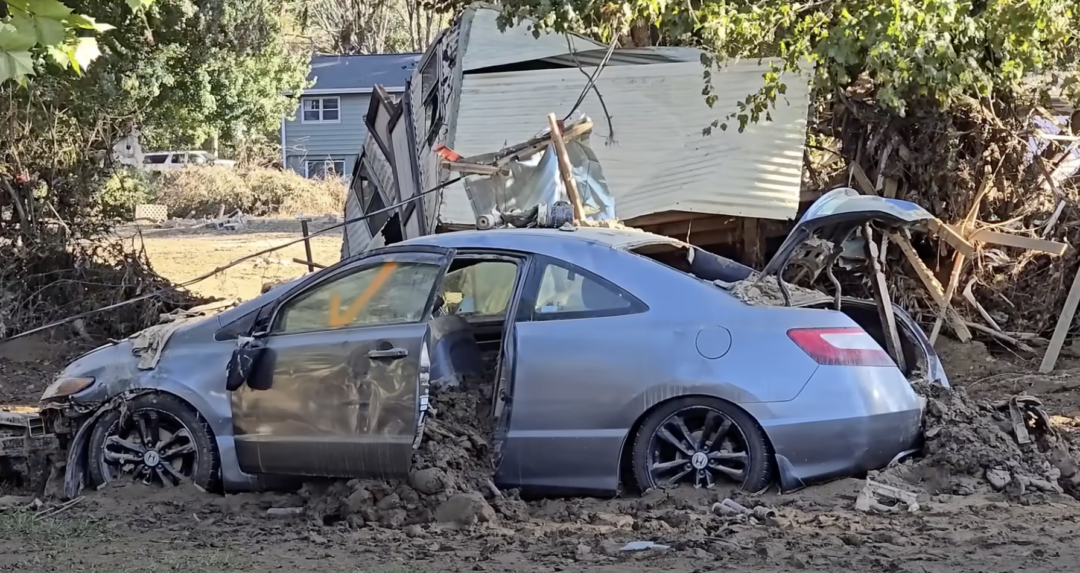
Even though Hurricane Helene ravaged North Carolina in September of last year, now, in mid-February of 2025, the tragedy is still front and center on the minds of North Carolina legislators who are currently banging out relief and recovery plans for the victims whose lives were decimated by the massive rainfall, flash flooding and high winds.
NC Governor Josh Stein and state lawmakers haven’t yet reached an agreement on the amount of money to be spent in a plan to meet immediate needs; however, the governor has proposed a plan that would cost slightly more than $1 billion, while state lawmakers are talking about an amount of roughly half that.
This is just for the relief that will meet immediate needs; everyone realizes billions more will have to go into the relief efforts for years to come.
Cities on the Florida coast are designed and constructed with the idea that a hurricane may hit; however, North Carolina’s mountain communities are not, and, when the hurricane hit a half year ago, the devastation was almost unimaginable.
Private and public relief began pouring into the towns and communities in Western North Carolina soon after the weather relented, but now longer-term relief is being sought.
In a letter to lawmakers, the governor wrote: “Hurricane Helene wrought great devastation across western North Carolina. Over 100 lives were lost, and many more were disrupted. We are facing nearly $60 billion in damages. Despite a tremendous response from federal, state, local, and private and nonprofit partners in the immediate aftermath … it is clear that much more is needed to restore and rebuild western North Carolina.”
Stein added, “True recovery from a disaster of this magnitude will require a powerful, coordinated, and timely response. We cannot ask the residents who are suffering today to wait until next fiscal year for relief. Their needs are dire and immediate; the state’s response should be immediate. The Governor and the General Assembly must work together with a sense of urgency to build western North Carolina back safer and stronger.”
The governor went on to say that the ultimate cost to the state in disaster recovery appropriations will amount to billions of dollars for years to come and that some of that money has to be appropriated and spent now.
The plan Stein has outlined commits $1.07 billion to address immediate needs in the western part of the state through July 1, 2025.
There’s a long list of programs included in the proposed package. Here are just a few of those initiatives:
- $150 million across two grant programs for businesses that suffered physical damage or significant economic loss.
- $30 million for grants to small towns and counties to rebuild downtowns and other business districts.
- $15 million to the Economic Development Partnership of North Carolina’s VisitNC division to support North Carolina’s tourism industry and to attract travelers and new businesses to the area.
- $100 million for revenue replacement grants to support local governments whose resources were exhausted by immediate disaster response – as they work to keep water and sewer services going, pay law enforcement, and support school operations.
In addition to rebuilding aid, some elements of the proposed package are meant to keep those whose homes were destroyed safe and warm until new housing is available. That includes:
- $150 million for a Helene Home Construction and Repair Program to immediately start rebuilding the estimated 5,100 homes that will need to be rebuilt post-Helene.
- $25 million to support people struggling to afford rent, mortgage, or utility costs because their home or livelihood was affected.
- $10 million for a program that supports people who are without homes and provides them with case management support.
- $50 million in incentives for affordable housing construction.
- $25 million to fill in gaps for home repairs that aren’t covered by FEMA.
The package also calls for replacing infrastructure, and that means millions more to repair roads and bridges – including private roads and bridges – and also cleaning up local parks and greenways in affected areas, which is estimated to cost 25 million. Then there’s expediting debris removal ($12 million), providing backup power for emergency operations and other critical infrastructure ($10 million), and repairing septic systems ($4 million).
The General Assembly’s scaled-back still-in-flux $500 million disaster relief spending plan addresses many of the same critical needs the governor’s plan does.
Other agencies are making moves to help the victims as well: FEMA for instance has extended its deadlines for filing for relief.
And there is a Shelter Trailer Program available for up to six months for eligible survivors whose homes cannot yet be occupied.
Even at the national level, the sixth-month-old tragedy in North Carolina is at the center of attention because President Donald Trump has announced his wish to get rid of FEMA and turn disaster relief over to the states. When the storm hit, before the election, Trump used what he claimed was a slow response by FEMA to blast Joe Biden and Kamala Harris, hoping it would help move the needle in North Carolina, which was considered to be an important swing state in the last election.
This week, Trump continued to blast FEMA in his social media posts, and he stated that FEMA will be “a whole big discussion very shortly.”
On Tuesday, Feb.11, a Truth Social post from the president read, “FEMA spent tens of millions of dollars in Democrat areas, disobeying orders, but left the people of North Carolina high and dry. It is now under review and investigation. THE BIDEN RUN FEMA HAS BEEN A DISASTER. FEMA SHOULD BE TERMINATED! IT HAS BEEN SLOW AND TOTALLY INEFFECTIVE. INDIVIDUAL STATES SHOULD HANDLE STORMS, ETC., AS THEY COME. BIG SAVINGS, FAR MORE EFFICIENT!!!”
Also, brand new US Homeland Security Director Kristi Noem, who now runs the agency that oversees FEMA, said recently that the federal government should “get rid of FEMA the way it exists today.”
Despite Trump’s desire to eliminate the agency, doing so would require legislative action, and support for the move might prove hard to come by given the millions and millions of victims the agency has helped and the lives that have been saved by the federal agency across the country throughout the terms of both Democratic and Republican presidents.
Also, while some richer states might be able to self-fund disaster relief programs, the action would likely harm the poorest states the most. Those are states where Trump is highly popular. In the November 2024 US presidential election, nine of the ten poorest states, starting with Mississippi, the very poorest, were carried by Trump by wide margins:
Mississippi: 60.89% voted for Trump.
Louisiana: 64.57%
West Virginia: 68.62%
Arkansas: 65.32%
Alabama: 64.57%
Kentucky: 62.09%
Oklahoma: 65.37%
South Carolina: 57.88%
Tennessee: 60.66%
(New Mexico voted for Kamala Harris, with Trump receiving 43.99% of the vote there.)




Hey Joe Bros, what happen?
Looks like more has gotten done in a couple of weeks then did in a couple of months.
What has Trump done?
Set tariffs against Canada and Mexico but quickly reversed course after the stock market dropped 600 points and Canada and Mexico agreed to do what they already committed.
Acknowledged he had no plans to lower prices as he promised he would do Day 1. (Only suckers actually beleived he would or could).
Cut all grants but had to quickly reverse as the executive order was so poorly written it read as if all government payments should be stopped except debt payments.
He is letting Musk make random cuts in goverment agency without any sense of real implications. And really just pennies from the total budget.
He cut NIH grant overhead which will pull billions out of a range if medical, engineering and other scientific research. Research of course is what makes our country a leader in most industry innovations. But we know maga doesn’t like education or science.
He canceled DEI fed programs which makes sense but has no real impact on American’s lives. Certainly had no impact on the plane crashes or fires like maga fools were led to beleive by president pants on fire.
He has inflamed any chance of peace in the middle east with his ‘kick em out’ proposal for Palestinians, passing off all Arab nations.
So there is that. Of course his maga hat suckers beleive those are progress.
But you be you.
(Oh and inflation hit it’s highest growth in over a year and a half…..one data point doesn’t make a trend but will be interesting to watch).
Looks like someone drank a 6 pack of Mountain Dew for breakfast
“..make random cuts in goverment agency without any sense of real implications.”
Do you pay attention or just regurgitate the talking point?
Do you just make hollow statements or have any real thoughts to add to the conversation?
Or you can make random Government Agencies without any real purpose or accountability other than channeling funds to constituents? Do you think we are stupid?
Yes. I Do. And your comment validates my assumption.
Thank you for asking.
So you look down your nose and trash talk Alan calling him out for his comments with your ‘holier then thou’ speeches only to do the exact same thing you accuse him of. My God the hypocrisy you revel in!
And BTW college educated, how long has President Trump been in office in relation to when this disaster took place? And how long was Biden in power prior to President Trump taking office?
Hope eyes are following this money. I’m sure all are aware FEMA sent $59 m to NYC to pay hotel fees for illegals, while Western NC is still struggling. Hopefully a clawback gets those funds back and praying Stein and NC lawmakers get their stuff together PDQ.
This story line was debunked months ago. Sad you keep spreading the conservative propaganda.
Sorry to tell you Chris but you’re wrong about the debunking part. DOGE just started getting the money back this past week. Go Trump and Musk
You mean the DOGE that fired the staff In charge nuclear weapon oversight because it was ‘wasteful’ to then had to rehire? I wonder how many other less obvious implications will arise from their reckless emotionally driven expense cuts.
Here are few other big ones to watch out for:
– Demand for US farmers production from allies alienated by Trumps American first policies and tariff and USAID cuts.
– drop in US research output due to arbitrary cuts in NIH budgets
– increases in cost of goods made with steel and aluminum due to trump trade wars.
– destsbilization of middle east due to reckless thinking on taking over gaza from Palestinian people.
And it’s only been a month. I do worry a great deal what other longer term implicatations will arrive from congress advocating spending power to president Musk.
No Chris just always you deflect the question when you’re proven wrong. You stated the 59 million was debunked months ago I’m guessing you haven’t seen that the NYC administration is going to sue to get back the 80 million the Trump administration just took back from them You are such a pitiful person
Happy to engage but….What in God’s name are you going on about? Are you having a conversation in your head and only sharing part of it in your comment? 59 million? Context might help.
That’s a drop in the bucket to the trillions that has been spent overseas on the USAID program in recent years. It’s time for someone to finally start holding the government spending accountable. Go Trump and Musk. Maybe it’s time for the IRS to audit Chris
Chris in response to my post on the 17th about the 59 million I spoke of, on the 12th JV posted that FEMA had sent 59 million to NYC to house ILLEGALS, you replied on the 13th that was debunked months ago that’s where the thread began. You may be able to keep up if you let go of the hate you have for Trump
in your little pea brain
President Trump. Please consider recognizing in some way the many dedicated volunteers that stepped up in North Carolina to assist the recovery efforts following Hurricane Helene! Without Samaritan’s Purse, contributions from private pilots contributing their time, planes, and fuel transporting supplies, as well as numerous volunteers on the ground there would have been many more lives lost in the Western Appalachian Mountains of North Carolina. FEMA was a disgrace, and I have been told by eyewitnesses on the ground they would show up for photo ops and then disappear leaving supplies not delivered and the hurricane victims suffering! NC Governor Roy Cooper’s lack of efforts here were almost as worthless!
Pathetic that you think the involvement of volunteer groups is a sign that FEMA failed. You, like most conservative, have fallen for the Trump lies and misinformation (i.e. propaganda) as you clearly lack any real critical thinking skills to understand the role of FEMA versus on the group emergency response teams. Amazing how Americans can fall for such a fool’s message of self-servicing purpose to drive division in our great country.
What cracks me up the most are the people who think FEMA wears a uniform and claim they never ‘saw’ a FEMA rep coordinating supplies etc… Trump is truly destroying our great country with his self-servicing lies that is small minded follows lap up while he fleeces our country and destroys our democracy for his own desire for more and more power and control.
“. . . .you clearly lack any real critical thinking skills to understand the role of FEMA”
Clearly, you are not discussing the issues but are ranting at those with whom you disagree. Need to take a debate class to learn the art of discussion and persuasion. But as you say, I guess you be you.
Just retorting in kind. Not complicated. If anyone responds in a thoughtful, respectful way, i will respond in kind. I will listen to your criticism of my comment when i see you provide the same analysis of those that do the same.
But you be you.
Democracy is not the best form of government, it’s a rule by mob the majority and has unlimited power to make laws, minorities have few protections from the will of the majority the mob. The next step forward from a democratic is socialism or communism light. The Biden administration refused to follow the rule of law. When the Supreme court ruled the Biden administration could not pay college debt off with taxpayers money. Biden refused to except and follow the supreme court ruling and continue to use tax dollars to pay college debt off after the Supreme Court ruled against him. Biden changed the policy governing how the pay ments would be provided and again the Supreme Court ruled against Biden but he did not stop paying College debt off. Biden continue to pay college debt off all the way up to his last day’s in office. Deliberately not following the rule of law. Trump has been ordered 3 times by lower courts that he has no right to government records. Trump did the right thing and Challenge the court order’s and won ever case. So who was destroying democracy, it definitely wasn’t Trump, but Biden refusing to follow the law of the Supreme Court. As I have kept up with Trumps governing and the executive orders he has issued by reducing the size of a government searching for fraud and government spending that is not in the best interests of Americans taxpayers dollars, seems to me Trump is moving toward a Republic form of government, and I hope he succeeds.
Republic is a better form of government. Under a Republic individual citizens hold the power.
Laws are created according to the constraints of the constitution. Laws made by elected representative. Rule is by elected representatives of the people. The protection of rights comes from the constitution that protects the rights of all people from the will of the majority mob.
Amen!
my AMEN was definitely not to Chris !
According to your statements more than half of the voting public in the most recent presidential election consisted of republicans, democrats and independents and they are “suckers” and “fools”. What are you?
Jv, I did not say that nor do I think that. By the way, since you asked, I am a Libertarian and was the Libertarian candidate for governor of NC in 1996.
My response was directed to Chris, dated 2-12
6:55 pm…. not you.
Scott, my reply was directed to Chris, 2-12…6:55 pm. I don’t believe more than half of the nation that voted for Trump were suckers or fools as Chris stated. Just curious as to what Chris really is.
Ok. Thanks for letting me know.
another example of a conservative that can’t add 1 plus 1. Thanks for trying. Maybe ask you kids to help you next time.
I experienced flooding in the nc mountains due to hurricane remnants firsthand in 2004. FEMA was as worthless then as it is today.
Meanwhile, I think Governor Roy Cooper was in La La Land finishing his term thinking he was riding Kamala Harriss’ Coat Tails to a prestigious Cabinet Position. Hope North Carolinians’ will remember who deserted them when Governor Roy runs for his next Political office!
Initially there were many missing people in Appalachia resulting from Helene . Deaths from the storm have been reported, but have all those identified as missing been located?
Many likely won’t is my understanding from a few of the news stories on the topic. Many were washed away downstream among mass of structural debris that will make locating and identifying bodies difficult.
Gosh, to be as perfect as you think you are. Go hug your unicorn Chris and keep kidding yourself.
Eliminate FEMA. When disaster strikes, give federal money to the governor of the state. Governors can do a better job than any federal bureaucracy. If the governor fails to do the job adequately, vote the governor out of office. No one can vote a bureaucrat out of office.
This is the lie your dear leader tell you? So now all 50 states will carry there own inventories of emergency supplies and temp housing resources? All 50 states will have the army of people on call to drive the assessment of loss so money is properly allocated without risk of fraud?
Since you already believe the lie that FEMA acts as a first responder (when it’s local emergency services that acts as first responders) and FEMA’s early roll is establishing supply distribution centers for food and water i guess you ill value very anything.
This is just Trump wanting to be able to withhold emergency funds from states headed by political opponemts and MAGA buys into it like the good sheep they always are for Trumpty Dumpty.
Chris Obama said it first but I’ll say it again, elections have consequences Trump won so get over yourself. Had the democrats left the election alone in 2020 Trump would be gone now and you could be living in the fantasy land that’s in your head
We should always stand up to poor leadership in office. Trump won less than half of the popular vote so clearly didn’t win a mandate of any kind.
It is scary how congress has advocates it’s authority over spending to the executive branch and the recent calls to impeach judges that attempt to reign in the executives orders thst break thr law is one of the scariest things I have ever heard in American politics. It is sad that MAGA think all this is a good thing. Just sad. So yeah, I am going to what little I can to resist and call out the hypocrisy incompetence and corruption of the Trump administration.
Why don’t you speak the same of ole pudding head’s administration. He checked all the boxes you listed and then some. First time in my lifetime I’ve ever seen someone pardoned before they were charged or convicted. Please explain that one in your most liberal way
I don’t think Biden did an awful job. His biggest failure was communicating with the public and not showing empathy to the impact of inflation. Otherwise, he passed infrastructure bill, beat back inflation without causing a recession, got us through covid by promoting Trump covid vaccine, reduced deficit spending inflated by Trump, record oil and gas production, clean energy investment (cuz you know, science is clear….climate change is a real threat and is man made), Chips act to counter act China’s threat to chip manufacturing, ended war in Afghanistan ….to name a few of the bigger achievements.
Also note, he didn’t make enemies of our allies by threating to hit them with across-the-board tariffs or make them our 51st state (Canada) or buy them (Greenland) or raid them (Panama Canal) or disrupt middle east peace process by wanting to kick Palestinians out of Gaza to build resorts, etc….
I have always said that Biden should have taken action on the boarder early but he elected to push legislation (That Drump blocked), acknowledged his COVID relief bill was too broad (as were Trump’s) and did add to Trump monetary policies that caused the inflation (on top of supply chain disruptions etc…) Lastly, I was critical of Biden for breaking his word and running again as he was clearly too old to run an effective campaign.
Note, I believe the president should be a leader. Not a doer. Drump is a control freak who thinks he has all the answers when in fact he doesn’t understand even understand the basic of economics, foreign policy strategies, or how to build a consensus on legislation. Hence his only tool is executive orders and bully tactics with allies and enemies alike.
With Trump in office, I truly miss Biden, …..even though I have always said the only people worse to have as President are Trump and Hillary.
Since you claim Biden checks all the same boxes tell me how did Biden:
– Threaten Allies
– Exceed executive authority
– Threaten judges that tried to stop him from breaking the law
– Pushed economic policy in spite of economic principles that advise against such practices as across the board tariffs, using tariffs to replace income taxes, or thinking trade surplus is same as debt?
– Make emotional cuts to federal agencies with little regard to impact such as his firing of staff who safeguard US nuclear weapons
– Politicizes natural disasters (WNC and LA Fires)
– Blames tragedies on DEI policies by spreading misinformation AND THEN cuts FAA staff after deadliest accidents in years.
And that isn’t even a full list of the things that worry me about Drump and it has only been a month.
Chris, are you suggesting that there is no fraud in FEMA? You joke, right? FEMA was created by Executive Order by Jimmy Carter in 1979. The same Jimmy Carter who created the Department of Education in 1979. What did states do prior to FEMA? Camille in 1969 devastated Richmond VA with flood waters washing over the James River Bridge and Nickle Bridge. What about Agnes in 1972 causing devastation in Virginia, Pennsylvania, Maryland, and New York? What about Hurricanes Celia, Beulah, and who can forget Hazel in October 1954? All response and recovery without a FEMA. So, you see, Chris, Federals are not the best at handling disasters. If the federal government wants to help, send money. The states will do the rest. The federal government could appropriate budget money earmarked for “disasters,” not to be touched by any agency. The states could have a disaster readiness plan in cooperation with the federal government. Abolish FEMA and act like it is 1978 or earlier. And, Chris, I did not say that FEMA acts as a first responder. If recent history is any indication, is FEMA a responder at any time during a disaster?
It’s more efficient from two perspectives:
1) warehousing key recovery supplies thst can be distributed nationally such as trailer homes and basic supplies.
2) the staff that go on-site to i spect damages before distributing of funds are centrally managed to a standard.
I am tired of claims of fraud without evidence of fraud. If Musky and Drump claim these cuts are to reduce fraud, you have to find the fraud first. They of course don’t care about fraud. Trump just wants control so he can withhold funds from unfriendly govenors like he did to NC during his forst term and has said he will do with the LA fires.
FEMA has been providing temporarily housing and distributed millions in immediate short term funds as well as coordinated over a 100 distribution centers for supplies. Do.you want me to drag out the entire fact sheet of what FEMA has done for WNC?
If you have a source exposing fraud from FEMA please share or I will assume you are just a hater of FEMA because Drump told you to be one.
Chris, you use the word “hate” a lot. The federal government invites illegal immigration by paying for services for illegal immigrants. The federal government paid $220M to lease the 4-Star Roosevelt Hotel in NYC to house illegal immigrants. That was our tax dollars. Are you okay with that, Chris? And, we do not know what additional costs may have been included in the lease that would have driven costs above $220M. We do know that additional money was paid by FEMA for housing the illegal immigrants. It is my understanding that a Pakistani company owns the Roosevelt Hotel. If correct, the $220M is now offshore and out of the US economy. Why is FEMA money being used to house illegal immigrants? Let the 10th Amendment work by eliminating FEMA.
Unlike Trump, Biden didn’t believe cruelty is an appropriate strategy for fighting illegal immigration in the same way Trump does. I agree with Biden on that issue. Biden should have done more sooner but he bet on legislation in spite of conservative track record of disrupting needed change in the name of not giving the ‘other’ party a win.
So, yeah. I am ok with NOT treating illegal immigrants as criminals when in reality they are desperate people (often families) looking to escape oppressive poverty, gang violence, or war. Doesn’t mean they should all be given a life in the US but also doesn’t mean we should put families and kids in cages.
I will always say, if republicans really cared about reform, they would have passed the immigration bill. But they prefer to use cruelty while at the same time claiming to be a Christian Nation.
But you be you.
And point of clarity. The Roosevelt Hotel is being used for Asylum seekers, not illegals. Funny how conservative think they are the same thing. …but again, laws don’t seem to mean much to conservatives if they don’t ‘like’ them.
Of course, if republicans had passed the immigration reform bill, asylum loophole would have been closed by simplifying the process so they could be processed in days versus years as required under the current system.
Chris, Democrats are so good at playing word games. So, what you are saying is that every illegal immigrant in the Roosevelt Hotel qualify as asylum seekers because they say they are? They can only be labeled asylum seekers when an investigation is completed. If I say that I am a rabbit, does that automatically make me a rabbit? Chris, for your own sake, I would suggest you make a concerted effort to start thinking for yourself.
Democrat speak: Pregnant person, gender fluidity, cultural appropriation, mansplaining, inclusive, intersectional, systemic oppression, DEI, and on and on and on ad nauseum.
Chris I’m pretty sure the chain link facilities at the border were installed by Obama. Correct me if I’m wrong. They were there when Trump took office in 2016 and Biden in 2020 and still there today
The difference was how he separated families and then lost track of where each were sent. Of course, sending the them to GITMO now means no legal representation as well. So there is that too.
Firming was not a part of any conversation until Trump brought it up a couple weeks ago you little pissant pencil neck wiener. You can never have an actual factual argument
That is what the facts say. Don’t let them get in the way of your bias.
Is that according to Goggle Chris
Folks,
Proverbs 26:4, “Answer not a fool according to his folly, lest you be like him yourself”.
I prefer equating it with urinating into fast moving wind. The only thing you get is wet and smelly.