With early voting underway and Election Day just over two weeks away, Guilford County voters are once again being asked to approve a quarter-cent sales tax increase – but something seems to be missing this time around: The campaign to convince voters to support it.
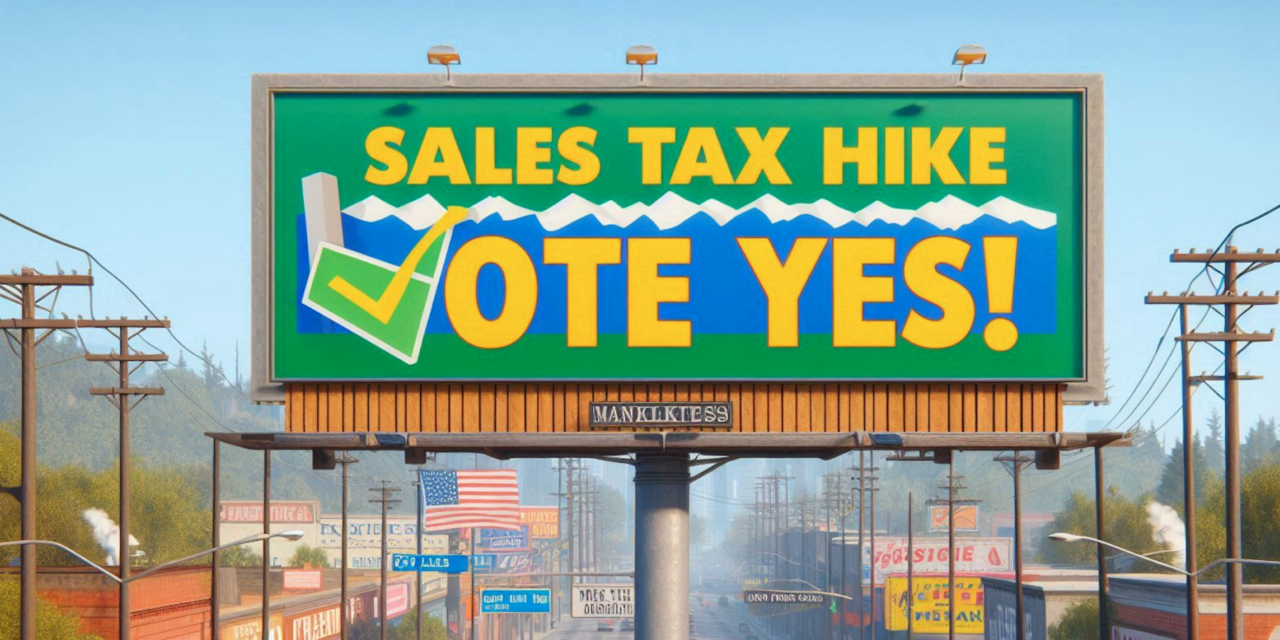
In previous years, sales tax referendums have been accompanied by public forums, advertising, promotional materials, news conferences and organized efforts to convince voters that the additional tax revenue was desperately needed. In 2024 there was a billboard campaign (pictured above) among many other efforts.
This year, however, there’s been comparatively little visible campaigning for the measure, which will appear on the Tuesday, Nov. 3 ballot.
That’s particularly interesting considering that Guilford County voters have rejected the proposed tax seven times since 2008. The upcoming vote will be the county’s eighth attempt to get the additional sales tax approved.
Guilford County Board of Commissioners Chairman Skip Alston, who’s been one of the leading advocates for the tax, told the Rhino Times that there is a group supporting the referendum, though he couldn’t recall the group’s name.
Alston said the Guilford County Board of Education, fire departments and Guilford Technical Community College supporters are also pushing for the tax.
Asked why voters should support the increase, Alston said the biggest advantage is that it would provide an additional source of revenue for public services without placing the entire burden on property owners.
Alston said Guilford County attracts a large number of shoppers and visitors from outside the county – meaning people who don’t pay property taxes here would help fund local services.
He estimated that 40 percent or more of the additional sales tax would be paid by people from outside Guilford County.
That figure has been used by county officials before. Minutes from a December 2019 meeting of county commissioners and school officials show that then-County Manager Marty Lawing cited an earlier study estimating that approximately 40 percent of sales tax revenue came from out-of-county taxpayers.
However, it’s unclear whether that estimate remains accurate today.
One significant difference between this year’s referendum and previous attempts is that the county has obtained special legislation from the North Carolina General Assembly allowing the ballot itself to state exactly where the money will go.
Previously, voters were asked to approve the tax without legally binding language specifying how the revenue would be spent. Commissioners could promise to spend the proceeds on education or other services; however, future boards weren’t bound by those promises.
Alston said that uncertainty has been one of the biggest problems with previous referendums.
He said voters didn’t necessarily trust promises from the current commissioners because a different board years later could decide to spend the money elsewhere.
Alston compared the situation to the longstanding controversy over North Carolina lottery proceeds, which many voters believed would provide additional education funding.
Under the new legislation, the money must be distributed according to percentages established by state law.
Seventy percent would go toward classroom teacher salary supplements, 18 percent toward fire protection equipment and services, 8 percent toward capital improvements at Guilford Technical Community College and 4 percent toward allowable expenses for qualifying municipalities.
The municipalities identified in the county’s referendum resolution are Oak Ridge, Pleasant Garden, Stokesdale, Summerfield and Whitsett.
The additional quarter-cent tax is projected to generate approximately $29 million annually, based on a state legislative estimate using fiscal 2023-24 sales figures.
That would mean roughly $20 million annually for teacher salary supplements, about $5.2 million for fire services, $2.3 million for GTCC and $1.1 million for qualifying municipalities, assuming revenue of $29 million.
The tax would increase the combined general sales tax rate in Guilford County from 6.75 percent to 7 percent. For an item subject to the general sales tax, that amounts to another 25 cents on a $100 purchase.
Alston said that getting the new ballot language approved took considerable work.
He said he personally met with North Carolina Senate President Pro Tem Phil Berger, along with county staff, and that Republican Commissioner Pat Tillman helped arrange the meeting.
The effort ultimately resulted in legislation giving Guilford County special authority to spell out how the revenue would be divided.
Alston said he believes that change will address the concerns that have prevented the tax from winning voter approval in the past.
“That’s why I think it’s going to pass this time,” Alston said.
Despite that confidence, the public campaign this year has been far less visible than in some previous elections.
In 2014, supporters organized public forums and distributed campaign materials under the slogan “1/4-Cent For Schools.” A forum at Elon Law School brought together school officials, education advocates and other community leaders to make the case for the tax.
The 2020 effort was also highly visible.
That year, the sales tax referendum appeared alongside a $300 million school bond referendum, and county and school officials undertook an extensive public information effort involving websites, videos, advertising and other outreach.
An October 2020 Rhino Times article reported that then-Clerk to the Board Robin Keller was coordinating the county’s public education campaign and had introduced a website, schoolbondfacts.com, explaining the two ballot measures.
Keller told commissioners at the time that additional press releases, news conferences and other information would follow.
In 2022, educators also publicly advocated for the sales tax and school bonds.
This year, the Guilford County Board of Education has publicly backed the proposal – including adopting a resolution concerning the tax and teacher compensation in October.
The Replacements, Ltd. political action committee has also published an endorsement supporting the increase.
However, a similarly visible countywide campaign specifically promoting the 2026 sales tax referendum hasn’t been identified.
It’s also unclear how much taxpayer money the county has spent on public “education” concerning the current referendum compared with earlier efforts. In the past some of those tax-payer funded educational material have looked a lot like a pro- sales tax ad campaign.
The question now is whether the new, legally binding ballot language will make a difference with voters even without the kind of highly visible promotional campaign seen in some previous years. After seven unsuccessful attempts, Guilford County voters will once again have the final say on Nov. 3.