


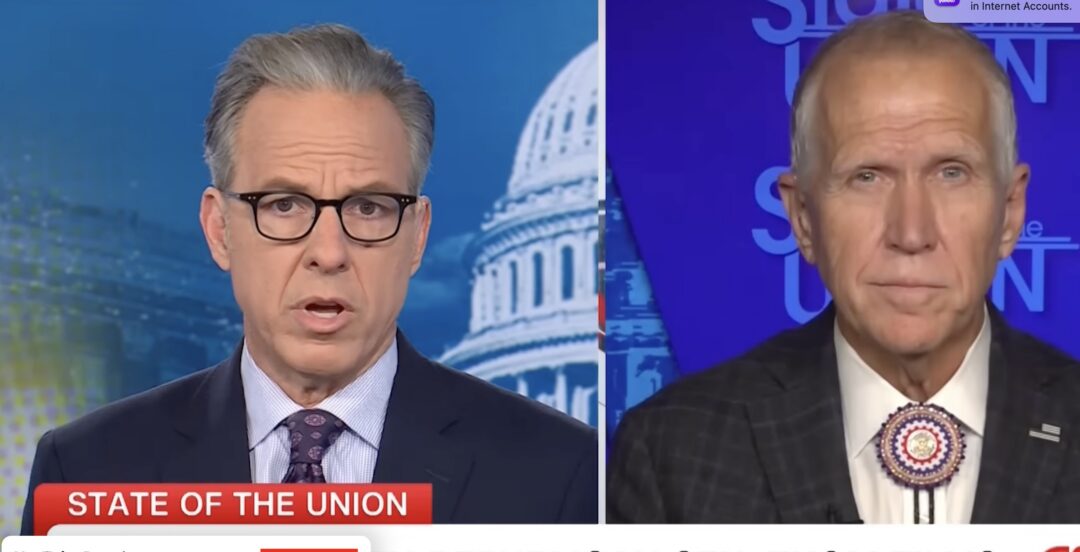
With Election Day little more than a month away, Republican US Sen. Thom Tillis delivered a remarkably blunt assessment Sunday of Republican Michael Whatley’s chances of succeeding him in the US Senate.
Tillis stopped short of saying that Republicans should give up on the North Carolina race, but he came pretty close.
Appearing Sunday, Sept. 27, on CNN’s “State of the Union,” Tillis said Republican leaders need to look at the polling and decide where their campaign money has the best chance of keeping Republicans in control of the Senate.
“If we have a path to victory, then we double down on it,” Tillis said. “If we don’t, we move where we have the opportunity.”
CNN host Jake Tapper then asked Tillis directly whether the data showed that North Carolina should no longer be a top Republican priority. Tillis responded that when an average of polls has a candidate trailing by high single digits or double digits, “it’s approaching a point where it’s going to be difficult to make it up.”
That’s a somewhat extraordinary assessment coming from the Republican who currently holds the seat Whatley is trying to win.
Tillis emphasized that he wasn’t declaring the North Carolina race over. He noted that elections can change quickly and candidates can make mistakes – but his larger point was that the National Republican Senatorial Committee has a limited amount of money and its primary objective should be maintaining the Republican Senate majority rather than protecting any individual candidate.
Tillis pointed to his own 2014 race against Democratic US Sen. Kay Hagan. Tillis said on the Sunday morning show that Republican officials questioned late in that campaign whether they should continue investing in North Carolina, and he told them that if they didn’t believe he had a path to victory they should put the money elsewhere.
They ultimately stayed in the race, and Tillis won.
This time, however, Tillis suggested Republicans also need to concentrate on races in Maine, Alaska and Ohio, along with other states becoming competitive.
The comments come as Whatley – the former chairman of both the Republican National Committee and the North Carolina Republican Party – continues to closely associate his campaign with President Donald Trump.
Tillis has publicly encouraged Whatley to establish more independence from Trump. Whatley has instead emphasized their relationship.
At Trump’s Sept. 16 rally in Whatley’s hometown of Gastonia, Whatley recalled being asked to help Trump’s first presidential campaign in North Carolina in 2015.
Whatley said he agreed because he believed in what Trump was proposing and he added that, 11 years later, “I am still with that guy.”
Ahead of Trump’s Gastonia visit, Whatley also posted that “President Trump needs an ally in the Senate and North Carolina needs a fighter.”
Trump has strongly backed Whatley: Whatley entered the Senate race after Tillis announced he wouldn’t seek a third term, and Trump endorsed Whatley as his preferred successor.
Trump traveled to Gastonia to campaign for him Sept. 16, and Vice President JD Vance appeared in Greensboro for Whatley five days after that.
Tillis suggested Sunday that Republicans’ insistence on near-total loyalty to Trump may itself be creating political problems. He pointed in particular to Texas, where Trump opposed longtime Republican US Sen. John Cornyn and supported Attorney General Ken Paxton.
Tillis called Trump’s decision regarding Cornyn a “colossal mistake” and he added that Republicans wouldn’t be spending enormous amounts of money defending Texas if Cornyn were the nominee.
Tillis also criticized what he described as Republican “loyalty oaths” to Trump – arguing that Republican officeholders who support Trump almost all the time shouldn’t be targeted just because of the relatively few occasions when they disagree with him.
Such expectations, Tillis said, are “unrealistic” and “unsustainable,” and can cause Republicans to lose elections.
Tillis also corrected Tapper’s characterization that Trump forced him out of the Senate race.
Tillis said that he was already leaning toward retirement and joked that Trump simply gave him “a good opportunity to announce my retirement.”
The polling helps explain Tillis’ concern about the North Carolina race. A High Point University Poll released Thursday, Sept. 24, found former Democratic Gov. Roy Cooper leading Whatley 50 percent to 42 percent among likely North Carolina voters. Another 3 percent supported another candidate and 5 percent were undecided.
The same HPU poll in August found Cooper ahead 50 percent to 45 percent – meaning Whatley’s position in the university’s polling has worsened during the final months of the campaign rather than improved.
Earlier polling also showed Cooper ahead. An Emerson College poll had Cooper leading 47 percent to 41 percent and showed a major difference in name recognition between the two candidates.
Cooper, who served two terms as governor and previously four terms as state attorney general, is better known statewide than Whatley.
Prediction markets have moved even further toward Cooper, although those markets are wagers by traders rather than scientific surveys of voters.
As of the weekend, North Carolina Senate contracts on Kalshi were trading at about 93 cents for Cooper and 7 cents for Whatley, with more than $2.2 million traded in the market. Polymarket showed a similarly large gap. However, those prices can change rapidly as traders react to polls, news and campaign developments.
Whatley still has several factors working in his favor: North Carolina hasn’t elected a Democratic US senator since Kay Hagan won in 2008, and Trump carried the state in 2016, 2020 and 2024. Trump and national Republicans are also actively campaigning for Whatley, and more than a month remains before the Nov. 3 election.
But Tillis’ comments Sunday indicate that at least one prominent North Carolina Republican believes time may be running out for Whatley to demonstrate that the race remains worth a major national investment.
National reports last week raised questions about whether Republicans were preparing to shift resources away from North Carolina. Politico reported that NRSC Chairman Tim Scott had identified seven states as spending priorities without including North Carolina. The NRSC strongly disputed that report, saying Scott had made no spending announcement and had praised Whatley’s polling momentum.
For Tillis, the question now isn’t simply whether Whatley can still win North Carolina. The question is whether Republicans trying to preserve their Senate majority can afford to bet that he will.




I supported Thom Tillis, and for good reasons.
As a conservative, I appreciated his generally conservative voting record on taxes, regulation, Second Amendment rights, immigration, and the judiciary.
He was a strong advocate for North Carolina’s military installations, defense industry and economic interests, and he brought considerable legislative experience to the Senate.
I also respected that Tillis was willing, at times, to break with his own party when he believed constitutional principles, institutional checks and balances, or the Senate’s role required it.
On foreign policy, he generally favored a strong national defense.
Most importantly, Tillis showed that being a Republican did not necessarily mean marching in lockstep with the party. That independence was a big reason I supported him.
I can’t see voting for Whately, who seems to offer little original thinking on what NC needs to recover from the failures of Trump’s war with Iran. Ranting about crime feels like an effort to avoid the elephant in the room: Trump’s economic failures.