
Years ago, a Rhino Times reader criticized former Rhino Times owner and editor John Hammer for subscribing to and reading the Greensboro News & Record.
Hammer responded with something to the effect of, “I’d be crazy not to read the News & Record. They’re the competition.”
The current owner and editor of the Rhino Times appreciates that sentiment. However, he isn’t crazy enough to pay more than $900 a year to read what remains of Greensboro’s once-mighty daily newspaper.
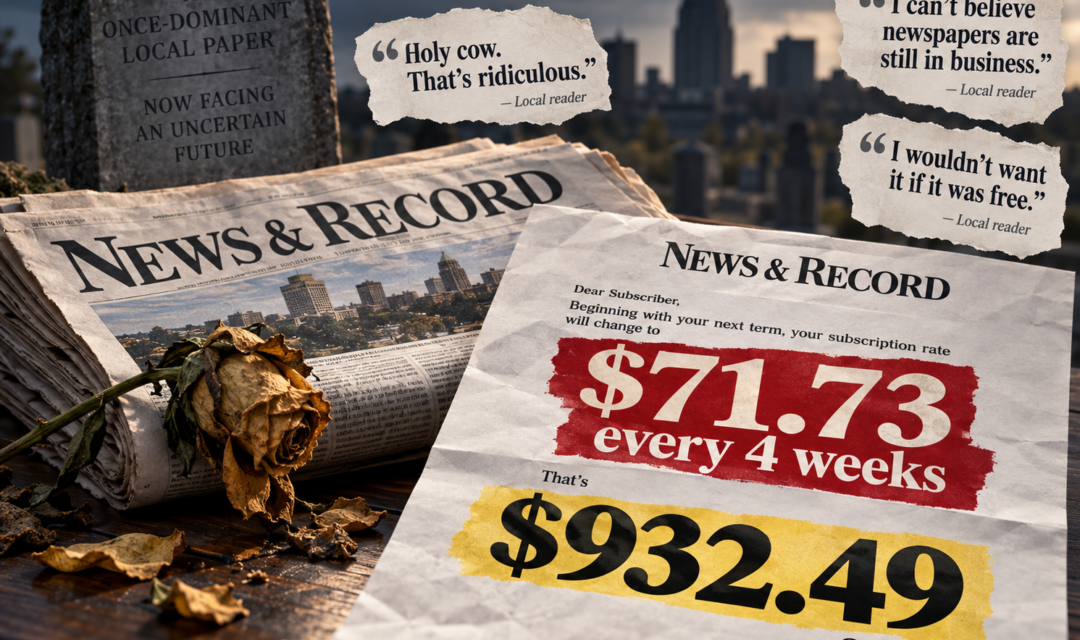
The News & Record recently sent letters to subscribers informing them of some eye-popping subscription increases. In the case of the Rhino Times, the new price would be $71.73 every four weeks, or $932.49 a year.
That’s about $78 a month for a newspaper that no longer even arrives in print seven days a week.
The Rhino Times had been paying $8 a month under a special promotional arrangement that lasted for a couple of years. That rate eventually increased to about $25 a month. Now, the new annual cost will be more than three times that amount.
And the timing couldn’t be worse for a newspaper that has been hemorrhaging readers for decades.
The subscription letter, dated Oct. 19, begins by thanking readers for their loyalty and explaining the benefits of the newspaper –including breaking news, photography, podcasts, dining reviews, sports coverage and access to its archives.
Then it delivers the bad news.
“Beginning with your next term, your subscription rate will change to $71.73 every 4 weeks, which includes a delivery fee of $7.20,” the letter states.
It goes on to explain, “The new price reflects our value as the unmatched No. 1 source for local news and sports coverage of the city and surrounding region.”
That claim might have been easier to defend 30 years ago. These days, the News & Record is a shadow of its former self – and asking subscribers to pay nearly $1,000 a year for the diminished product seems like a good way to make certain that even more readers disappear.
In October 2025, the Rhino Times ran an article titled “Is The News & Record On Its Death Bed?” after the newspaper announced that it would eliminate its Monday print edition beginning in November.
That decision ended the paper’s longstanding tradition of publishing a printed newspaper seven days a week.
At the time, the News & Record explained that the change was necessary because of industry pressures, declining advertising revenue and rising printing costs. Now, one year later, the latest subscription increase raises another question: How much longer can the print edition survive?
In 1984, the Greensboro Daily News, which arrived in the morning, and the Greensboro Record, which arrived in the afternoon, merged into the Greensboro News & Record. Their weekend editions had already been consolidated.
For decades, the papers had been institutions in Greensboro. They covered City Council meetings, county commissioners, schools, courts, local businesses and high school sports. They carried pages of advertising, obituaries, comics and classified listings.
At one time, it seemed that nearly everyone in Greensboro subscribed to one paper or the other, and plenty of households received both.
As the Rhino Times reported last October, the News & Record had a daily circulation of approximately 90,400 in 2006 and a Sunday circulation of about 111,000.
By 2021, reported daily circulation had fallen to 21,510.
In 2023, the reported daily circulation was 15,151, with Sunday circulation of 16,725.
A figure cited in the Rhino Times’ earlier article put the average daily print run in 2025 at approximately 7,000 copies.
That’s a staggering decline for a newspaper serving Guilford County and the surrounding area.
The newspaper’s physical presence in Greensboro has practically vanished as well.
Its once-prominent downtown headquarters was abandoned and eventually demolished. Much of its operation moved to Winston-Salem.
The paper itself has gotten progressively smaller.
The pages have narrowed. The sections have disappeared or shrunk. Popular comic strips have been eliminated. Headlines and subheads have grown larger, apparently in an effort to fill space where actual reporting once appeared.
And the local news coverage has dwindled.
Where the newspaper once had reporters covering virtually every important local government meeting, it now sends reporters to far fewer of those meetings.
At Guilford County Board of Commissioners worksessin, for example, the Rhino Times is frequently the only news organization represented.
That’s a far cry from the days when both the News & Record and the High Point Enterprise routinely had reporters in the room.
The newspaper also has a serious problem with timeliness.
Years ago, a major sporting event ending late at night could make the following morning’s paper. Now, with earlier printing deadlines, the results of an evening game might not appear in print until two days later.
Much of the remaining newspaper consists of Associated Press articles that readers may already have seen on television or online the previous day, along with generic feature stories offering advice on subjects such as reducing spam emails or improving household organization.
There’s certainly nothing wrong with those articles, but they’re hardly what Greensboro residents once expected from their hometown newspaper.
And now readers are being asked to pay substantially more for substantially less.
The reaction on social media suggests that the latest pricing decisions aren’t exactly winning converts.
In a Nextdoor discussion about the subscription costs, one commenter, Sandra Burns, wrote, “I can’t believe they have the nerve to ask that price for their awful paper.”
Another commenter, Chris R., responded, “$488? Holy cow. That’s ridiculous.”
At least that’s a better price then the Rhino Times would be getting.
James Bartorelli offered an even more fundamental observation: “I can’t believe newspapers are still in business.”
Not everyone thought the price increase was entirely unreasonable. Brian Thomas, who said he delivered newspapers 40 years ago, recalled that subscriptions cost about $140 annually back then and said he expected prices to have risen substantially over four decades.
However, he also suggested that online subscriptions could be obtained for considerably less.
Others argued that the issue wasn’t simply the price but the newspaper’s steadily diminishing value.
Trudy Matthews wrote, “I wouldn’t want it if it was free. Pitiful paper.”
Another commenter, Phyllis Kranz, wrote that her household had stopped getting the paper years ago and suggested that newspapers had priced themselves out of business.
The comments were hardly a scientific survey of public opinion; however, they illustrate a problem that should concern any newspaper publisher: Some former readers no longer believe the product is worth buying at any price.
The decline isn’t unique to Greensboro, of course.
Newspapers across the country have lost circulation and advertising revenue as readers have migrated to the internet. Printing and distribution have become increasingly expensive, while digital competitors offer news instantly, frequently at no charge.
The Rhino Times understands those pressures firsthand.
After decades as a printed weekly newspaper, the Rhino Times ended its print edition in 2018 and moved entirely online.
That decision allowed the publication to eliminate printing and distribution expenses while continuing to cover local government and other Guilford County news.
The News & Record may eventually find itself making the same decision.
There’s also an economic problem with the newspaper’s new approach: When a business loses customers, increasing prices can bring in more revenue from those who remain. But there comes a point when the higher prices drive away so many additional customers that the strategy becomes self-defeating.
And nearly $1,000 annually seems like a good place to test that theory.
The News & Record’s subscription letter assures readers that the new price reflects the paper’s value as the region’s leading source of news.
But the question isn’t how much the newspaper believes it’s worth. The question is how much its remaining subscribers are willing to pay.
The Rhino Times has already answered that question.
At $932.49 a year, keeping an eye on the News & Record has become an extraordinarily expensive proposition.
And if enough other subscribers reach the same conclusion, the News & Record may discover that its latest price increases were less a financial rescue plan than a death warrant for its remaining print edition.