


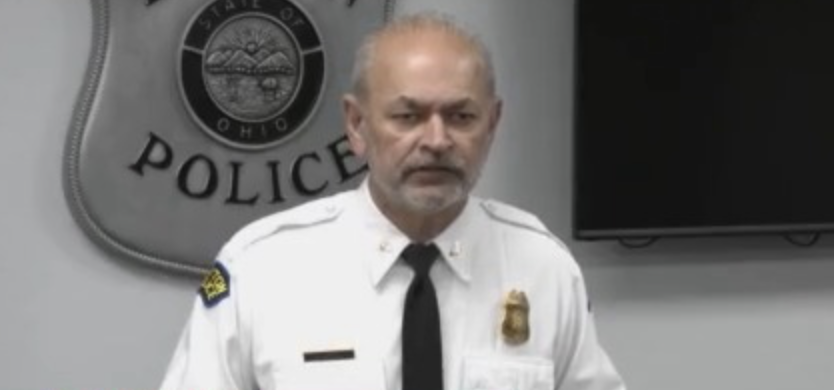
After a national search, the City of Greensboro has its next police chief – and he’s bringing with him decades of experience, a track record of reducing violent crime and a philosophy that leans heavily on community trust.
Greensboro City Manager Trey Davis announced this week that Kamran Afzal will take over as Greensboro’s new police chief, replacing John Thompson, who retired earlier this year. Afzal is scheduled to begin the job on May 13, 2026.
Afzal arrives with a long résumé that spans more than three decades in law enforcement, including leadership roles in Virginia, Colorado and, most recently, Dayton, Ohio.
According to the City of Greensboro’s press release announcing the hire, Afzal began his career with the US Capitol Police in 1991 before moving to the Arlington County Police Department, where he spent 24 years – including 12 years on the command staff.
That’s a whole lot of time learning the nuts and bolts of policing – from community engagement to special operations to the behind-the-scenes work that keeps a department running.
And that “behind-the-scenes” part turns out to be important.
Afzal has emphasized developing leadership from within departments – something he talked about in a recent interview on ABC 45 after taking the Greensboro job.
“I knew that I was the fourth consecutive chief from outside,” Afzal said, according to ABC 45. “Let’s develop people internally so they can compete for a position.”
That focus on building depth inside a department could matter in Greensboro, where long-term stability and leadership continuity have been ongoing concerns.
Afzal described how he rotates leadership within a department to give rising officers broader experience – something that he says prepares them for future leadership roles.
“We move people around to make sure that they’re exposed to different aspects of the organization,” Afzal said.
That kind of approach may sound like management jargon, but it gets at a real issue: whether a police department is building its next generation of leaders – or constantly starting over fresh.
Afzal’s career path also includes stints as police chief in Durango, Colorado, and Hopewell, Virginia, before he was selected in 2021 to lead the Dayton Police Department after a nationwide search.
A news report from Dayton at that time noted that officials were looking for someone who could lead reform efforts, strengthen community relationships and reduce crime – and they believed Afzal fit the bill.
That’s where his record starts to get particularly relevant for Greensboro.
In Dayton, Afzal pointed to measurable reductions in violent crime during his tenure.
In an interview earlier this year with a Dayton news outlet, Afzal said violent crime was down about 17 percent there compared to the previous year, and roughly 15 percent over a five-year average.
But his tone wasn’t celebratory.
“From my perspective, that means there’s still at least one person being victimized,” Afzal said in January. “There’s really not room to celebrate.”
That mindset – acknowledging progress but refusing to declare victory – may resonate in Greensboro, where crime issues, particularly downtown and in certain neighborhoods, remain a major concern.
Afzal also emphasized something that often gets overlooked in crime statistics: the importance of long-term trends over year-to-year fluctuations.
“Numbers can go up and numbers can go down year to year,” he said while in Dayton. “But you want to see, over a period of time, a decline.”
That kind of long-view thinking could be important in Greensboro, where debates over crime often focus on short-term spikes rather than sustained trends.
Another key piece of Afzal’s approach is staffing.
While in Dayton, he pointed to increased officer staffing levels as one factor contributing to reduced crime.
Having more officers on the street, he said, “brings the temperature down.”
That’s a simple way of putting it – but it reflects a broader philosophy that visible policing combined with strategic deployment can deter crime before it happens.
Afzal doesn’t stop at traditional policing: One of the most notable aspects of his approach is his emphasis on community cooperation.
“We can’t solve crimes on our own,” Afzal told a Dayton news outlet earlier this year. “That’s a very small percentage of crimes that we solve on our own – people who commit harm don’t call us.”
Instead, he stressed that solving crime depends heavily on relationships with residents – people who are willing to share information and work with law enforcement.
That’s a big deal for a city like Greensboro. Downtown concerns, homelessness issues, and crime in certain areas often intersect with broader community challenges – meaning that enforcement alone isn’t likely to solve the problems.
Afzal appears to understand that.
His career includes a strong emphasis on community policing, including initiatives aimed at building trust and encouraging public input for department policies.
While serving in Hopewell, Virginia, he made community input part of department policy and he worked to increase transparency according to City of Greensboro officials.
That kind of approach could play a role in Greensboro, where trust between law enforcement and parts of the community has been uneven at times.
Afzal has also shown an awareness of how crime patterns vary across a city.
In Dayton, he pushed back on the idea that any one area – such as downtown – should be the sole focus of policing efforts.
“Everything is a focus for us,” he said in that Dayton interview, noting that different areas require different strategies.
That’s another point that may carry over to Greensboro, where discussions about crime often center on downtown but extend to neighborhoods across the city.
Afzal’s background also includes experience with technology and modernization efforts. During his time in Arlington County, he helped implement in-car cameras, red light enforcement programs and other initiatives aimed at improving both safety and accountability for the department.
That mix of traditional policing with modern tools could shape how Greensboro approaches law enforcement going forward.
On a personal level, Afzal said his decision to come to Greensboro was both professional and personal.
In the ABC 45 interview this week, he noted that he already has connections to this area – including ties to the local Pakistani American community.
“I do love this place,” he told ABC 45.
That connection could matter more than it might seem at first glance.
Police chiefs aren’t just administrators – they’re public figures who have to navigate politics, community expectations and internal department culture.
Having roots, or at least connections, in the community may help ease that transition.
Afzal also acknowledged that his time in Greensboro may be limited – noting that, given his age, he likely has only a certain window left in his career.
That could cut both ways: On one hand, it might create urgency – a desire to make an impact quickly; on the other, it raises questions about long-term continuity and what happens after his tenure.
Still, Greensboro officials clearly believe they’ve found the right person for the job.
The city’s announcement highlighted Afzal’s experience in leadership, training and community engagement – as well as his educational background, which includes degrees in economics and public administration.
Greensboro, like many cities, is balancing multiple challenges – crime concerns, downtown issues, homelessness, and the need to build trust between police officers and members of the community.
Afzal’s track record suggests he will approach those challenges with a combination of data-driven strategy, community engagement and an emphasis on developing and elevating people within the department.




———–
He sounds good. i wish him luck.
– Welcome to Greensboro, ban chut ! [No offence. My buddies called each other that all the time ]
Hiring a Chief from outside the department generally hurts department morale. There are assistant Chiefs already in place that could have easily stepped into this role, and would have caused less stress for all of the officers. I’ve seen many times just how bad it is to hire leaders from outside when there are many qualified people ready to step up and accept the challenge. I doubt he will be here long, but it will take much longer for the department to heal from this really poor decision. I’ve always supported law enforcement and pray daily for the safety of every officer. I sincerely hope that this decision doesn’t tear the agency apart, but I have my doubts that despite his qualifications that he will be the real leader that GPD needs.