
For only the third time in history, a nationwide ground stop was ordered for all US flights. While those in the air could continue to their destination, no planes were being allowed to take off late Friday afternoon.
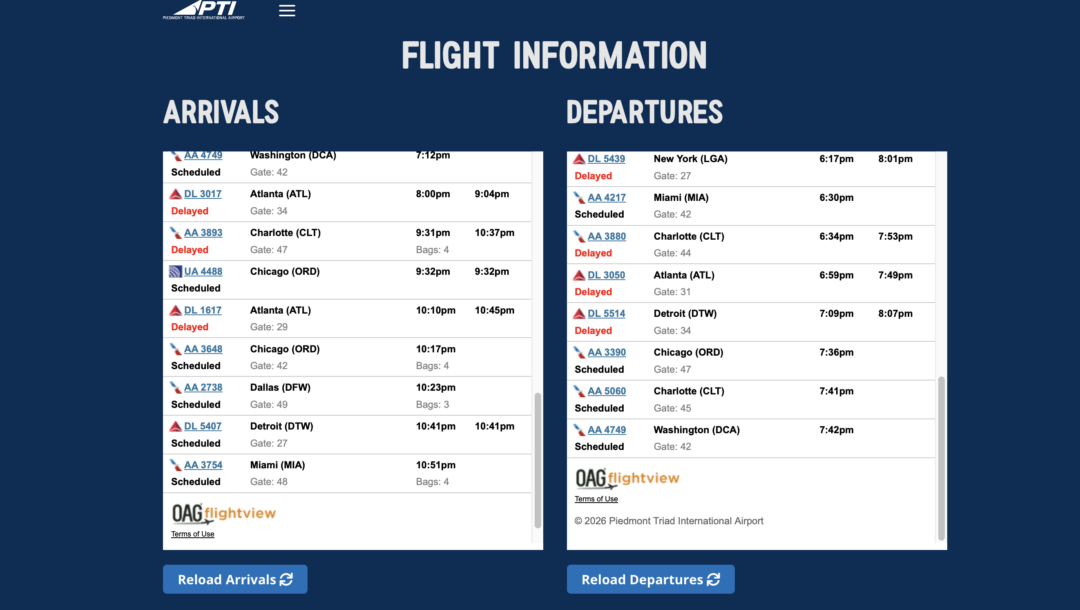
The Federal Aviation Administration halted departures nationwide just before 4 p.m. Friday, Nov. 13, after communications problems hit the regional air traffic control centers that guide planes between airports. By about 5 p.m., Piedmont Triad International Airport’s flight board showed at least nine departures and five arrivals marked delayed.
American Airlines Flight 5923 to Charlotte, scheduled for 4:10 p.m., was pushed back to an estimated 6:15 p.m. Delta Flight 5439 to New York’s LaGuardia Airport went from 6:17 to 8:01 p.m. – and United Flight 4576 to Chicago O’Hare went from 5:40 to 6:36 p.m.
The board also showed delays on departures to Atlanta, Detroit and Philadelphia.
On the arrivals side, Delta Flight 5107 from LaGuardia was expected at 7:37 p.m. – more than an hour after its scheduled arrival. American Flight 3893 from Charlotte moved from 9:31 to 10:37 p.m., and flights from Miami and Atlanta also showed delays. Those were the estimates posted around 5 p.m.
Those delays were likely to keep rolling: The initial FAA advisory listed 11 p.m. Eastern as the end of its advisory window and instructed airports to hold departures until further notice.
PTI is advising travelers to check directly with their airline for the latest times.
Planes already in the air could continue to their destinations and land. So, if the person you were picking up was already on the way to Greensboro, their plane could still come in. If they were waiting to change planes in Charlotte, their flight to PTI was subject to the same hold as flights leaving Greensboro.
The FAA said it would handle inbound international flights case by case.
The FAA’s technology problems go back well before Friday’s ground stop. A September 2026 Government Accountability Office report found that 51 of the FAA’s 138 air traffic control systems were unsustainable and another 54 were potentially unsustainable. Together, that’s more than three-quarters of the systems.
That report also documented outages in February and March 2025 in the system that sends safety notices to pilots. Neither prompted a nationwide ground stop. And now two of the three nationwide ground stops in US history have come in less than four years – one after the pilot alert system went down in 2023 and the other after Friday’s communications failure. The FAA is still investigating what triggered Friday’s failure, but the two stoppages raise a question about how much longer the agency can rely on aging equipment while it works to replace it.
Transportation Secretary Sean Duffy said Friday that FAA technicians were investigating the communications failure.
The New York Post, citing an unnamed source, reported that a software upgrade was one possible cause. The FAA had yet to confirm what triggered the problem. Many fear it’s the start of the cyberwar but no evidence of that was apparent on Friday.
Friday’s stop was only the second nationwide halt to departures since the Sept. 11, 2001, terrorist attacks, when federal authorities stopped takeoffs and ordered planes already in the air to land.
The other came on Jan. 11, 2023, when the FAA system that alerts pilots to hazards and runway closures went down. That stop lasted from about 7:15 to 9:07 a.m. The FAA’s preliminary review in that case found that contractors had accidentally deleted files while trying to fix a problem synchronizing the main database with its backup.