
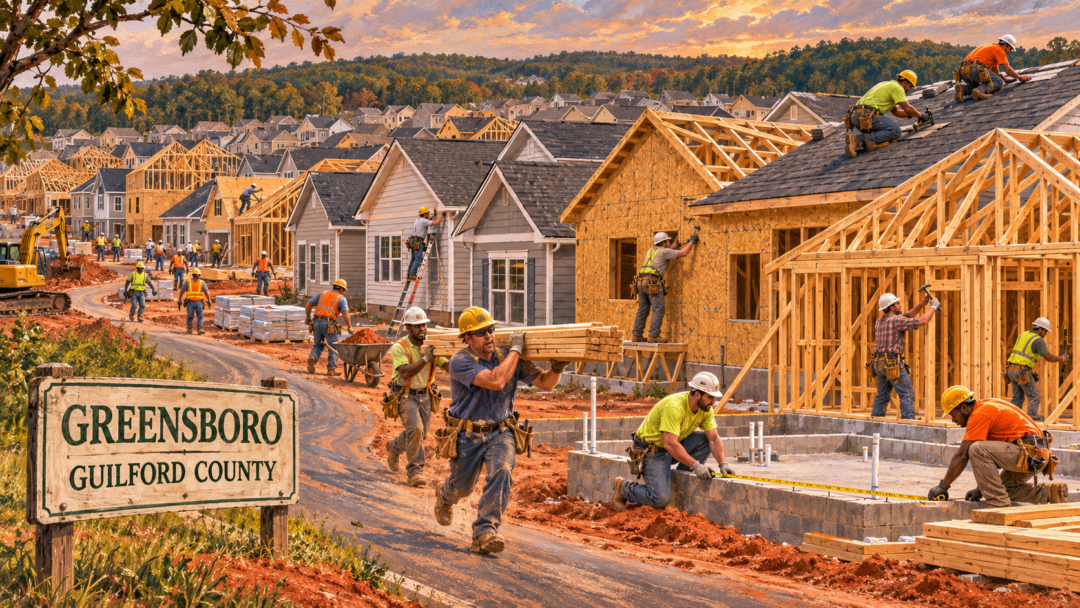
Chairman of the Guilford County Board of Commissioners Skip Alston is about to be reelected to that position again in two weeks, and one of his top priorities in 2027 is bringing lots and lots of new housing to Guilford County.
Because more houses mean more property taxes, which means more money for him and the new true-blue board to spend to their hearts’ content.
And Alston would much rather have those property tax bills mailed to addresses in Guilford County than to addresses in Alamance, Forsyth or Randolph counties.
In an interview after the commissioners’ Wednesday, Nov. 18 meeting in High Point, Alston told the Rhino Times he’s been trying to get more developers to build in Guilford County and get local governments to approve their plans faster.
His concern is that people will come here for the jobs, look around for a house they can afford and end up buying someplace else.
“I want that money to stay in Guilford County,” Alston said.
How many homes does he think it’ll take? A lot.
Alston said he was “being conservative and saying we need 35,000,” and added that he thought the county could need something closer to 90,000. Those were his estimates in the interview.
Greensboro’s target, which covers just the city and runs through 2030, is 10,000 new housing units.
Finding affordable housing is a problem in plenty of places. Around here, it’s made more pressing by the sheer size of some of the employers coming in. Toyota has already started production at its battery plant in Liberty, just across the county line in Randolph County, and says it’s building a workforce of more than 5,000. JetZero broke ground in June on its airplane manufacturing plant at Piedmont Triad International Airport, where it has committed to creating more than 14,500 jobs over time. Workers at either plant will have plenty of choices about which county to live in – assuming they can find a house they can afford.
As the Rhino Times reported, Alston brought builders, planners, county staff and Vice Chair Carlvena Foster together inn August of 2025 at the Old Guilford County Court House in August to talk about getting more homes built. Alston said Wednesday that staff had told him builders were waiting an average of eight or nine months to get plans approved. He wants to get that down to three or four months.
Alston said staff had found that some approvals were being held until reviews for all the trades were in and could be issued together. He said he believes the process is already moving faster.
Greensboro, meanwhile, is more than halfway to its goal on paper. In October, the city reported more than 5,000 homes either completed or under construction under its Road to 10,000 initiative. The city is counting housing at all price levels, and some of those homes are still being built. The City Council unanimously adopted a policy framework in July to guide the effort.
There’s also the matter of what has to be built or upgraded outside the front door. Greensboro’s 2025-26 budget called for rehabilitating 13 miles of water mains and 10 miles of sewer lines – along with $5.8 million in stormwater improvements.
The city has also pointed to building on underused land in existing neighborhoods as one way to limit the strain on infrastructure. Where the homes go matters to the county, too, since that will determine which schools see more students and where demand for county services grows.
At his October State of the County address, Alston cited a projection of more than 86,000 additional Guilford County residents over the next 20 years.
He put the infrastructure question plainly that night. “We cannot wait until the classrooms are crowded, the housing is out of reach, our services are stretched too thin before we start planning,” he said.