


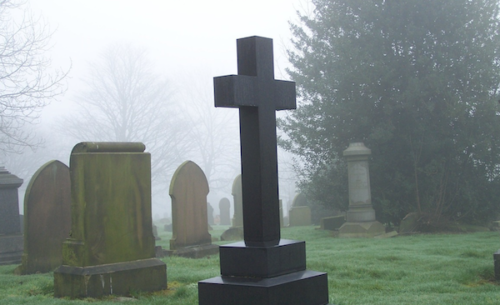
They say about money that you can’t take it with you, but it turns out that, if you paid too much in taxes on a family cemetery, then you can get the money back and spend it while you are alive
For five years, Guilford County collected thousands of dollars in property taxes from a private family cemetery in Browns Summit. Now county officials have determined that the cemetery was exempt from those taxes – and the county is preparing to give the money back.
At their Thursday, Oct. 15 meeting, the Guilford County Board of Commissioners is set to approve a $39,345.08 property tax refund to Green Family Memorial Gardens, a private cemetery located at 8017 Old Reidsville Road in Browns Summit.
The refund covers taxes paid from 2021 through 2025, during which time the cemetery was paying about $8,000 a year in property taxes that county officials now say it didn’t owe.
Green Family Memorial Gardens isn’t a commercial cemetery where members of the public can purchase burial plots. According to filings with the Internal Revenue Service, it’s a private family cemetery and mausoleum established for the benefit of Harry and Iola Green and their descendants.
The cemetery is owned by Green Family Memorial Gardens – a North Carolina nonprofit corporation that’s been recognized as federally tax-exempt since 2014. The organization’s stated purpose is to preserve, maintain and safeguard the cemetery and mausoleum for the Green family’s descendants who have burial rights there.
The county’s agenda materials explain that Green Family Memorial Gardens submitted an application for a property tax exemption on April 17, 2026.
After reviewing the application and additional information submitted by the property owner, the Guilford County Tax Department determined that the cemetery qualified for an exemption under North Carolina law.
The county notified the owner of that determination in a letter dated May 22, 2026, and exempted the property from taxes for the 2026 tax year.
However, that left five years of property taxes that had already been paid.
In August, the cemetery submitted a formal request for a refund covering those years. County officials have recommended approving the entire amount: $7,661.07 for 2021, $7,821.28 for 2022, $7,781.99 for 2023, $7,960.80 for 2024 and $8,119.94 for 2025.
North Carolina General Statutes provide a property tax exemption for real estate set aside for human burial purposes – including land, tombs, vaults, monuments and mausoleums.
Under that law, qualifying private burial property that isn’t held for sale, rental or the sale of burial rights is exempt from property taxes. And, unlike certain other tax exemptions, the owner of the property isn’t required to file an application to receive it.
North Carolina law also specifically prohibits local governments from denying the exemption simply because the owner doesn’t have a survey or plat identifying the burial property. The General Assembly expanded the cemetery exemption in 2021 – with the changes taking effect in July 2022 that also allowed qualifying commercial burial property to receive an exemption after filing an application.
Another change that took effect in July 2026 clarified that the exemption applies to human burial grounds. But the exemption for qualifying noncommercial burial property existed well before those changes.
That raises an interesting question in the Green Family Memorial Gardens case: If private family cemeteries are exempt without even having to apply, why was the county collecting thousands of dollars in property taxes from this particular cemetery?
The county’s agenda simply states that the Tax Department became aware of the cemetery’s private nature after receiving the exemption application and additional information from the owner.
It also isn’t clear from the publicly available agenda materials whether Guilford County has reviewed the tax status of other private family cemeteries to determine whether similar situations exist.
And there are plenty of family burial grounds in Guilford County.
For instance, a historical marker in Summerfield recognizes the Charles Bruce Family Cemetery, where Revolutionary War-era figures Charles Bruce and James Gillies are buried. That small cemetery is near Summerfield Road.
Local genealogical records also identify the Case Family Cemetery in Summerfield – along with numerous other family burying grounds scattered throughout Guilford County.
Greensboro’s municipal cemetery records cover facilities such as Forest Lawn, Green Hill and Maplewood, but there are numerous other burial grounds in the county that aren’t part of the municipal cemetery system.
The Greensboro Public Library also has historical resources concerning family burial grounds and older cemeteries in the area.
Of course, the existence of other private cemeteries doesn’t mean those properties are being taxed incorrectly: Their ownership, use and tax classifications would need to be examined individually.
However, the Green Family Memorial Gardens refund shows that a property can remain on the county’s tax rolls for years before officials determine that it should have been exempt.
Under another provision of North Carolina law, General Statute 105-381, taxpayers who’ve paid an unlawful tax can generally seek refunds within five years after the tax first became due, or within six months after payment, whichever is later. The governing body must act on a properly submitted request within 90 days.
In this case, the county commissioners are being asked to approve the full refund, and county officials have already determined that the cemetery should no longer receive property tax bills.
The larger question is whether Green Family Memorial Gardens represents an isolated situation or whether other Guilford County family cemeteries may also be paying property taxes they don’t legally owe.




can every property owner claim that any section of their property is their ‘cemetery’ ? add ‘pets’ ? & not pay property taxes ? my back yard just became my cemetery/garden
Great story Scott! Sounds if Guilford County was abusing the system for the all mighty tax dollar they love to waste. Will the Green Family Memorial Gardens also be able to collect lost interest on this refund?
Another prime example/snafu of Guilford County Commissioners and staff. How many more citizens are being screwed?