
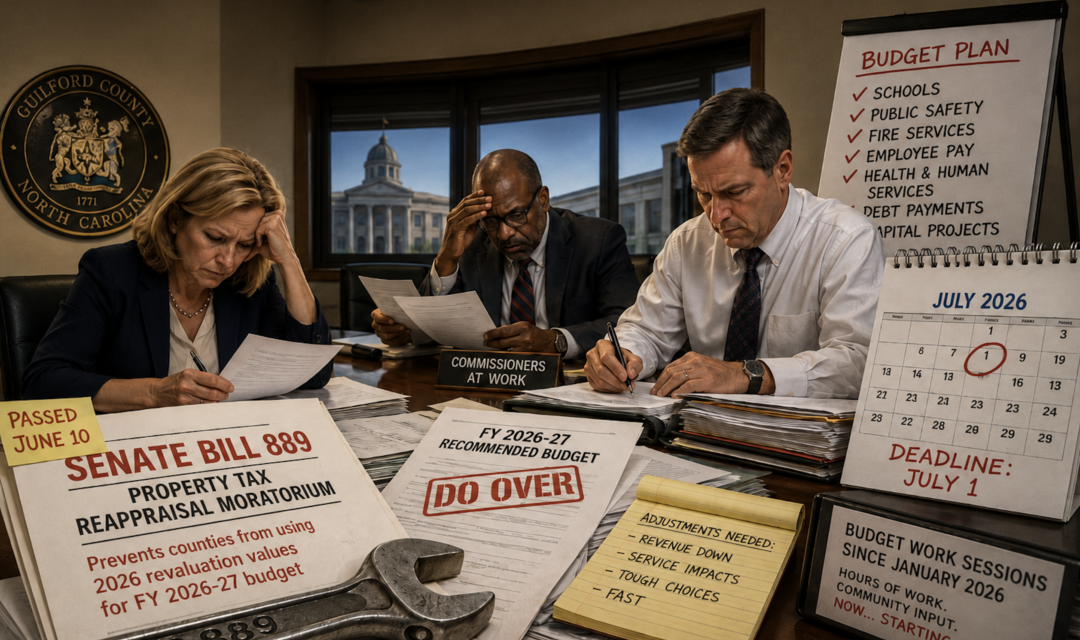
The Guilford County Board of Commissioners isn’t calling it an emergency work session but that’s essentially what the afternoon meeting on Thursday, June 18 will be after state legislators in Raleigh threw a very large wrench into the board’s budget plans at the last minute.
The commissioners had planned to adopt a budget on June 18 based on new property values the Guilford County Tax Department spent over a year preparing – but Senate Bill 889 prevents them from doing that and that means the board will have to come up with a new budget.
And fast: The deadline for local governments adopting a new fiscal budget in North Carolina is July 1.
It’s highly unfair of the state to dump this on the commissioners at the last minute like this. Usually, it’s the type of thing elections departments have to deal with when state or federal lawmakers make last-minute changes and elections officials have to do a whole lot of work over again.
The commissioners rarely have to do something like that but, in this case, they can’t take their time, go to the state, and say on July 1, the dog ate my budget.
First of all, that wouldn’t be true.
It was the state that ate the planned budget.
In fact, the new bill affects the budgets of all the towns and cities in the county, and even the fire districts, which are all in the same boat.
The Guilford County Board of Commissioners has scheduled a work session for Thursday, June 18 at 3:30 p.m. in the Carolyn Coleman Conference Room on the first floor of the Old Guilford County Court House at 301 W. Market St. in Greensboro.
The stated purpose of the work session is “to receive a legislative update and discuss considerations related to the FY 2026-27 recommended budget and conduct any other necessary business.”
In other words, the commissioners and county staff have to figure out what the county’s new budget options look like now that the county can’t simply adopt the budget that was being built around the new 2026 property values.
The notice also states that the board “reserves the right to take action on any properly noticed items” – which means this may be more than a sit-around-and-talk meeting.
Guilford County had planned to adopt its fiscal 2026-2027 budget at the board’s regular Thursday, June 18 meeting. That budget had been prepared using the new 2026 property revaluation numbers, which were supposed to be used for tax bills in the upcoming fiscal year.
However, Senate Bill 889, the “Property Tax Reappraisal Moratorium,” was passed by the North Carolina General Assembly on June 10 and that threw that plan into chaos.
The bill prevents counties with reappraisals effective Jan. 1, 2026 from using those new values for the 2026-2027 fiscal year. For Guilford County, that means the county is now being forced to base its budget on the older 2022 property values rather than the 2026 revaluation numbers the county had been preparing to use.
That’s not a minor adjustment. The county budget is a massive document with hundreds of moving parts, including school funding, sheriff’s department funding, fire service funding, employee pay, health and human services, debt payments, capital projects and outside agency funding.
Guilford County began its fiscal 2026-2027 budget process in late 2025. The Board of Commissioners kicked off its annual budget retreat in January 2026 and, since then, the board has held a series of bi-weekly budget work sessions, six community input meetings and a June 4 public hearing on the recommended budget.
Now, after all that, the county is being forced into a last-minute do over.
In a county press release announcing the budget adoption schedule adjustment, county officials stated that, under the North Carolina Local Government Budget and Fiscal Control Act, counties are required to adopt a balanced budget ordinance no later than July 1.
The county also announced that, because of the impact of Senate Bill 889 on Guilford County’s recommended budget, the Board of Commissioners is no longer considering adopting the budget at the June 18 regular meeting.
Instead, the board will give county staff more time to prepare budget adjustment options.
Chairman of the Guilford County Board of Commissioners Skip Alston said the county manager has been asked to prepare items for the board to consider.
“We have asked our county manager to prepare items for the Board to consider adjustments to his recommended budget as result of the restrictions placed on us by the state at this late date,” Alston said.
The chairman added: “The Board remains committed to adopting a balanced budget by the statutory deadline while carefully evaluating the impacts of this legislation on education, public safety, workforce preparedness, rural fire services, and other core county services.”
That quote gives a pretty good idea of where the pain points are likely to be.
Education is almost always the largest and most controversial part of the county budget. Public safety is another area where cuts are difficult and politically dangerous. Rural fire services are also directly affected because fire districts depend on the county’s tax base – and the same sudden shift in property values affects them as well.
The county now has to sort through the effects of SB 889 while also trying to preserve, as much as possible, the budget review process that’s already taken place.
County officials stated this week that the revised budget adoption date will allow the Board of Commissioners to consider the impacts of Senate Bill 889 “within the context of the extensive public input and budget review process already completed.”
That’s a nice way of saying that a lot of the work already done still matters, but the numbers have changed.
For those who don’t want to attend in person, the county will also provide virtual access through Zoom. The meeting can be watched or listened to by visiting the ZoomGov platform and using webinar ID 165 360 9579. Those joining by phone may call (646) 828-7666 and enter the same webinar ID if required.
The meeting will also be livestreamed on Guilford County’s Facebook page.
County officials stated that they will provide public notice of the revised meeting schedule and budget adoption date for a special called meeting before July 1.
Under North Carolina’s Open Meetings Law, a special meeting requires at least 48 hours’ notice before the meeting date.
The new world order means they have a couple of weeks to redo the budget they just spent half a year on.