

The City of Greensboro is good at some things and has a lot of practice doing them – building sidewalks, painting wide bike lanes and putting up four-way stop signs at minor intersections to name a few – and has some problems sometimes doing other things.
Hopefully, as the city gets into the commercial loan business with taxpayer money, this will be something it’s good at.
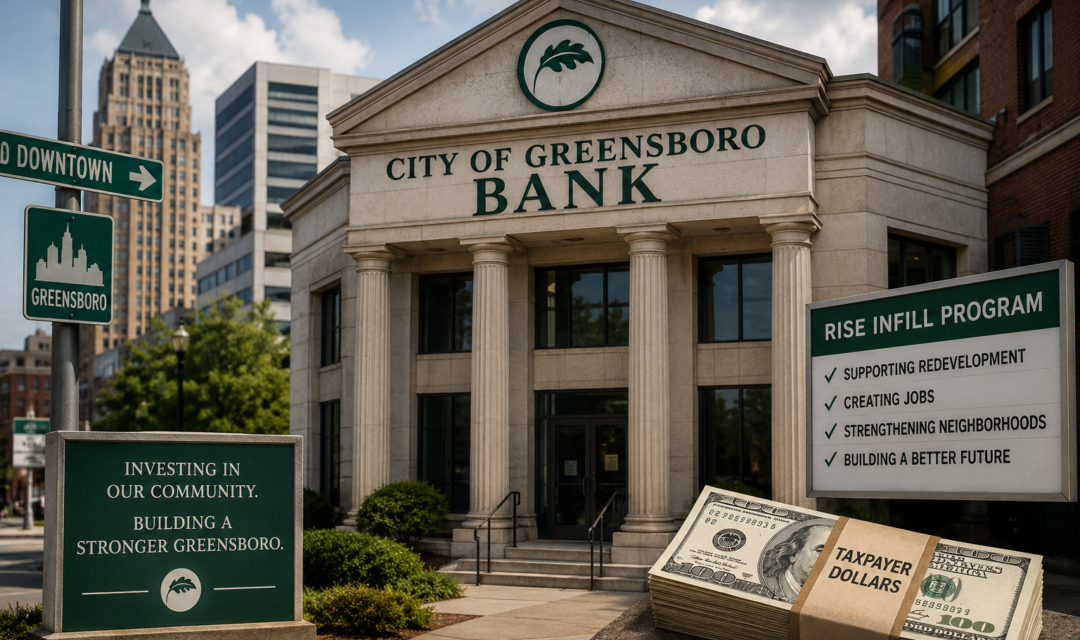
City officials announced on Tuesday, May 26, the launch of a new redevelopment financing program called “RISE Infill,” which city officials say is designed to help breathe new life into vacant, aging and underused commercial properties around Greensboro.
According to the city, the new program is aimed at helping developers and property owners tackle one of the biggest challenges in redevelopment projects: getting enough financing together to make complicated projects work financially.
City leaders behind the program stated that redevelopment projects are often a whole lot harder to finance than brand-new construction – especially in older commercial corridors and downtown areas where renovation costs can quickly pile up.
Here’s how the program works: The city will participate in loans alongside private banks. The loans will still be originated, underwritten and serviced by private lenders. However, the city’s participation is intended to help close financing gaps that might otherwise kill projects before they ever get off the ground.
Economic Development Manager Marshall Yandle stated in the city’s announcement of the program that older redevelopment projects frequently struggle even after developers have private financing and their own money committed to the deal.
Yandle used the example of a developer purchasing an underutilized two-story downtown building with plans to renovate the first floor for retail or restaurant use while converting the upper floor into apartments or office space.
According to Yandle, even when private lenders are willing to participate, there can still be a remaining financial gap that prevents the project from moving forward.
“RISE Infill gives the City a way to partner with lenders to help close that gap and support projects that can create long-term investment and community benefit,” Yandle stated.
The city says the new initiative is the first piece of a broader redevelopment framework called “RISE,” which appears designed to become an umbrella for future redevelopment and economic development efforts.
The focus of the program is on commercial redevelopment and mixed-use investment projects located within designated reinvestment areas and redevelopment corridors around the city.
The city hasn’t released detailed maps with the announcement, but Greensboro has spent years targeting redevelopment in older commercial corridors and struggling commercial areas where vacant storefronts and aging buildings have become increasingly common.
Programs like this are often designed to encourage redevelopment in areas where conventional financing can be difficult because renovation projects carry more uncertainty than new construction.
Older buildings can come with environmental issues, outdated infrastructure, expensive code upgrades and other unexpected costs that make lenders more cautious. That’s where your money comes in.
City officials are clearly hoping the program will encourage additional private investment while also helping improve commercial corridors that have seen years of decline or underinvestment.
The four participating banks are Towne Bank, First Bank, United Community Bank and M&F Bank.
Representatives from each of the participating banks praised the city’s effort in statements included with the announcement.
Scott Baker, Triad president for Towne Bank, said the program strengthens lending opportunities for investors and small businesses while improving Greensboro’s overall investment climate.
John Vestal, senior vice president and regional executive for First Bank, said the bank was excited to partner with the city, business owners and developers through the initiative.
Justin Spradley, senior vice president for United Community Bank, said the program could help redevelopment projects move forward that otherwise might not happen.
James Sills, CEO of M&F Bank, said the effort could help move projects “from the drawing board into something tangible that benefits neighborhoods and small businesses.”
City officials behind the program say that developers and borrowers interested in the program will work directly with participating lenders rather than applying through the city itself.
Additional information about eligibility requirements and program details is available through the city’s website




————
It is now perfectly clear that the City has more money than it knows what to do with.
Austin,
Please allow me to slightly correct you…the City has STOLEN more money then it knows what to WISELY do with.
Personal opinion…the City Overlord has received marching orders from the Omnipotent One. The next step for him is to clone, on a County level, what they have done.
“The liberties of a people never were, nor ever will be, secure, when the transactions of their rulers may be concealed from them.”
My namesake.
So, the government is going to use tax dollars to invest in something that private banks are not willing to invest in by themselves because they don’t deem the project viable at that price point. Sounds like an awesome use of tax money.