


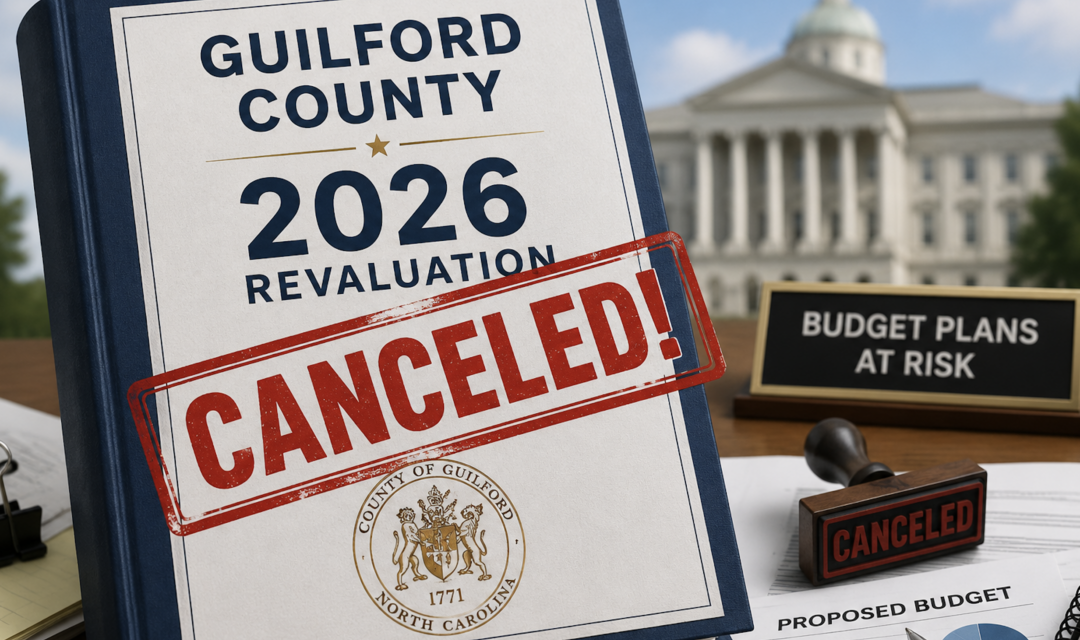
Chairman of the Guilford County Board of Commissioners Skip Alston said this week that he believes a bill moving through the North Carolina General Assembly that would delay the impact of Guilford County’s new property revaluation is “100 percent” certain to pass – and he warned that, if it does, Guilford County would be forced to scale back services and rethink its proposed budget just weeks before commissioners are expected to adopt it.
The bill is Senate Bill 889, which is officially titled the “Property Tax Reappraisal Moratorium.” It would delay the use of new 2026 property revaluations in certain counties — including Guilford County — until 2027.
Alston said he believes that the legislation, which has already passed the North Carolina Senate, is headed for final approval soon and could dramatically alter Guilford County’s budget planning for the coming fiscal year.
“They’re going to pass that bill,” Alston said. “It passed the Senate and it’s going to pass the House too.”
The bill would effectively delay the impact of property tax increases tied to new county property valuations until next year in certain counties, including Guilford County – where many homeowners recently received sharply higher assessments.
Guilford County Manager Victor Isler’s proposed budget currently assumes revenue based on the new revaluation numbers and includes funding increases for schools, EMS, the sheriff’s office, social services and other county departments.
However, Alston said that, if the state blocks the county from using those higher property valuations this year, he has no interest in simply increasing the county’s tax rate to recover the money.
“I’m not going to play that game,” Alston said. “I’m not going to raise the tax rate by 8 cents more than what it is now and put that tax burden on the citizens this year,” he said.
Alston acknowledged that technically the Board of Commissioners could simply increase the property tax rate and still collect roughly the same amount of money needed to fund the proposed budget of a version of it modified by the commissioners. But he said doing so would undermine what state lawmakers are attempting to accomplish politically and would effectively shift the burden right back onto county taxpayers.
“If the state wanted to do that, then we’re going to have to probably cut some services,” Alston said of the bill he expects to pass. “We’re just going to have to adjust accordingly.”
His comments suggest the county could face difficult decisions in the coming weeks if the legislation becomes law before Guilford County adopts its final budget, which is expected in about a month.
Alston also said the timing creates a potentially enormous amount of extra work for county officials because the county has already spent months building a budget around revenue projections that could suddenly disappear.
“It would be an awful lot of work,” Alston said, noting that county officials may essentially have to redo major portions of the budget process if the legislation passes.
The chairman praised Isler’s proposed budget and said the county manager and department heads had spent considerable time identifying growing service needs throughout Guilford County government.
“Victor has a very good grasp on what’s needed in the county,” Alston said. “He’s asked his people to be tighter.”
But Alston warned that many of those proposed improvements may now be in jeopardy.
According to Alston, the county may no longer be able to hire some of the additional employees requested by county departments, particularly in rapidly growing areas of the county.
“We’re not going to be able to hire some of the employees that the sheriff was asking for, EMS is asking for, social services is asking for and some of those other department heads are asking for,” Alston said.
Alston said that Guilford County’s growing population has increased pressure on the county’s services, especially in rural areas where growth has accelerated in recent years.
“We have thousands of other people that have moved into Guilford County since last year,” Alston said. “The services for them have to be provided.”
He specifically warned that EMS response times could worsen if staffing increases are delayed or eliminated.
“Now the question would be how long is it gonna take for EMS services to get to you if you’re having a heart attack,” Alston said. “Right now, they can get there in 9 minutes and 48 seconds. Would they possibly have to get there in 15 minutes instead? Possibly.”
Alston said the sheriff’s office could face similar challenges.
“Somebody knocking down your door trying to get in your house to hurt your family – now is it OK for sheriff’s deputies to get there in 20 minutes because the sheriff doesn’t have enough people to be able to cover those areas because of the expanded population?”
Alston also pointed to the Division of Social Services, where he said residents already face long waits for assistance.
“DSS lines are already long,” Alston said. “They’ll probably get longer.”
The chairman said Guilford County Schools could also receive significantly less funding than requested if the county’s revenue projections change.
“They’re not going to be able to get that kind of money,” Alston said of the school system’s request. “The manager might be able to give them somewhere near a fraction of that.”
Alston repeatedly framed the legislation as a political maneuver by Senate President Pro Tem Phil Berger and Republican lawmakers.
“It’s good politics for Phil Berger,” Alston said. “It’s a feel-good thing.”
Alston argued that the measure only delays the impact of higher property valuations for one year and he said taxpayers will still eventually face the increase.
“It delays it for a year,” Alston said. “At the same time next year you’re going to have to add it up.”
The chairman claimed that Berger is thinking ahead politically to future elections.
“Phil Berger is going to be running in 2028 again,” Alston said. “He wanted to get his people circling around him for helping them out this year.”
Berger lost a very close race to Rockingham County Sheriff Sam Page.
Alston also accused Republican lawmakers of “playing politics” while the state itself hasn’t passed a full budget in two years.
“If it wasn’t for them, we wouldn’t have to be doing all these increases because they would’ve been giving the teachers their pay like they’re supposed to,” Alston said.
The revaluation delay bill is currently the issue creating the most immediate concern for Guilford County officials, though lawmakers in Raleigh are also discussing a separate constitutional amendment that could eventually place long-term limits on property tax growth statewide.
However, that second proposal would likely take years to fully implement, while the revaluation legislation could directly impact Guilford County’s budget almost immediately.
For now, Alston said county officials are waiting to see exactly what lawmakers in Raleigh do next week before determining how much of the proposed county budget may have to change.




Chairman Alston says, “I’m not going to raise the tax rate by 8 cents more than what it is now and put that tax burden on the citizens.”
I call BS on this ludicrous statement. It makes no sense at all.
Regardless of what the county says my home is “worth” on paper, I still have the same income and the same expenses to deal with. My ability to pay a tax bill doesn’t magically increase just because a spreadsheet says my house value went up.
A $4,000 tax bill still has to come out of the same bank account balance, whether the county calls it a “rate hike” or a “valuation jump.” You can’t pay taxes with “paper wealth.” If the county can’t fund their $1.1 billion budget without these massive valuation spikes, they are the one living beyond their means—not the taxpayers.
—————-
MJ is dead right. Unrealized gains should never trigger a tax bill. How can they? They’re unrealized.
If my house value goes up by $100,000 it doesn’t put any money in my hands (until I sell it).
The taxation of unrealized gains is wrong, and ought to be ruled unconstitutional.
I think the main goal for any Guilford county residents should be to get the emperor Skip
out of office. That is the only way I conceive if it’s nonsense from this government will stop. The only thing they do is overspend and then come to the taxpayers and charge them more to supply their wasteful spending.
David, I so agree. I checked into what that would take for a friend of mine to run for office to even get to be a county commissioner, let alone be elected Chair!
The estimate is that you need at least a minimum of $1M in the bank and be willing to work 24/7 to flip the voters, no matter the party. Then, to flip Skip, it would take a miracle and more funding, because you would have to flip the other seats to be able to even address it!
Also, you would have to make sure they in nothing in your past that could be used against you! Any Takers? Sad to say, we need outside help in this county to address ever seeing a change! I sstill believe in miracles and am praying for them every day to come in my lifetime!
“The taxation of unrealized gains is wrong, and ought to be ruled unconstitutional.”
You see any way possible of ever getting that in front of the NC Supreme Court? Or maybe the “Supreme” Supreme Court?
Hope I live long enough to see that.
—————–
No, sadly.
But it’s still wrong.
It really isn’t tax unrealized gains. It is designed to be a reallocation of taxes as different properties go up and down in value at different rates. For example, currently personal property is going up in value faster than commercial properties.
I understand why during times of high growth it can ‘feel’ like a tax on unrealized gains. Especially the way Skip considers it an ‘automated’ tax increase. But end of the day is an ad valorem asset tax. If it were a tax on unrealized gains it would be rate set against the increase only.
End of the day it is just a means for allocating taxes across the population of citizens for shared services such as roads, schools, police, fire, etc..
But I fully understand the frustration as Skip makes it so much worse with his treating it as an automatic tax increase.
It is a tax on unrealized gains (paper gains.) If my house is worth $100,000 and the value increases to $200,000 and if the property tax I pay is based on the ad valorem (according to value) tax, I am paying taxes on the increased value even though I have not actually realized a gain except on paper. And it is not a means for allocating taxes across the population of citizens for shared services because the population of citizens do not all pay property taxes. And the shared services are services not utilized by all citizens, i.e. schools. Property taxes for homeowners should end. They are dishonest and unjust.
If only that were true, Dummy. But we are also paying for all the stuff you left out, which needs to be cut. Nonsense projects, feel good programs, forced charity, etc. Keep dreaming that your tax money is well spent.
————-
IT IS A TAX ON UNREALIZED GAINS. Fact.
Termlimits, first addressing your statement that all people don’t pay property taxes. With the exception of non-profits, all people and businesses pay property taxes. Some pay directly and others pay indirectly if renting a home or leasing a commercial property.
Back to the primary question of property tax as a tax on unrealized gains?…..if the tax rate were held level by rule, I would agree but that isn’t the norm (except in Skips awful mindset and approach). In most communities, the rate is typically adjusted to meeting a targeted budget need. This is why it is a reallocation of taxes based on value of property distribution. The theory is—a community needs $1 million in budget….they set a rate against current market value of property as a means to allocate the budget needs across a population.
Skip of course took the mentality that property went up 30% so he determined how to spend an additional 30% in budget which is not the norm and amazing he was able to get away with such an approach. In Skips treatment, it certainly felt like a tax on unrealized gains; however this current go around of property reevaluation, he is taking a more typical approach but still leveraging it as a means to increase taxes more than is most likely needed.
Hope that helps.
Austin, if you have a source to back up your claim other than your personal opinion, please share.
I sourced my information from The Tax Policy Center who explicitly categorizes property taxes as a form of wealth tax and Shell Capital which had a nice summary article on the topic.
Links below if interested:
https://taxpolicycenter.org/briefing-book/what-wealth-tax
https://shell-capital.com/asymmetry-observations/is-a-capital-gains-tax-on-unrealized-gains-the-same-as-property-tax
The r/AskEconomics subgroup on reddit also had a really interesting exchange on the topic worth a read.
Don, I am not sure how you implied from my explanation of property taxes not being a tax on unrealized gains that I believed the taxes in Guilford County were being used efficiently or effectively? Weird.
———–
Is it just me, or is The Poseur Professor just pathetic?
He’s so incapable of thinking for himself that he has to resort to “studies” and “data” to determine what an unrealized gain is.
Tosser. Liberal. Wanker.
An ‘unrealized gain’ is a specific financial and accounting concept. It is defined by financial data and tax codes, not personal opinions.
Imagine thinking that using facts and data to define a financial term is a bad thing.
But as always, when you resort to personal insults instead of addressing the actual data, it usually means you don’t have a real argument.
Best wishes
Everybody,
You must realize that professor/Cxxxxxxxx X Rxxx/Chris/Polly Pocket/Sybil/whatever is using his icon’s technique of double, triple, and quadruple talk and masking it with his vaunted college edumaction.
Oh, let’s not forget he doesn’t really care since he doesn’t live in Skip the Omnipotence’s fiefdom, aka ‘got no dog in this fight so I don’t really care’. He’s here just to troll you.
“End of the day it is just a means for allocating taxes across the population of citizens for shared services such as roads, schools, police, fire, etc..”
Because your above statement implies that in your mind taxes are only being used for essential services. That is absolutely not the case and you know it. So disingenuous.
Don, I didn’t intend nor do I agree that was implied in that statement…..but we can agree to disagree.
I don’t think government is nearly as efficient or as effective as it should be…THAT we can agree on.
Patrick, I thought we trying to end the ad hominems. Oh well. Your insults don’t make me wrong.
Cheers
———–
YOU are the one who suggested ending the personal attacks, even as your offer contained the most vile barbs against myself and others.
Then, in your very next comment in that thread, you dredged up personal attacks on me from YEARS ago.
Chrissy, it’s YOU who’s incapable of debating without attacking the other person personally.
Not us – you. That’s why every comment column you enter degenerates into abuse.
If someone doesn’t want to be labeled a racist, then they should retract their numerous arguments that different races are lessor evolved than others. (ie the actual definition of racist)
If someone doesn’t want to be labeled a bigot, then they should retract their numerous refences to LGBTQ people as deviants as if use of that word is intended to be anything other than an insult.
If someone doesn’t want to be called out for lying, then they should stop leaving out key details to stories so they can use it feed a false narrative.
It really is as simple as that for whoever it applies.
Otherwise, I have removed all insults from my comments even in the face of ongoing insults directed at me by most people engaging in debate. Hope you can do the same.
Cheers
————
MGBGT people ARE sexual deviants, because their sexuality deviates from the norm. That’s just a fact – one of many facts that Leftists like you can’t deal with.
Here’s another fact that makes you squirm:
Average Japanese IQ = 108
Average Somali IQ = 68
Facts!
Ha, ha, ha…..
Why don’t you go have a little cry in a corner? And don’t forget your comfort blanket.
Still very weird of you Austin to not understand the difference between countries and races.
LGBTQ are not deviants. They are as God made them and deserve all the same opportunities, rights, and social approval as hetero couples.
So agree, Austin! And with the Leasing Companies moving in all over our areas, they are going to be the only ones to sell to, which will destroy our county for everyone else!
I could never see myself in good faith selling to a Leasing Company, as I have seen firsthand what happens to a neighborhood.
I now have 3 Leased Homes across the street from me, and the homes are not being kept up, nor do the tenants want to be neighbors, and they move out fairly quickly once they see the extra charges for services they have to pay in addition to their $2000 monthly lease.
——————
Thanks, Sue!
.
If they gave up their paychecks it might cover what Alston sees as reduced services…
“I’m not going to play that game,” Alston said. “I’m not going to raise the tax rate by 8 cents more than what it is now and put that tax burden on the citizens this year,”
The idea that he blames citizens paying more in property taxes (i.e. tax burden) on the valuation increase shows how stupid he thinks the average Guildford County taxpayer is to not realize that property valuation increases in no way requires the County to charge more taxes for the same property. Many Counties keep tax neutral rates or limit those increases to a rate near inflation.
Glad I left GC.
(Low gravely voice with an accent) Ya know, this is a really nice place you got here. It would be a real shame if something were to happen to it.
Skip the Omnipotent “…specifically warned that EMS response times could worsen if staffing increases are delayed or eliminated.”
“Now the question would be how long is it gonna take for EMS services to get to you if you’re having a heart attack,” Alston said. “Right now, they can get there in 9 minutes and 48 seconds. Would they possibly have to get there in 15 minutes instead? Possibly.”
“Alston said the sheriff’s office could face similar challenges.”
“Somebody knocking down your door trying to get in your house to hurt your family – now is it OK for sheriff’s deputies to get there in 20 minutes because the sheriff doesn’t have enough people to be able to cover those areas because of the expanded population?”
“Alston also pointed to the Division of Social Services, where he said residents already face long waits for assistance.”
“DSS lines are already long,” Alston said. “They’ll probably get longer.”
Now I don’t know about anybody else, but I interpret those comments as threats and personally I don’t take kindly to threats, but hey, that’s just me. And when it comes to where someone in power has to threaten you, that IMO is borderline extortion
Alston also accused Republican lawmakers of “playing politics” while the state itself hasn’t passed a full budget in two years.
“If it wasn’t for them, we wouldn’t have to be doing all these increases because they would’ve been giving the teachers their pay like they’re supposed to,” Alston said.”
I read this as Skip and the County Commissars holding taxpayers upside down by the ankles shaking them so more money falls out of our pockets while saying ‘look what you’re making us do’.
The Omnipotent claims “We have thousands of other people that have moved into Guilford County since last year,” Alston said. “The services for them have to be provided.”
Really? (looking around) Really?
Folks, I may have been born at night, but last night.
Remember Boston Harbor and bring teabags to the County Commissars meetings!
Exactly. It’s all smoke and mirrors. Makes no difference if my taxes go up due to reevaluation or higher rates
Totally agree, Alan! Thanks for always speaking out for us!
It absolutely is a threat coming out of him. He is threatening to cut response times because him and Danny Rogers are butt buddies. He will tell him what to do and Danny is going to do it because Skippy spoke. If they would stop putting our tax money to the stupid unnecessary nonprofits, the county would have money. If Skippy would quit padding his pocket, the county would have money. He is making a threat and he intends on following through with it. He is a piece of garbage and he needs to get out of there.
————-
All the catastrophic effects sound good to me ! No extra bureaucrats, and the existing ones actually have to do some work.
I think I’ll have a beer.
You can say that assuming you don’t use those public services were service will decline. But I understand you don’t care about other’s needs.
—————
You understand nothing, “Professor”.
i understand nothing @ the grade school level
Oh, that’s right Chris, you don’t live here so what have you in this…wanker
Cute you are even talking like each other now.
I consider that a compliment Chris.
To be fair Alan, I was making fun of you as a sycophant for mimicking Austin.
I recommend Yuengling if you haven’t tried it Austin.
————–
Thanks Alan, but I’m rather particular about my beer. Hope you’re not offended but I think Yuengling is dreadful stuff. Completely unremarkable overly malty crap.
If I can return the favour, I recommend Radeberger German Pilsner (NOT the wheat version). Available at Total Wine and Bestway… but not always, so grab it if you see it!
Make sure it’s thoroughly chilled to about 32, and let me know what you think.
Cheers!
I thought you guys liked your beer warm. Lol !
No offense taken my friend.
Thank you, I’ll give it a try.
As long as we’re talking beer, give Red Oak a try. Good local beer.
—————
It’s NOT my personal opinion ! Everyone understands what an unrealized gain is.
Except you.
Show your source that supports your position that property taxes are a tax on unrealized gains versus a wealth tax as my sources confirmed.
Saying ‘everbody says’ so is not a valid source.
————-
Sorry Randy, I didn’t intend that last comment to appear as a response to your excellent commendation of Red Oak.
My laptop was behaving strangely,. It was obviously meant as a reply to the simpleton who thinks that we need to cite “sources” in order to understand what an unrealised gain is.
If I said “2 + 2 = 4”, he’s characterize it as nothing more than my personal opinion, because I didn’t cite a source or study.
He thinks his chronic references to “studies” and “science” make him look erudite, but it’s hilarious when his stupidity shines right through.
———–
Are you really plain stupid, or are you deliberately misrepresenting what I said?
I didn’t say that Property Tax is a tax on unrealized gains, I sad that Property Tax hikes that are based on a supposed increase in the value of the property are a tax on unrealized gains.
Do you understand the difference, or is it too difficult for you?
Sure, I understand the difference. The difference is subtle and irrelevant as I also understand they are both inaccurate statements.
While your statement would be correct if every time we had a property reassessment, that your taxes went up proportionally (as Skip did the last go round), but that isn’t what happens the majority of the time. Most local governments adjust the rate to fit the budget need (yes some like Skip falsely call this a tax decrease) versus a default proportional bump in taxes.
Again, your view assumes a 1:1 direct causal link where Property value Goes Up = Tax Bill Goes Up. In real fiscal policy, this link does not automatically exist. This is why in NC, state law requires local governments to calculate and publish a “Revenue-Neutral Tax Rate” so we know how much THEY are CHOOSING to increase taxes.
Hope that helps.
————
The difference is fundamental, and clearly beyond your obtuse intellect.
ditto about yuengling. add brown ale & newcastle to ‘dreadful stuff’. when i homebrewed it cost 12 cents a bottle to make (5 gal batch) & intellect stimulating (fermentation/chemistry)
are you a moonshiner? where do i get my hands on the good stuff
————
Agreed, Markl. Newcastle Brown is the same kind of crap, and has disappeared from our local grocery stores. In the end, no amount of cool advertising and packaging will overcome a poor product – when that product has to get repeat buyers.
I hate to say t because I grew up in the North of England, but “Newcy Brahwn” is just not a good beer.
But Tetley Bitter… that’s a different story.
There would be plenty of money if they didn’t give it away and pocket it.
Alston makes it sound perfectly clear according to the article that he is in sole control of where the tax rate comes out to in Guilford. It shouldn’t be a whole lot of work to determine a reworked budget…..just trim back the increases equally among all departments commensurate with the available funding. Wow. Living within our means……
Peter. Skip could start by getting rid of the 6 extra jobs he personally made for the mwbe department a couple years ago, well after the budget was presented. Not to mention the total expenses of almost a million dollars a year.
Agree with that.
Thank you Scott! I can’t and will not address all the BS quotes in this article from Skip. I pray Bill 889 totally destroys the current budget from Skip and his clown commissioners. I would love to see them and department heads have to “work” and provide a real budget to the citizens verses spoon feeding the pet projects, the freebies to payback for votes. I hope department heads are forced to provide a real budget verses incorporating DEI tactics and having nothing more than created government bloat. I hope the school system gets zero funds. They also need to cut the excessive fat of school administration that they have created. Skip and schools have cried wolf for to long and it’s time to take care of tax paying citizens who foot the bills and not the invited homeless and numerous pet projects doing the same function just using a different name.
I hope Skip and commissioners budget is shot to pieces. I wonder what kind of ” work” they can do instead of all the scare tactics listed by Skip. Use your vote wisely.
Is it me, or does this not sound a lot like his “dilapidated schools tour” to get all the parents to demand the school bonds be approved. Then after it’s over admiting they redirected all the maintenance funds to other things and just let the schools rot. Oh and don’t forget he also knew they could only fund half the promises….even as he was promising them.
Promise them what they want, get it passed, then just do whatever you want….
The budget increased two years ago $82 million and we have survived the last two years with that budget. Skips statement showing an absolute unwillingness (king baby, if you will) to work with what he has. How did we ever survive with Republican leadership and not raising taxes yearly? There’s an election coming up folks.
It was 95 million.
The standard threat. “If we don’t get the money we want, we will cut your services”. They will start with the most visible, like reduced garbage/trash/waste pickup. Police, etc. But NOT the faithful on the dole.
Arrogant, trough guzzling incompetents – all.
I’ll never understand the concept of wanting to attract more people to move to your county to “increase revenue”, then taxing the existing residents even more than they were paying before because we need “more revenue” to pay for the people moving in. Why doesn’t the increased revenue from taxing the new folks cover the cost? All those new residents are paying sales tax, property tax, income tax and fees, right?
———–
Exactly! As the tax base expands, so the tax burden per citizen should fall.
But just as declining enrollment in the schools is a reason for greater funding – just like increasing enrollment! – every change of any kind, in any direction, is always a reason why The Parasitic Sector demands more money.
Pure, unadulterated greed. They’re taking the money because they can. It’s taxpayer abuse.
But during periods of high growth that isn’t true. As large industry moves in, the city and county have to increase infrastructure (water, sewer, roads, etc…) to support the growth. As population growth spikes, the same issue can occur. I don’t think there is a big population boom in Greensboro but if the massive inflow of corporate investment continues, I think there is a chance it gets worse for GC before it gets better in terms of infrastructure spending etc..
Add on the lack of past investment in school infrastructure and the need for a large bond during times of increasing loan rates, and it further exacerbates the probem.
Lastly, as the State shifting structural costs downward and passes law that restrict how local movements can raise their own revenue. The biggest cost shifting has been in the public education space.
Hope this helps.
Professor when has Guilford County provided water and sewer or trash pick up. We have the sheriffs dept., EMS and county fire department that our property taxes help subsidize You are such a moron.
Guilford county has a Solid Waste department that costs over a $1 million per year. Sure they don’t pick up from your house but they still have to cover cost of the garbage removal via solid and hazardous waste sites.
The county does actually offer sewer in some county townships. Pleasant Garden has sewer for example (on a limited basis). Plus, the county has capital budgets for expanding these sewage treatments in the county as they expand services.
I stand by my statement. Also in more general terms, the tax increase from the property assessments is also happening in the City AND the County. You hear more about the county since the county handles the reassessment and the city only uses those assessments to set their tax rates but the issues overlap.
————-
“The lack of past investment in school infrastructure”…?
One thing that Government Schools are not short of is money.
Based on what metric? I use the following to support my opinion….what do you use to support yours?
-NC Schools are 47th out of 50 on operational spending per student.
– NC teachers pay ranks 46th in the nation on average
-In terms of school buildings an independent study over 50% of the district’s campuses were rated in poor or unsatisfactory condition.
—————–
The Poseur Professor isn’t interested in truth; he’s interested in winning arguments, so he can demonstrate his intellectual superiority. That is why he’s adopted the pseudonym “Professor” in these columns. He want us to think he’s some kind of intellectual giant, when he’s actually a pitifully mediocre intellect who can barely express himself correctly.
In this particular instance, please just Google “Will NC have highest teacher starting pay in the South”, as I just did. There are plenty of news reports to see, and the answer is yes.
The amount of money that NC Government Schools demand – and get -every year is obscene.
It’s a Black Hole.
Just a reminder that I was given the username Professor by a number of folks in a past comment string…..I kept it poke fun at the attempted insult. It still makes me giggle a little inside every time I type it.
I just bring facts, data, and valid sources to counter biased opinions based on misinformation, incomplete information or propaganda in this little corner of the internet to disrupt the echo chambers many places have become that feed a cycle ignorant led hate, bias and bigotry.
Regarding your search prompt recommendation:
Yet again you leave out key fact……NC Legislature actually agrees with my opinion that NC current ranking 46th in teacher pay is a major problem and therefore just recently passed a budget to gives a significant bumped in new teacher pay to improve teacher recruitment quality to NC schools.
So not sure if you were attempting an ‘own’ given your search prompt validates all my comments about the underfunding of NC schools being a significant problem given this new budget proposal by NC Republicans. But thanks for validating how my data was accurate and my conclusion correct.
Hope this means you will start validating your opinions with data, facts and sources more often.
Thanks!!
————–
Yeah, somebody here started calling you The Professor” because of your pompous, didactic, and condescending remarks. It suits you.
And you just love being called Professor, don’t you? That is why you have adopted it as your pseudonym.
It fits right in with your psychological craving to be seen as intellectually superior.
I do love that is annoys you so….like when the MAGA crowd adopted “Deplorables” after Hiliary used the slur.
Chris, I can’t use professor any longer as your lack of common sense makes a mockery of true professors. The only reason Guilford County supports a sewer system for Pleasant Garden was to avoid a huge threatened lawsuit by county residents over illegal septic systems that were installed by a dishonest septic system contractor in the 70’s and then passed inspection by a Guilford County inspector who took bribes to pass them. Guilford County as a whole is not in the business of providing water and sewer services
So Guilford County provides sewer on a limited basis. Got it. Just as I noted. But if you want to split hairs fine. Not at all relevant to the original discussion. Especially given that the issue applies to the city the same as the county as noted in today’s RT article.
Call me whatever you like. Just please don’t use my real name any longer as that sadly became an issue with some weirdo.
Regarding your earlier comment about only nonprofits do not pay property taxes, are country clubs nonprofits, are retirement facilities nonprofits, are religious institutions nonprofits, is the Woolworth Museum nonprofit. The list could go on and on and on.
As far as renters paying property taxes, depending on the size of the apartment complex. each renter MIGHT pay and extra $25.00 to $50.00 monthly. That is a far cry from $2,000, $3,000, $4,000, $5,000 annually. And as far as apartment complexes, are the builders getting a sweetheart deal for building apartments.
Developers and builders get so many breaks from government. City of Greensboro paid for the streets in a Samet Corporation business park and the City of High Point gave D.H. Griffin $3,000 toward their street costs in their development on Sandy Ridge Rd. These decisions are mostly made at the Council level. There is no way the average citizen can keep up with what is going on at Council meetings. But it is certain that corporate welfare is alive and well. And, professor, the same is true of entities that do not pay property taxes, the most unfair tax.
My understanding is that country clubs are classified as non-profits….i don’t agree with it but that is the current law of the land.
I think we have had this debate before, and I am not sure where you are getting your numbers. In GSO for example, the property tax per apartment unit is approximately $2000 – $3000 per unit per year. So that is 167 to 250 per month. Not to mention the number of people and families that rent houses as well.
https://www.guilfordcountync.gov/2026-reappraisal-education-session-presentation/open
One word–GOOD. Stop Alston in his tracks!
Not sure what more our services that Chairman Alston is threatening could be cut if the property taxes do not go into effect the way he has planned for them.
We live in the county and have been advised we need to protect ourselves if anything were to happen, as it will take more than 20 minutes to get to our area at the best of times. We live close to a volunteer fire department, but again, there are limited resources there, even though they work hard, so if anything happens to us, we don’t wait for EMS to get to us; we have to get to a hospital on our own.
Then we pay extra for our water, (and those rates are going up too), have to pay privately for our trash pickup and, recycling, handle our own leaf pickup, and we have no street lights.
We are also dealing with leasing companies buying up the homes in our area, which looks good for the county, but devalues our neighborhood and our properties, as they are not keeping up the properties, nor do most of the tenants stay very long once they see the services they do not receive, and have to pay extra in addition to their monthly lease of $2,000.
But we have decided to ride it out, as we have lived in our 38-year-old home for over 36 years, and it is paid for. We know we could not get the new appraised value if we decided to move, so we rearrange our budget and still focus on being a valuable neighbor, citizen, voter, and keep up our property, along with others who have no choice but to stay.
The one thing I would love to watch is when the serpents start biting one another.
So it’s OK to pass a tax increase on to county residents using the new tax values, but it is not OK to do effectively the same thing using the old tax values? That makes no sense Skip. You say you aren’t play that game, but you ARE playing a game. You’re trying to pass a tax increase and use increased property values to hide it. This is why people don’t take you seriously. You can’t have it both ways Skip.
Guilford County is spending like a drunken sailor. The number of employees has grown exponentially. They continue to accumulate excess debt to build new schools despite decreasing enrollment. The Commissioners seem oblivious to current economic conditions. Ideally Commissioners would constrain spending, if they won’t, the State Legislature should.
I didn’t read past the first paragraph yet. I’m just so grateful for this news. Put that in yer pipe and smoke it, Skippy the Taxman!
Skip the Omnipotent,
“Alston said the sheriff’s office could face similar challenges.”
“Somebody knocking down your door trying to get in your house to hurt your family – now is it OK for sheriff’s deputies to get there in 20 minutes because the sheriff doesn’t have enough people to be able to cover those areas because of the expanded population?”
Ever heard of that pesky Castle Doctrine?
If it’s going to take 20 minutes for LEO to arrive, I have enough time make coffee and get some cookies out for the folks that will be coming to clean up the mess.
An additional benefit, we the taxpayers save money on lengthy court costs that don’t really solve the problem.
I’ve discovered a new abbreviation I’m having made into a T-shirt…FAFO.
OK, now that I read the article, I see that the skipper is completely delusional. His egotistical shakedown of Guilford County citizens is appalling. To borrow a quote from history, I can only ask… Skip, “Have you no sense of decency, sir, at long last?” Let’s all vote him and his Guiford County Board of Commisioner minions OUT of office. They pose a threat to civil society. They really do.
—————–
Taxers gonna tax.
You can tell who they are because they have a (D) after their name.
We live outside the city so when the 911 call is made the fire department arrives much sooner that EMS does, so response time is less critical. When the county has plenty of taxpayers money to spend they have no reason to be more responsible in spending it. Hopefully this situation will result in the commissioners having to tighten up as we do at home with our money.
This article is the sweetest music to my ears!
Pass the bill. Make the Democrat Commissioners tighten the belt.
Guilford County citizens are getting squeezed by Skip and his band of
Pirates on the Board. Guilford County citizens are paying for local
government waste and lack of efficiency. We are tired of these huge government spends.
All this talk about valuations misses the bigger picture. The County can increase your taxes without revaluing your property just by raising the tax rate.
What really needs to happen is the state needs to pass legislation limiting local governments’ ability to raise property taxes in any way during a person’s continuous ownership and use of a primary residential property. During that period, taxes should never be allowed to increase beyond the CPI. There should also be no tax increase allowed for property owners beyond age 67 (full social security age).
Revaluations should only be allowed when property are sold or otherwise transferred to new ownership, or if they are converted from primary residential use to rental or other use.
Remember Skip’s St. James Homes on Eugene Street? Skip boondoggle #1
Remember he hires “his” computer IT friend for $48.000 with no results? Skip boondoggle #2
When he reran for the county commissioner for district #1 he said, “I’m fighting for the black man”. That’s true, he fights for himself and only himself.
How much were his properties re appraised for this go around? For that matter, the commissioners in general, how much was their evaluation?
And of course when Skip “hisself” said, “I AM THE CEO OF GUILFORD COUNTY!” The no King’s demonstrations should have been for Skeeeep ALL-STUN
As I have pointed out, ALL citizens of Guilford County do pay property taxes. Directly or indirectly. Go into your favorite supermarket for your weekly groceries. The Supermarket pays property taxes, so they have to raise their prices to cover it, or go out of business. Go to your favorite restaurant or fast food joint, same effect. Etc.
Even non-citizens pay Guilford County property taxes by the same means.
I live in Randolph County, but most of my shopping is in Guilford County, so I still pay Guilford County property taxes.
I SAW ON THE NEWS THIS MORNING THAT GREENSBORO IS AT THE BOTTOM OF THE LIST. RATED 50th. OF TOWNS THAT SUPPORT SPORTS.. CHARLOTTE IS RANKED 3.