

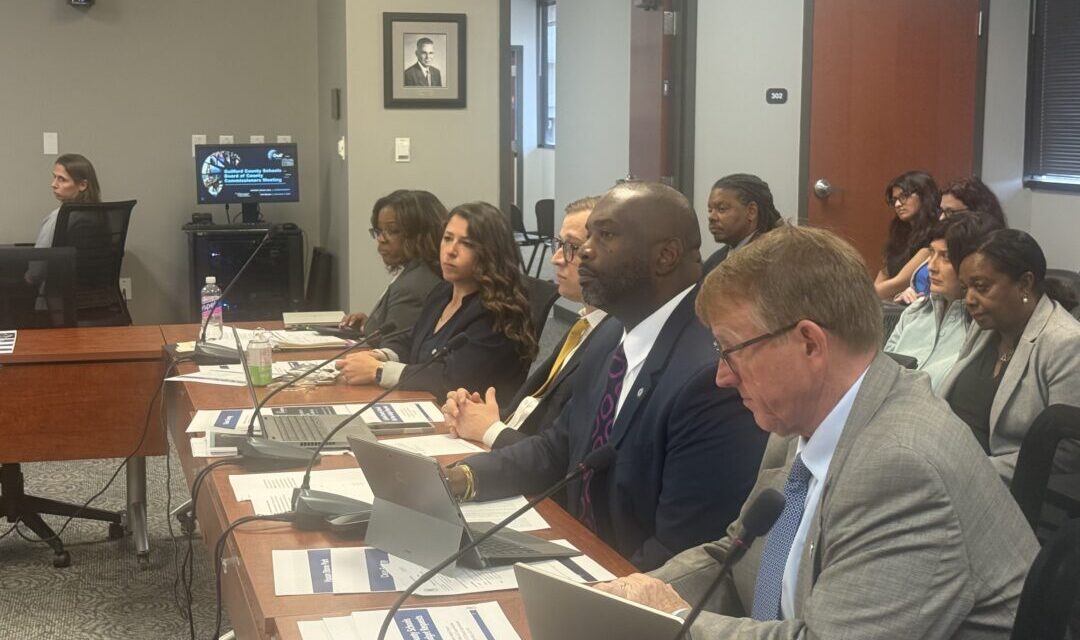
The Good Book says, “Ask and you shall receive,” and, while that might be true regarding the Lord Almighty, it did not turn out to be true of the Guilford County Board of Commissioners when school system leaders asked for $5.3 million in new money during a Thursday afternoon, Nov. 5 work session in the third-floor conference room of the county-owned Truist Building in downtown Greensboro.
Just two days earlier, North Carolina voters had approved a constitutional amendment requiring state lawmakers to limit how much local governments can increase their property tax collections. At the end of Thursday’s discussion, Guilford County Manager Victor Isler said the property tax amendment was the reason he recommended against granting the $5.3 million request from Guilford County Schools. With state lawmakers still to decide how much local governments can increase property tax collections, Isler said it was unclear how much revenue Guilford County could raise next year.
Last year, a request to help cover teacher raises ordered by the state would probably have gotten a yes from the education friendly board.
This time, the county manager was looking at what it would cost to keep paying for those raises next year, when Guilford could be writing a budget under a set of tax rules that Raleigh has yet to spell out.
As the Rhino Times reported leading up to the election, the amendment leaves a fairly important detail to the General Assembly – the size of the cap. There’s no percentage or dollar figure in the amendment. It directs lawmakers to pass a general law limiting increases in the property tax levy and allows them to write exceptions.
Under the law that put the question on the ballot, the amendment takes effect when the referendum results are certified.
The levy is the total amount a local government raises through its property taxes. That’s a different number from the tax rate commissioners vote on and from the bill that shows up in a homeowner’s mailbox. When property values rise, a county can collect more money even if it cuts the tax rate. Just how much of that additional revenue a county could keep – and what exceptions it might be able to use – will depend on what lawmakers write into the now very nebulous law.
And there’s already a dollar figure for the problem Isler was looking at. The county’s work-session presentation showed that, under its fall projections for fiscal 2027-28, recurring revenues would grow by $19.7 million while spending would grow by $38 million if the county followed its plans for county operations, the schools and Guilford Technical Community College.
That already left a projected hole of $18.3 million.
Factoring in both midyear school requests would have pushed that projected gap to $24.2 million.
The school request grew out of two budgets adopted less than two weeks apart. Commissioners adopted Guilford County’s budget on June 25, giving Guilford County Schools about $288 million in operating support, up $5.6 million from the previous fiscal year.
Then, on July 7, the state adopted a budget with average teacher raises of about 8 percent and raises of 3 percent for classified employees like bus drivers, janitors and cafeteria staff. Those raises applied to locally funded positions as well as state-funded ones.
On July 14, the school board formally asked the county for another $5.3 million.
The school system’s presentation put the additional local cost of the state budget changes at $5,263,998. About $4.6 million of that was listed as the direct impact of the legislative changes, with roughly $700,000 in additional charter-school costs. The district had planned on a 3 percent increase for certified employees, like teachers, principals, counselors, etc.. It estimated that the new salary schedule would mean a weighted average increase of 13 percent for its locally funded certified employees – many of whom are early in their careers.
School officials told commissioners they were already making cuts to balance the budget: The district increased class sizes, reduced some teacher and assistant principal allotments, realigned bus routes and moved from one computer or laptop per student to one for every two students in K-8 schools.
Commissioners did, that same afternoon, approve a separate request for $512,517.
Updated state data showed charter school enrollment was 156 students higher than the figure county and school staff had used when estimating the outcome of the state’s school-budget dispute formula. That raised the estimated increase under the formula from $5.6 million to about $6.1 million.
Isler recommended covering that difference with investment earnings on federal American Rescue Plan Act funds.




We the People at least took the first step towards stopping the National Socialist Democrat Party and Skip the Omnipotence continuing fleecing of the what they consider the We the Peasants. Now we need to pressure our “representatives” to do the right thing…but I’m not holding my breath.
Buckle up conservatives and reasonable thinking Democrats of Skip’s Fiefdom of Guilford County. As soon as the ring kissing ceremony is over Hell may well begin.
So schools were given less than 2% increase in budget. Given the rising costs (inflation now at 4%)…..good luck with that…
I was on pins and needles waiting on professor chris’s response, as always he never fails to deliver
North Carolina counties are finally being forced to do what the rest of us have done since our first paycheck: look at how much money is coming in before deciding how much to spend. For years, the local playbook was pretty straightforward. Pick what you want to buy, add up the bill, and tweak the property tax rate until the math works. Now that voters have passed the property tax cap, Guilford County is having to learn how to live within its means. What makes this really tight is the tab coming due on $2 billion in school construction bonds. Those payments don’t care about tax caps, and bondholders get paid first. Signing off on the bonds was the easy part—now comes the fun of paying the credit card bill on a fixed income.
Voters delivered a 60.4% statewide mandate to cap property taxes, alongside a 61.9% vote to lower the state income tax cap to 3.5%—and both measures pulled massive crossover support even in the Democratic stronghold of Guilford County. With Democrats holding the Governor’s mansion, the State House, and all of North Carolina’s major cities—while Republicans still control the State Senate—this next session should be quite entertaining.
Perhaps this is the time to raise the state corporate income tax rate to the same 3.5% the amendment will cap the state individual income tax rate. Corporations are the most profitable enterprises in North Carolina. Why not demand the same contribution from their profits as the state demands from individual taxpayers?
You didn’t mention the recent increase in the sales tax that is supposed to go toward teacher pay.
Key word there…”supposed”…like it’s going to happen
I totally agree that teachers need to get paid but I am sick and tired of that being all you hear about. This is the story that we hear over and over but what about the policeman and the firemen that work for the citizens. You would think that a teacher is making $15 an hour like a Walmart employee. You know you can look up to education salaries on a website for Guilford county you might be surprised.
Maybe Skippy can use the increase in the sales tax to offset the expense!
Ok, so about the payola paid to non-profits. The council could start with that. But………not bloody likely. The left still needs to buy votes, and pad the payroll.
Perhaps the new NC house will try to fix this?
Just make me King of Guilford County.
Thanks, Scott for writing about this. I recall that one of the big issues of the American Revolution was excessive taxation. I think people kind of forget about this. Also tied in with it was ownership of property.
You mean Skip and his subs may have to work and provide a real budget and make actual hard decisions? Maybe start with the elimination of pet projects ala vote buying. Maybe start with schools eliminating the multiple layers of administration which teach students nothing. Maybe start with eliminating past and future DEI hires and God forbid the numerous favoritism programs shown to a selected segment of citizens.
I hope they struggle as hard as we taxpayers do instead of the continued finanacial rape they dish out each year.
I suggest they find some water to support all the housing for everybody programs and all the flood of people coming for all Skips jobs he continues to mention. I believe this area will continue to suck the hind teat on the boar with those running the current zoo.
.