


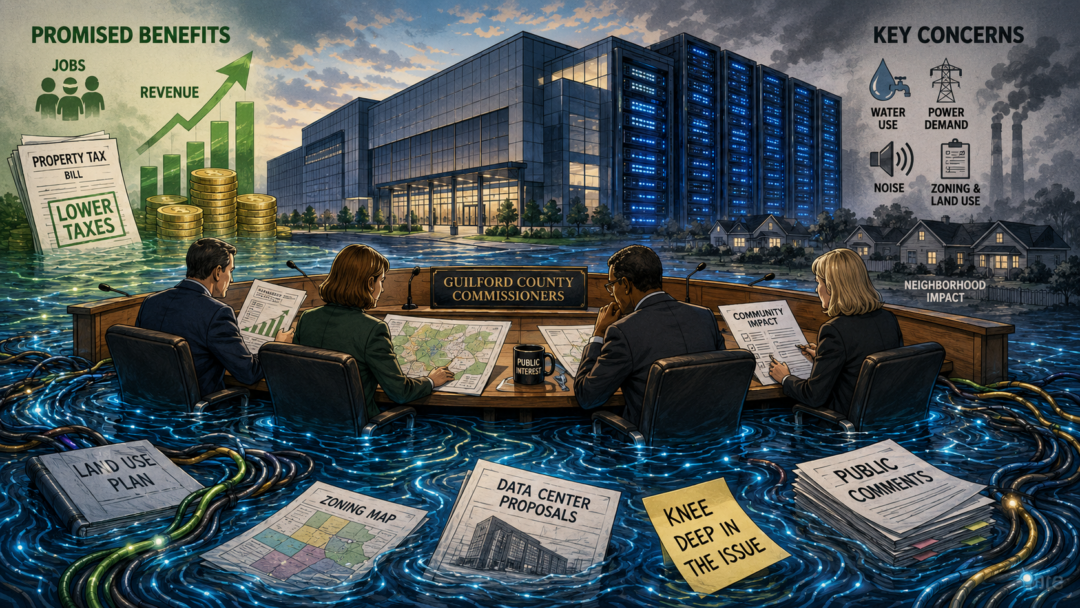
For the last several months, the Greensboro City Council has been up to its neck in the increasingly contentious debate over massive data centers. Now the Guilford County Board of Commissioners is getting pulled into the water as well.
County commissioners are planning an upcoming work session on data centers, and the subject was one of the hottest topics at the North Carolina Association of County Commissioners Annual Conference held Thursday, Aug. 20 through Saturday, Aug. 22 in Durham.
The conference drew county commissioners and staff from across the state, and one of the featured sessions was “Data Centers: Opportunities, Challenges, and Considerations for North Carolina Counties.”
That discussion apparently made quite an impression on Guilford County Commissioner Pat Tillman.
Tillman said that, while the conference addressed a long list of issues facing counties – including property taxes, school funding, health and human services and changing federal requirements – the data center session stood out.
“The data center seminar was by far, to me, the highlight,” Tillman said.
Tillman said the session included a UNC School of Government expert who discussed the legal issues surrounding moratoriums and land-use regulation, as well as a representative from Chesterfield County, Virginia, where data centers have become a significant part of the county’s economic development strategy.
Chesterfield has actively recruited data centers but has also tightened the rules governing them. New data centers there are no longer automatically approved in an appropriately zoned area and instead require a conditional-use permit and a public zoning process. The county has data centers operating, under construction and approved for future development.
The attraction for local governments is, of course, money.
Chesterfield estimates that every $1 billion in data center development can produce about $4.2 million annually in real estate and business personal property taxes. The county estimates Google’s three planned campuses could eventually produce more than $40 million a year in county revenue.
Tillman said those numbers caught his attention.
“I think we really need to educate ourselves and spend some time with thought leaders and subject matter experts on this,” he said.
Tillman said the Guilford County commissioners and other commissioners and county staff at the conference heard about many of the same concerns that have dominated the Greensboro debate – water consumption, electricity demand, noise, the placement of facilities and whether the enormous investment involved produces enough benefits to justify the downsides.
He said one point driven home at the conference was that data centers vary considerably in size, design and resource consumption.
“Not every data center is the same,” Tillman said. “If you’ve seen one data center – it only means you’ve seen one data center. You’ve not seen them all.”
Water use is one example: Chesterfield’s own list of existing and proposed projects shows enormous variation. One planned facility has an anticipated maximum water use of 6 million gallons a day, while another data center project under construction anticipates no ongoing water use because it will employ a closed cooling system.
Tillman said location and zoning would be critical if Guilford County ever decided to allow or recruit large data centers.
“We wouldn’t put a data center near a park or a neighborhood,” he said, adding that areas already devoted to heavy industrial uses would make considerably more sense.
Tillman said Guilford County hasn’t received a data center proposal that he’s aware of, and commissioners aren’t yet discussing particular sites. But that issue will no doubt be in front of the county in the not too distant future and the commissioners want to be up to speed on it when it happens.
Tillman said the county is still in the information-gathering stage.
“We’re planning a work session on it,” Tillman said. “I think it’d behoove us to go take a trip to Virginia” to see firsthand how communities with a large data center presence have handled them.
Guilford County Commissioner Frankie Jones also said that a county plans to discuss the issue at an upcoming work session. Jones said he expected the session to be held within roughly the next 30 to 45 days, though a date hadn’t been set.
“I think everyone’s just getting their arms around it and hearing about it,” Jones said.
Jones said the conference presentation offered general information on data centers, including zoning considerations and state law. He said he wanted to reserve his own conclusions until commissioners receive the fuller presentation at their upcoming work session.
Jones also pointed to one of the issues that has become central to the debate.
“Not all data centers are the same,” he said. “Understanding that there’s different sizes and so forth, I think that’s part of the equation right now.”
Jones also noted a potential conflict-of-interest issue for himself because of work he’s done elsewhere.
The county discussion comes immediately after the Greensboro City Council imposed a temporary halt on very large data center projects inside the city.
On Tuesday, Aug. 18, the council voted 8-0, with one recusal, to approve a 180-day moratorium on data centers requiring more than 10 megawatts of electricity. The moratorium, which runs through Feb. 14, 2027, stops the city from accepting, processing or approving applications for those projects while council members study their effects and consider new development regulations.
The council initially considered a 120-day moratorium but lengthened it following public input.
The issue took a remarkable political turn in Greensboro.
In July, the council voted 5-4 against beginning the moratorium process. Less than two weeks later, after council members were deluged with concerns from residents, the council reversed course and voted 9-0 to move forward with one.
Residents and council members have raised concerns about electricity demand, water consumption, noise, generators, transmission lines, environmental effects and the possibility of giant industrial facilities being located too close to homes.
Supporters counter that data centers can bring enormous capital investment and expand the local tax base without creating the traffic and demands on government services that come with most other forms of development.
Tillman said he’s well aware of one frequently cited drawback: Once construction is finished, data centers generally don’t employ large numbers of people.
“It is a totally different economic development type of avenue for us,” he said.
But Tillman said the potential tax revenue is large enough that county officials would be making a mistake if they simply dismissed data centers before studying the possibilities.
“We really need to have some clear eyes on this data center opportunity,” he said.
There’s also some history here that provides evidence the county may be a good place for data centers.
In 2013, Guilford County officials seriously explored Project Haystack, an ambitious plan to use the roughly 800-acre Guilford County Prison Farm and surrounding land along the Guilford-Alamance county line as the centerpiece of a roughly 2,000-acre data center and advanced manufacturing park.
A feasibility study predicted up to $6.5 billion in private investment; however, nearby residents strongly opposed the project and major questions remained about water, sewer, roads and the cost of preparing the site. Project Haystack ultimately died without attracting the massive private investment envisioned for it.
Thirteen years later, artificial intelligence and the enormous computing infrastructure needed to support it have made data centers one of the hottest economic development issues in the country.
This time, Guilford County commissioners will be entering the debate with Greensboro’s very recent experience right in front of them – and, judging from last week’s county commissioners conference, with a whole lot more homework to do




Skippy wants to know how HE can benefit from it
Why not make the presentation online so Guilford County property owners could know what the county board learned? Something? Anything? County Board is very government in the closet. Thank you to Scott Yost or county would make sure we (taxpayers/property owners) would know nothing . County board just rubber stamps spending money — and the 3 minute talk time is talk to the wall.
Any company considering Guilford County for a business should be aware of the long tentacles of the Property Tax Man, and the DSP government.
Way to go PAT TILLMAN! Finally, a thoughtful careful review is being done.
We do not need a data center in Guilford County. People who live near them complain about the humming noises being so loud and giving them headaches. It disrupts the wildlife. We need to stop the heavy development in Guilford County. All of the leaders complained there are not enough homes, but yet they want to put something like that here. Which means yet more homes. Which means more wildlife being displaced. What is wrong with people? Seriously! We are destroying this planet. We are destroying the land and we can’t make more land. We do not need more homes in Guilford County. If people want to live somewhere they can go to another County. That might sound cold but get over it. We need to stop taking every inch of land and putting a home on it. Our great grandkids are not even going to know what animals look like unless they see a picture in a book. But all the leaders care about in this county is money. Money is their God and money is all they see. When is it going to stop? At this rate we’re going to be putting houses on top of houses. The development needs to stop. Especially when it comes to a data center. We don’t need it using up all the water resources. We don’t need it harming the environment. Just stop already.
The city and county can only see the money and kickbacks and then plan how they will waste it on the typical pet projects. Nothing here to help citizens.
The current NC corporate income tax, 2% is scheduled to be 0% by 2030 which means the state will capture almost nothing from the profits of any data center. Furthermore, the processors and related equipment will qualify for accelerated depreciation so the tax value will also decline, and probably the real estate value itself. This suggests that data centers will not necessarily be long term revenue contributors to the cities or counties where they are built, while they will probably remain significant consumers of water and power, and possibly producers of noise, heat and other pollution for as long as they are in operation. These are basic reasons why existing users of water and power should be fully insulated from additional costs related to the additional demands any data center will impose on existing systems.