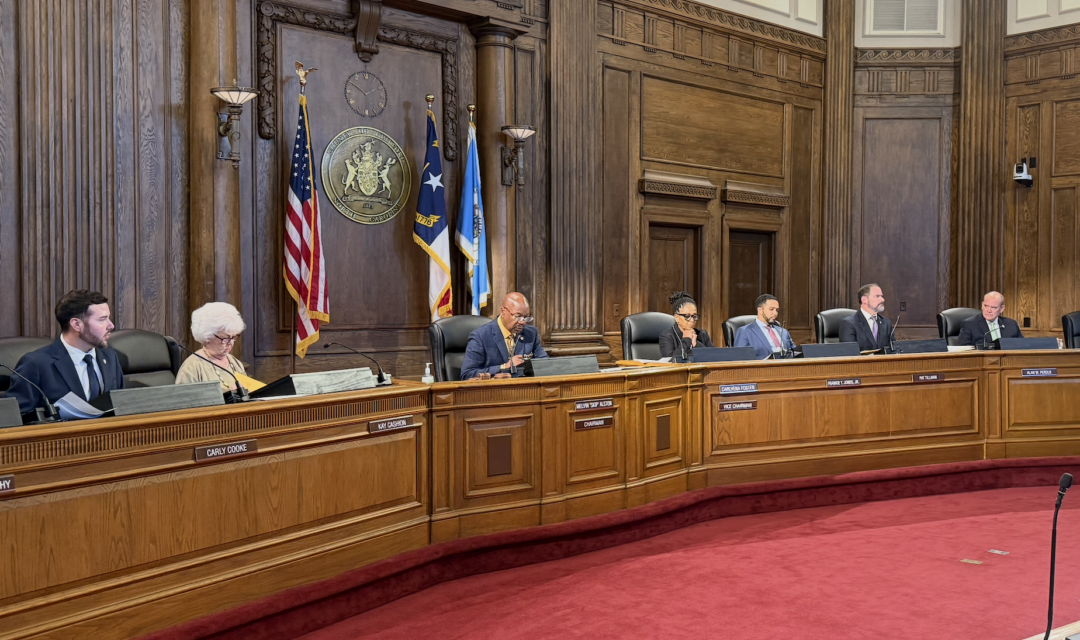
At a special called afternoon meeting on Thursday, June 25, the Guilford County Board of Commissioners approved a county budget that raises the county’s property tax rate by 5.9 cents.
All seven Democratic commissioners voted in favor of the budget while the board’s two Republicans – Commissioners Alan Perdue and Pat Tillman – voted against it.
Several Democratic commissioners acknowledged that they didn’t enjoy raising taxes but said the county’s financial obligations left them with little choice. They argued that rising costs, state and federal funding reductions and continued investments in county services made the increase necessary.
Perdue and Tillman countered that families across Guilford County have had to tighten their own budgets and said county government should have done the same. Both praised County Manager Victor Isler, the Budget Department and other county staff for their work on the spending plan, but said they couldn’t support a tax increase of nearly 6 cents.
The tax increase was set at 5.9 cents per $100 of assessed value rather than an even 6 cents for the same reason items in stores are priced at $5.99 instead of $6 – because, well, it sounds better.
One source familiar with the commissioners’ budget process said that, while a 5.9-cent increase would pass, it seemed unlikely the board could find five votes for a 6-cent increase.
The current tax rate is 73.05 cents per $100 dollars of assessed values; the new one will be 78.95 cents.in a few days.
Democratic commissioners emphasized the services and investments included in the budget but made little mention during deliberations of appropriations that include $200,000 for the International Civil Rights Center & Museum and about $1.8 million set aside for grants to nonprofit organizations, including museums and other groups – like the athletic booster club of the high school one of the commissioners attended. Some of those non-profits will be ones that practically no one has ever heard of.
For Greensboro property owners, the county’s increase comes shortly after the Greensboro City Council approved a 12.6-cent property tax hike, meaning many city residents will see a combined local property tax increase of 18.5 cents.
Commissioners adopted the budget just days before the July 1 deadline after the North Carolina General Assembly passed Senate Bill 889 late in the budget process. The law required counties that completed reappraisals for 2026 to calculate their budgets using prior property values instead of the new revaluation.
The county tax rate remained unchanged following the 2022 revaluation even though higher property values generated substantially more tax revenue from much higher tax bills. That revaluation amounted to a “hidden” 14-cent tax increase – likely the largest in county history and certainly in this century.
The adopted General Fund budget totals just over $889.2 million.
According to county officials, the budget was designed to replace lost state and federal revenue, absorb inflationary cost increases, continue funding school construction, provide employee raises and make several capital investments.
One of the clearest examples involves Food and Nutrition Services administration – a program that used to be known as food stamps. Cuts in that program at the federal level are having a real impact at the county level.
Federal reimbursement for administering Food and Nutrition Services has been reduced from 50 percent to 25 percent – creating what county leaders call a $3.1 million annual unfunded mandate revenue loss.
Also, county officials say that new federal requirements are increasing workload demands.
County officials state that the higher tax rate will cost the owner of a median-valued Guilford County home, valued at $171,600, about $8.44 more per month.
They don’t mention that that comes to $101.28 per year. Nor do they point out that it will cost the owner of a $350,000 house $209.65 more this year.
And if that $171,600 house is in Greensboro, then the combined city and county tax increase would be $318 and change. For the owner of a $350,000 house in Greensboro, the tax increase will be $647.50 this year.
Under the new tax rates for both the city and the county, the owner of a $350,000 house in Greensboro will get a bill from Tax Director Ben Chavis for $5,558.80 this year.
County officials said that one factor behind the tax increase was approximately $7.5 million in lost state and federal revenue. That includes the $3.1 million reduction in federal reimbursement for administering the Food and Nutrition Services program and another $4.4 million in lost revenue related to Senate Bill 889.
Like the members of the Greensboro City Council, Guilford County officials cited inflation as a significant factor in this year’s budget – pointing to higher costs for fuel, utilities, healthcare, foster care, detention operations and other mandated county services.
The county also noted that longer detention stays have increased jail operating costs, including higher food expenses.
The budget reduces the county’s planned use of fund balance – savings, that is – by $5 million and includes more than $3.7 million in reductions to departmental operating budgets in an effort to offset part of the increased spending. The board is still dipping into the county’s savings account, which the board has been doing for the last half decade. It’s just that this year they are taking out less savings than the manager’s budget recommended.
The spending plan provides a 3 percent merit-based pay program for county employees and funds seven new positions. County officials said additional investments will focus on public safety and health-related positions, including deputy sheriffs, detention officers, paramedics and nurses. The budget also provides additional funding requested by rural fire districts for staffing and operations.
Under the new budget, the County Attorney’s Office will get two new attorneys – rather than the four in the manager’s recommended budget – bringing that number to 17 attorneys. (Several weeks ago, the Rhino Times misread last year’s budget and reported erroneously that the County Attorney’s Office had 24 attorneys. The Rhino Times regrets the error.)
A lot of the work being done in the attorney’s office is for foreclosures – that is, cases where the owners can’t pay their property taxes.
Education remains the county’s largest single area of spending. Guilford County Schools will receive $288.1 million for operating expenses during the coming fiscal year, an increase of $5.6 million, or about 2 percent, over the current budget.
The new budget also includes an additional $26.9 million in property tax revenue for debt service on voter-approved school construction bonds. The total property tax set aside for school debt is $72.87 million.. School projects underway include, among others, work at Erwin Montessori, Sternberger, Sumner, Allen Jay, Swann, Lindley, Northwood, Shadybrook, Northwest Middle, Joyner, Bessemer and Millis Road, while several new schools have already been completed through the bond program.
Guilford Technical Community College will receive $20 million for operating expenses in the new fiscal 2026-2027 budget, an increase of about $300,000. The budget also establishes $57.4 million in project ordinances for workforce-related capital projects supporting aviation, advanced manufacturing, health sciences and biotech workforce programs.
The budget also authorizes several capital projects, including $15 million for deferred maintenance and improvements at county parks, $10 million for a Women’s and Children’s Residential Recovery Center and $1.5 million for improvements at the Greensboro Courthouse.
Other spending includes continued funding for the county’s Tenant Education, Advocacy and Mediation Program, about $3.1 million for technology upgrades and replacement of county computer systems, and $500,000 to continue food security and Family Justice Center programs that had previously been financed with federal American Rescue Plan Act funds.
This happens all the time with local governments: Federal dollars fund programs for a few years and then, when the money runs out, those local governments continue the programs, making them permanent additions to county or city governments.
The budget takes effect July 1.