


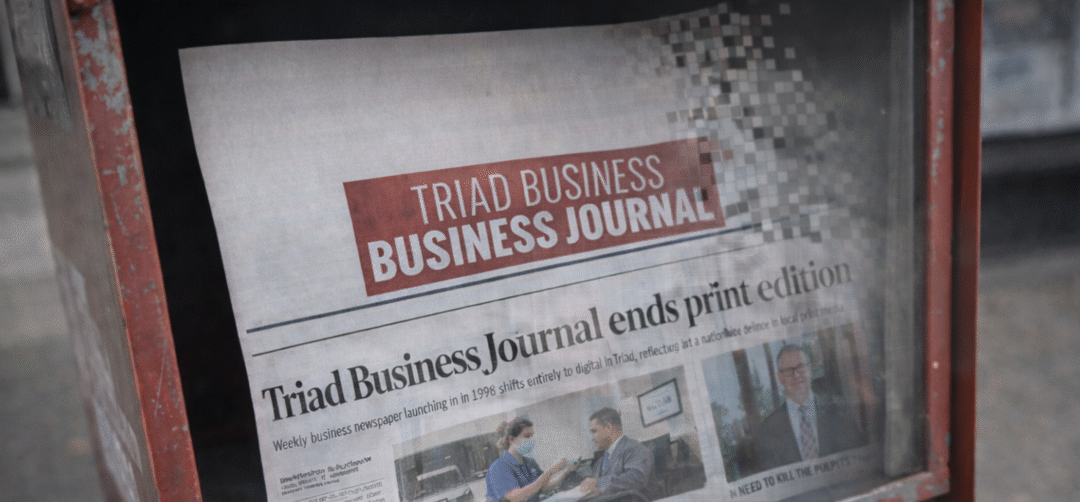
The Triad Business Journal announced this week that it will end its print edition and move to an all-digital format – marking another significant moment in the long, slow retreat of printed newspapers in the Triad.
The change is scheduled to take effect this summer and it will leave the Triad Business Journal as a digital-only publication after more than a quarter of a century in print.
The paper is owned by American City Business Journals, one of the most successful specialized media companies in the country, with business newspapers in dozens of metropolitan areas.
In announcing the move, the company emphasized that the decision reflects changing reader habits and the realities of the modern media business rather than a lack of interest in local business news.
The Triad Business Journal will continue to publish daily online and maintain its reporting staff; however, the physical newspaper will disappear.
The Triad Business Journal was launched in 1998, at a time when the Triad’s traditional daily newspapers were still robust but already beginning to feel pressure from the internet. Over the years, the weekly business paper carved out a strong niche – becoming one of the region’s primary source for coverage of banking, real estate, manufacturing, health care, law firms and executive leadership.
As the staffing levels at the region’s daily newspapers declined, the paper increasingly filled a gap for business-focused reporting.
Now, however, even that specialized model is no longer enough to justify the costs of ink, paper, printing presses and delivery trucks.
Those costs aren’t trivial: Printing a newspaper requires industrial presses, maintenance crews, expensive paper contracts and a workforce to bundle and distribute the product. Then there are the drivers, the fuel, the insurance and the constant logistical challenges of getting thousands of papers to doorsteps and racks before dawn.
Advertising revenue, which once paid for those systems many times over, has largely migrated to digital platforms run by companies that produce no journalism at all.
Facebook, Google and other tech giants now capture many local advertising dollars.
The Triad Business Journal is far from alone: Across Guilford County and the broader Triad, print newspapers have been folding, shrinking or abandoning print altogether.
The Rhino Times made that decision years ago.
After decades as a printed weekly, the Rhino ended its print edition in 2018 and went fully digital because the economics of print had become unsustainable. Printing and delivery costs were rising sharply while advertisers increasingly preferred digital placements that could be targeted, measured and changed instantly.
Also, it became clear that, even when the printed Rhino Times were still hitting the streets, many, many readers were already reading the stories on their iPhone or computers rather than the paper version.
The move allowed the Rhino Times to survive and continue covering Guilford County government at a time when fewer and fewer outlets were showing up in meeting rooms.
The recent struggles of the News & Record illustrate just how far the ground has shifted. Once one of the most powerful regional newspapers in North Carolina, the Greensboro paper has steadily reduced its print footprint. In recent years it has dropped print days, cut sections and thinned out to a fraction of its former size.
Circulation figures tell the story starkly. Where the News & Record once reached tens of thousands of homes each day, recent estimates put its print run at roughly 7,000 copies. In a county of more than half a million people, that number means the paper is already functionally digital, even if a printed version still exists.
Many of those remaining copies go unread. Some are recycled immediately. Others sit untouched on racks.
The same pressures have claimed smaller community newspapers. Publications that once served specific towns or regions in North Carolina have closed after decades of operation. The loss is felt most acutely in the places those papers served, where even modest coverage of town councils, zoning boards and school issues can disappear overnight.




They sit untouched because of the lack of content.
I love the TBJ. They do a fantastic job.
ditto