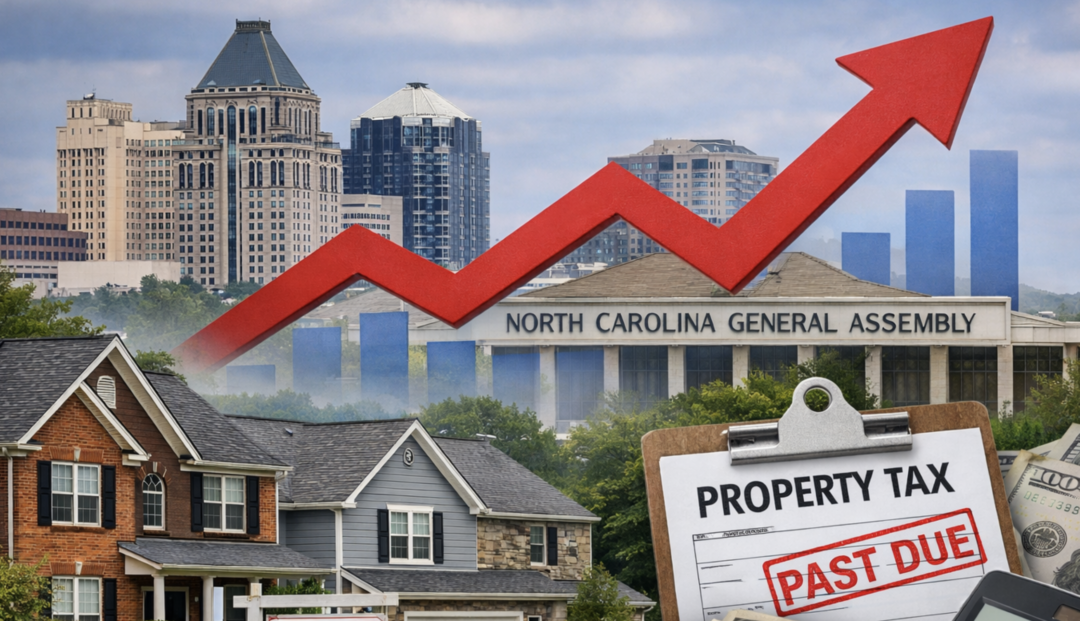
As homeowners across Guilford County open their 2026 revaluation notices and see sharply higher home values, state lawmakers in Raleigh are taking a closer look at whether North Carolina’s property tax relief system needs an overhaul.
A bill filed in the North Carolina General Assembly – House Bill 432 in the 2025-26 session – directs the legislature’s Revenue Laws Study Committee to examine possible expansions to existing property tax relief programs for elderly and disabled homeowners and disabled veterans.
While the bill doesn’t immediately change the law, it outlines ideas that, if ultimately adopted, could directly affect homeowners in Guilford County, where many residential properties are showing significant increases compared to the last revaluation. It would of course affect the other 99 counties as well.
In some neighborhoods, assessed values appear to be up by 40 percent or more.
Under state law, counties must calculate a revenue-neutral tax rate after a revaluation – a rate that would generate roughly the same total revenue as the previous year, excluding growth.
However, commissioners aren’t required to adopt that rate. If they leave the current rate in place, higher values would translate into higher tax bills.
County officials have previously estimated that leaving the rate unchanged after revaluation could generate $175 million in additional annual revenue countywide.
That possibility has many homeowners concerned, particularly retirees on fixed incomes who may have seen their home’s paper value rise dramatically while their income has not.
House Bill 432 directs lawmakers to study raising income limits for senior and disabled homeowner exclusions, increasing the amount of value that can be excluded from taxation and potentially creating a cap that would limit annual increases in a home’s taxable value for qualifying primary residences.
The measure also calls for examining expanded deferral options that would allow certain homeowners to postpone part of their tax bill until the property is sold, as well as the possibility of allowing certain property tax benefits to follow a homeowner who moves within the state.
None of those ideas are yet law: The bill calls for a study and recommendations.
But the timing is notable.
Guilford County commissioners will have to decide later this year whether to adopt a revenue-neutral rate, a partial rollback or something closer to the current rate. What happens in Raleigh could shape how much flexibility counties ultimately have and how much relief homeowners see.
Commissioner Pat Tillman is part of an effort to make the tax rate in Guilford County revenue neutral; however, others on the board – like Chairman Skip Alston and Vice Chair Carlvena Foster – point to the county’s massive school bond debt and the need to increase services for an increasing number of county residents.
Property taxes remain the primary source of funding for counties across the state, supporting schools, law enforcement, social services and other essential functions. Any statewide expansion of exclusions or caps would have budget implications for local governments.
For homeowners watching their assessed values climb sharply ahead of the 2026 tax year, the debate in Raleigh may offer some hope – or at least signal that state leaders are aware of the pressure building across North Carolina.
For now, the bill begins as a study. For Guilford County residents facing higher assessments, it’s a study that could matter a great deal.